
Palm Oil Industry and Smallholder Farmers Strongly Oppose Surface Water Tax Proposal
Jakarta — A proposal to impose a Surface Water Tax (PAP) on oil palm trees is triggering significant controversy across the industry and farming communities. Several regional governments, including in Riau, are examining new regulations that would allow for tax collection of Rp1,700 per palm tree per month to boost local government revenue.
The plan has drawn objections from industry players and farmers, who argue it could add to production cost pressures amid rising input costs and volatile commodity prices.
Eddy Martono, Chairman of the Indonesian Palm Oil Producers Association (Gapki), believes the palm oil industry needs a simplification of various levies to maintain global competitiveness.
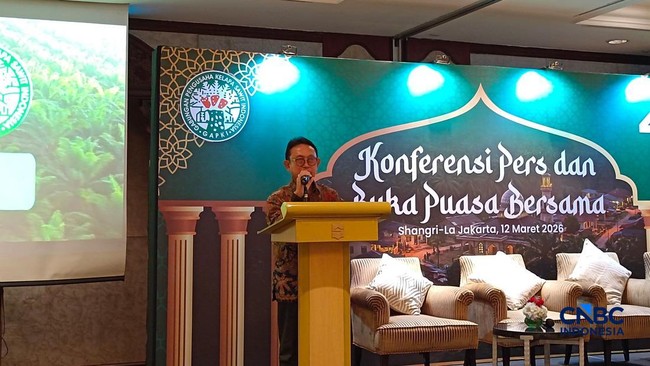
“We also expect industrial burdens, such as taxes, retributions, and levies, to be streamlined, so that the competitiveness of Indonesia’s palm oil industry in the global market continues to increase,” Martono said at a press conference and iftar gathering in Jakarta on Thursday, 12 March 2026.
He stated that the proposed Surface Water Tax on palm trees, reportedly reaching Rp1,700 per tree, would likely add further pressure to the industry.
“We understand that palm oil is now facing a proposed additional tax through the Surface Water Tax of Rp1,700 per tree. I believe this adds another burden, and in principle this should not exist,” he said.
Martono stressed that the government should instead support the sustainability of the palm oil industry given its significant contribution to the national economy.
“Rather, we should support how this palm oil industry can continue to thrive well and provide greater contributions to society and the nation,” he said.
Similarly, Gapki Secretary-General Hadi Sugeng Wahyudiono said the proposal has not yet become official regulation. However, his organisation continues to question the policy’s rationale.
“Regarding the proposed Surface Water Tax of Rp1,700 per tree — we still have questions because this has not yet been enacted, so we will continue to fight,” Sugeng said.
Hadi believes the tax could overlap with other existing levies, particularly those related to water usage.
“We already have taxes for underground water usage, so there are existing levies,” he noted.
He added that many water-related regulatory aspects could create confusion if the new tax is implemented.
“So in principle, if it doesn’t make sense, we should skip it. We object to this. We are also conducting studies showing it overlaps with other regulations. It’s all about water — surface water, underground water, rainwater. These various types create confusion,” he explained.
According to him, the additional tax would ultimately increase production costs for the palm oil industry.
“This will certainly burden our costs. I believe we will face problems,” he said.
Opposition also came from the farming community. Mansuetus Darto, Chairman of the Indonesian Palm Oil Farmers Association (POPSI), believes the proposed tax would be extremely burdensome for smallholder farmers and could threaten the sustainability of smallholder palm cultivation.
POPSI formally requested that the regional tax proposal be reviewed and even cancelled.
“This policy does not side with smallholder farmers, lacks transparency, and risks creating significant economic and social impacts. Taxation should benefit the people, not harm them,” Darto said firmly.
He outlined the potentially massive aggregate impact of the policy. In Riau Province alone, the area of smallholder palm plantations is estimated at approximately 1.7 million hectares with an average density of 136 trees per hectare, or around 231.2 million palm trees.
If each tree is taxed at Rp1,700 per month, the total tax burden on farmers could reach approximately Rp393 billion per month, or around Rp4.72 trillion per year.
At the farmer level, this burden equals Rp231,200 per hectare per month, or approximately Rp2.77 million per hectare per year.
“This figure is highly significant for smallholder farmers whose livelihoods depend on palm oil,” he explained.
Darto said the tax would likely suppress the price of fresh fruit bunches (FFB) received by farmers. Assuming an FFB price of around Rp3,000 per kilogramme and average production of 1.2 tonnes per hectare per month, farmers’ gross income would be approximately Rp3.6 million per hectare per month. A tax burden of Rp231,200 per hectare per month would be equivalent to an FFB price reduction of approximately Rp190-193 per kilogramme.
“This means the real price received by farmers would fall to around Rp2,800 per kilogramme, or a reduction of more than six per cent. This excludes costs for fertiliser, harvesting, transportation, and factory deductions,” he explained.
According to him, pressure on farmers could be even greater because palm oil mills would also be affected.
“Mills will certainly be squeezed, and ultimately farm-gate prices will fall further. Losses could reach 6 to 10 per cent per kilogramme of FFB,” he said.
For context, the tax proposal emerged during discussions on optimising regional revenue in Riau. Andi Darma Taufik, a member of the Riau Provincial Parliament’s Special Committee on Regional Revenue Optimisation, said his committee is examining the potential to impose PAP on corporate-owned palm trees at Rp1,700 per tree per month.
The scheme reportedly adopts similar policies already implemented in West Sumatra and Southeast Sulawesi.
According to Andi Darma, a revision of the Riau Gubernatorial Regulation of 2012 is necessary to create space for innovative regional revenue increases. With palm plantation areas of approximately 900,000 hectares under plantation business licenses (HGU) and nearly 1.5 million hectares under plantation business permits (IUP), the potential revenue from PAP is estimated to reach Rp3 trillion to Rp4 trillion per year.