
Palm Oil Energy Development Must Ensure Legal Sources and Prevent Deforestation
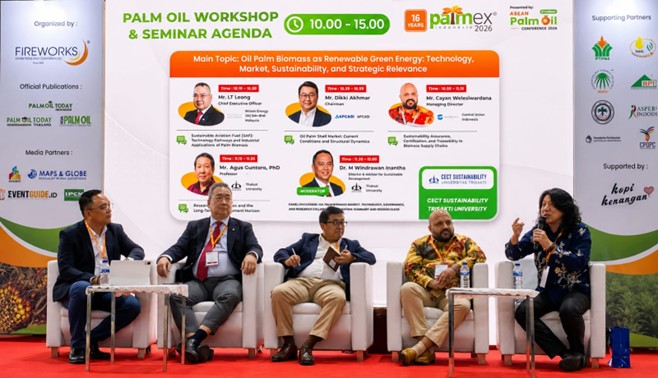
In 2025, Indonesia produced 51.66 million tonnes of crude palm oil (CPO) and 56.55 million tonnes of CPO and palm kernel oil (PKO). Exports of palm products reached 32.34 million tonnes, valued at $35.87 billion, or approximately Rp590 trillion. Approximately 12.5–12.7 million tonnes of palm oil were used for B40 biodiesel, equivalent to about 24–25% of CPO production. Beyond biodiesel, palm energy sources include shells, mesocarp fibre, empty fruit bunches (EFB), palm oil mill effluent (POME), fronds, and replanting stems. This was stated by sustainable palm oil practitioner Windrawan Inantha from the Center for Entrepreneurship, Change, and Third Sector (CECT) Sustainability at Trisakti University in Jakarta recently. “Indonesia’s palm biomass potential is immense. Palm Oil Expo (Palmex) 2026 revealed that from 150 million tonnes of dry palm biomass annually, around 50 TWh of electricity can be generated, equivalent to 15.7% of national electricity demand,” said Windrawan. However, Windrawan warned that palm oil energy development must be monitored with traceability, legal origin, emission audits, farmer protection, and sustainability limits to avoid deforestation, food and energy competition, and greenwashing. A discussion at Palmex 2026 on ‘Oil Palm Biomass as Renewable Green Energy: Technology, Market, Sustainability, and Strategic Relevance’ highlighted Indonesia’s commitment to ambitious greenhouse gas emission reduction targets under the Paris Agreement, with the national energy sector being a key contributor. Transitioning from coal-dominated power generation to renewables, reducing methane emissions from agriculture and waste, and decarbonising the rapidly growing aviation sector are priority pathways in Indonesia’s Nationally Determined Contribution (NDC) document. Windrawan explained that during the session on palm biomass as renewable green energy, it emerged that the palm sector has the raw materials, conversion pathways, and geographical spread to contribute significantly to all three priorities simultaneously. Achieving this requires not new technology but disciplined governance to connect existing resources. Agus Guntoro, a researcher in petroleum geology, tectonics, and regional geology at Trisakti University, stated during the discussion that emission reduction arguments must be understood within the energy system context. “Indonesian power generation still heavily relies on coal, while industry and transport are major consumers of diesel and LPG. Each unit of palm biomass replacing coal in power plants, diesel in industrial boilers, or LPG in process heat applications will reduce the greenhouse gas emission intensity of Indonesia’s energy consumption,” said Guntoro. He also stressed that Indonesia has abundant alternative energy resources that must be developed at micro, medium, and macro scales. “Regional comparative advantages must guide organisation. Palm-producing regions should be prioritised for palm biomass energy development as emissions reductions can be achieved where resources are sourced,” he said. This approach is seen as minimising transport energy footprints while maximising clean climate benefits. Guntoro’s presentation framed emission reductions not as a separate climate obligation from economic development, but as part of an energy sustainability strategy that simultaneously supports national growth and reduces import dependency. (X-6) Palm oil development as energy must still be carefully managed to avoid becoming a fiscal burden, environmental risk, or source of market conflict. PT PLN Energi Primer Indonesia (PLN EPI) continues to strengthen decarbonisation and sustainable energy transition through nature-based solutions. Readiness of electric vehicle infrastructure across regions remains a focus amid accelerated national energy transition and rising EV adoption. Walhi East Java revealed findings from an energy transition investigation in Java, which found continued coal plant lifespan extensions and lack of public participation. PLN Energi Primer Indonesia (EPI) is exploring a collaboration with PT Sorbu Agro Energi to develop sorghum-based bioenergy as part of energy transition efforts. Indonesia is targeting the Japanese market for EFB and palm shell pellet exports. With a potential equivalent to 38,760 MW, palm biomass is becoming a new foreign exchange asset for 2026.