
Palm Oil as an Energy Source Requires Certification and Farmer Involvement
Palm oil as an energy source is seen as capable of strengthening national energy resilience, reducing diesel imports, and increasing domestic value addition. However, its development must be carefully managed to avoid becoming a fiscal burden, environmental risk, or source of market conflict.
This was stated by sustainable palm oil practitioner Windrawan Inantha from the Center for Entrepreneurship, Change, and Third Sector (CECT) Sustainability at Trisakti University in Jakarta recently, following his role as moderator at the discussion titled ‘Oil Palm Biomass as Renewable Green Energy: Technology, Market, Sustainability, and Strategic Relevance’. The event, organised by CECT Trisakti, was part of the Palm Expo (Palmex) 2026 conference.
Windrawan emphasised that a key risk in involving palm oil in the energy transition is the competition between food and energy needs. Increased use of crude palm oil (CPO) for biodiesel could pressure export supplies, oleochemical industries, and cooking oil if upstream palm production does not increase proportionally.
Therefore, palm oil energy policy implementation must be phased, with buffer stocks, productivity increases, and price stabilisation mechanisms. Fiscal pressure is also a critical concern. Biodiesel subsidy and incentive schemes are heavily influenced by the price difference between CPO and fossil diesel. When CPO prices surge sharply, BPDP funding burdens could rise. Hence, funding transparency, incentive formula reviews, and energy feedstock diversification are needed for a more sustainable system.
Environmentally, risks of deforestation and Indirect Land Use Change (ILUC) must be anticipated. If energy demand drives new land clearance, emission reduction benefits could be lost due to land use changes. Therefore, principles of no deforestation, no peat, legal sourcing, traceability down to the plantation, and third-party verification must be core standards.
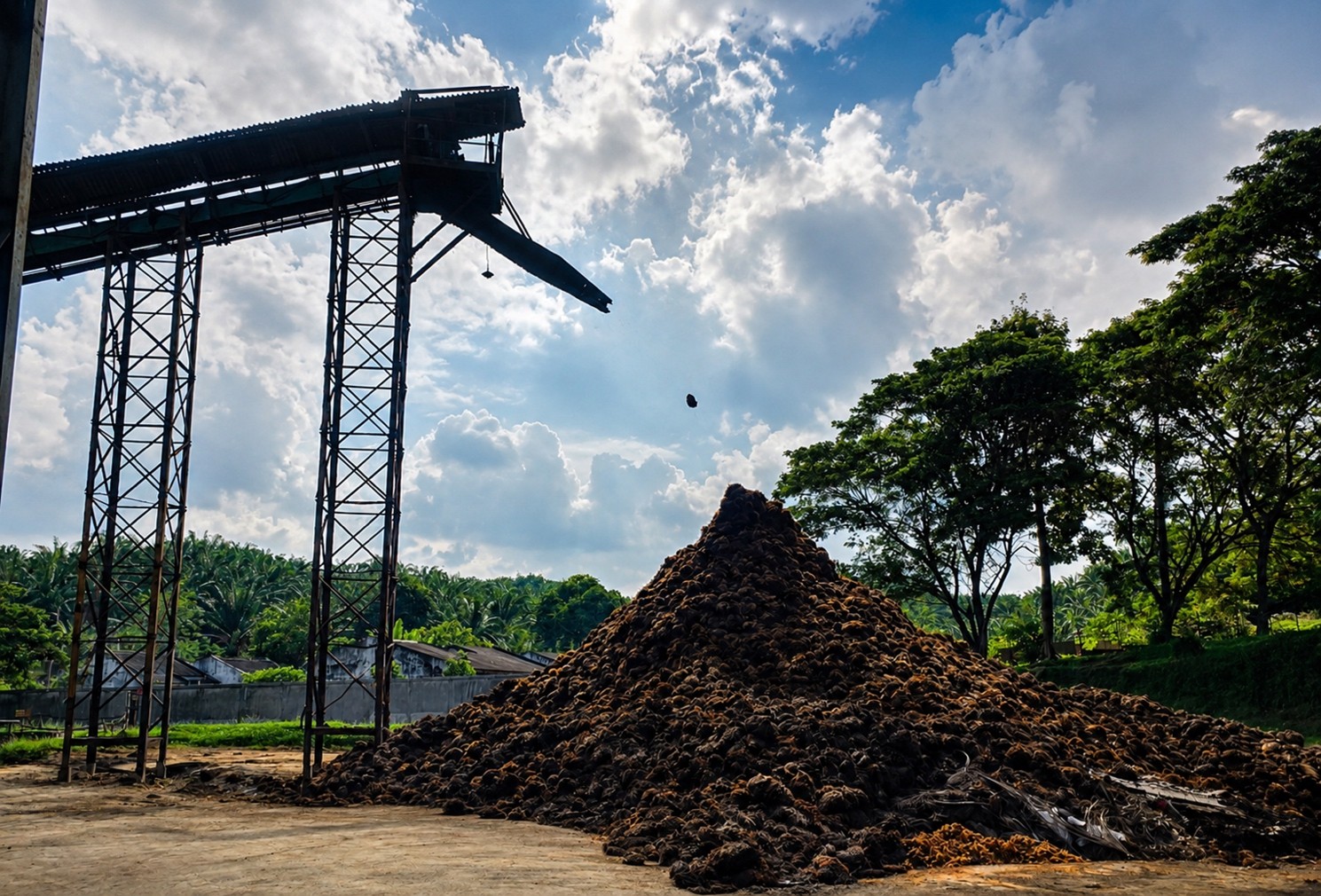
Palm oil biomass use must also consider the agronomic role of plantation residues. Excessive removal of empty fruit bunches (EFB), fronds, or trunks can reduce soil organic matter and increase fertilizer needs. Residue extraction should be limited based on soil conditions, nutrient requirements, and plantation characteristics.
Moreover, emissions and local pollution from biomass combustion must be controlled. Improper combustion technology can produce particulates, NOx, SOx, ash, and boiler corrosion. Poorly managed palm oil mill effluent (POME) can generate methane emissions. Hence, emission standards, appropriate boiler technology, methane capture monitoring, and Life Cycle Assessment (LCA) approaches are crucial.
‘Another risk is traceability and greenwashing. The palm biomass supply chain is more fragmented than CPO, increasing the risk of unsubstantiated green energy claims. Strengthening digital traceability systems, transaction certificates, independent audits, and certification are key instruments to maintain market credibility,’ Windrawan said.
Smallholder farmers must also be prioritised to prevent exclusion from the biomass energy supply chain. Documentation and certification requirements often pose barriers. Hence, group schemes, financial support, administrative simplification, and integrating smallholders into certification and supply systems are needed.
Operationally, palm biomass faces logistical challenges due to its large volume, high moisture content, dispersed locations, and high collection costs. Solutions include building regional logistics hubs, preprocessing or pelletising, long-term contracts, and locating biomass power plants near raw material sources.
Globally, export market risks must be considered. Markets like Japan, South Korea, and the EU demand strict proof of legal origin, greenhouse gas emissions, and sustainability. Failure to meet these could close off international markets. Hence, continuous audits, compliance with standards, and consistent data across the supply chain are critical factors.
Windrawan also stressed that Control Union, a global certification body, places governance, certification, and traceability as the foundation of trust in palm biomass. The biggest risk is not merely raw material shortages, but the failure to prove legality, low emissions, no deforestation link, and transparent traceability.