
PA GMNI Highlights Democratic Deficit and Ethical Standards of State Administrators
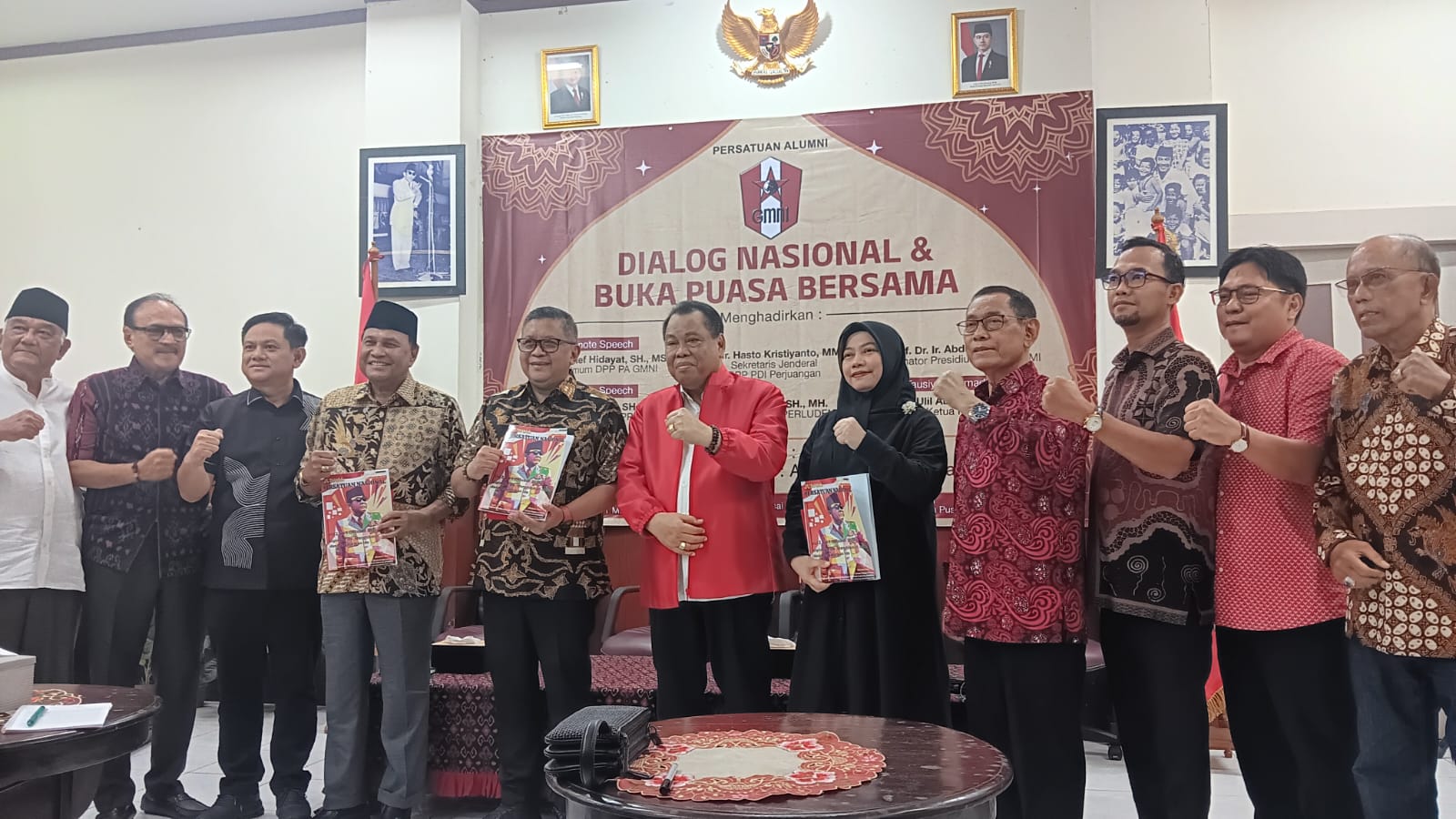
The Central Board (DPP) of the Alumni Association (PA) of the Indonesian National Student Movement (GMNI) organised a national dialogue entitled “Political Restructuring in Indonesia: Between Urgency and Regulation” on Wednesday, 11 March.
Prof Arief Hidayat, Chairman of the Central Board of PA GMNI and keynote speaker, highlighted that political reforms initiated in 1998 have brought fundamental changes to Indonesia’s constitutional system and democracy. However, nearly two decades after reform commenced, the implementation of a democratic legal state has paradoxically moved in the opposite direction towards a democratic deficit.
“Indonesia’s political system continues to face various structural problems that directly impact the quality of democracy. The practice of state administration has increasingly strayed from the will of the people, resulting from the absence of moral example and ethics from state administrators,” he stated.
He revealed that the constitution and laws are engineered to benefit certain parties and held hostage by those misaligned with power interests. Misuse of authority has occurred across all branches of government—the legislative, executive, and judicial branches.
“Changes to electoral regulations resulting from Constitutional Court decisions have influenced Indonesia’s political and electoral system direction. For instance, Constitutional Court Decision No. 62/PUU-XXII/2024 fundamentally altered the mechanism for nominating the President and Vice-President,” he explained.
Prof Arief further noted that the Constitutional Court also issued Decision No. 135/PUU-XXII/2024, stipulating that national elections (for President, House of Representatives, and Regional Representative Council) and local elections (for regional governors and regional parliaments) would no longer be held simultaneously but separated by a minimum interval of 2 years or maximum of 2 years and 6 months following the inauguration of the President, Vice-President, and elected members of the House and Regional Representative Council.
“These decisions further confirm that Indonesia’s political system is at a crossroads,” he declared.
Dr Abdy Yuhana, Secretary General of PA GMNI, stated that whilst these decisions aimed to provide constitutional corrections to deviating political practices, without strong ideological consciousness and national commitment, alongside clear regulatory frameworks oriented towards substantive democracy, political system changes risk creating new problems and weakening democratic quality. This may also trigger the phenomenon of democratic backsliding occurring systematically.
“In the context of nationhood, three matters require serious attention: first, Indonesia’s history; second, ongoing debates about state agreements; and third, the atmosphere of democratic euphoria,” he said in Bandung on Thursday, 12 March.
He emphasised that these conditions underscore the urgent need to restructure Indonesia’s political design to remain aligned with the principles of popular sovereignty and constitutional democracy.
Given these dynamics, political restructuring in Indonesia has become an inevitable necessity as constitutional developments and democratic challenges emerge from the imbalance between political regulation and democratic practices evolving in society, ensuring alignment with the constitution and principles of popular sovereignty.
“Political restructuring in Indonesia has become imperative, particularly as Indonesia approaches its centennial in 2045. This dialogue serves as a strategic space to formulate the direction of Indonesia’s political restructuring rooted in the constitution, grounded in Pancasila values, and reaffirming that democracy is not merely an electoral procedure but a means to uphold popular sovereignty as mandated by the 1945 Constitution of the Republic of Indonesia,” he concluded.
PDI Perjuangan Secretary General Hasto Kristiyanto highlighted the close connection between President Sukarno’s plans to strengthen national defence and his removal from power in 1965. He described historical evidence of how powerful Indonesia’s military forces were under Soekarno and internationally respected, with Indonesia playing a role in Pakistan’s independence from Britain.
“Had Indonesia’s first President Soekarno not been ousted, Indonesia would have successfully fought for Palestine’s independence,” he asserted.