
Over Rp500 Billion Disbursed for Housing Repairs for Sumatran Disaster Survivors
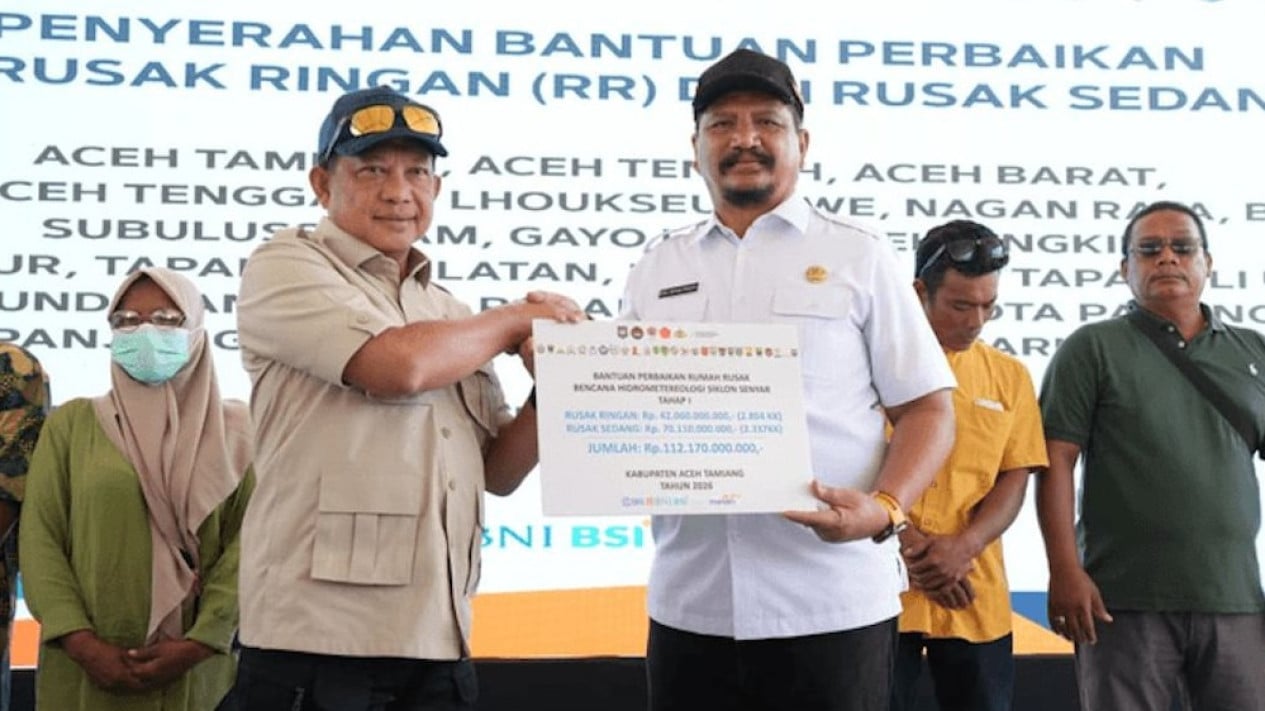
Jakarta – The Rehabilitation and Reconstruction Acceleration Task Force (Satgas PRR) for Post-Disaster Sumatera is accelerating the recovery of disaster-affected communities in Aceh, North Sumatra, and West Sumatra provinces. A key initiative underway is the disbursement of housing repair stimulus assistance to residents whose homes have been damaged by disasters.
According to Satgas PRR data as of 11 March 2026, housing repair assistance has been distributed to 25,076 units of lightly and moderately damaged homes across the three affected provinces, with a total value of Rp528.76 billion.
In Aceh province, assistance has reached 12,856 units of lightly damaged homes and 9,065 units of moderately damaged homes with a total value of Rp464.79 billion. In North Sumatra, assistance has been disbursed to 1,234 lightly damaged homes and 735 moderately damaged homes valued at Rp40.56 billion. In West Sumatra, assistance was provided to 811 lightly damaged homes and 375 moderately damaged homes with a total value of Rp23.41 billion.
Muhammad Tito Karnavian, Chair of the Satgas PRR for Post-Disaster Sumatera, stated that the assistance is given directly to homeowners as stimulus funds to enable the community to quickly repair their homes independently and rebuild their lives after the disaster. He explained that survivors with lightly damaged homes receive assistance of Rp15 million, whilst those with moderately damaged homes receive Rp30 million.
“For homes that are severely damaged or destroyed, temporary shelters are being prepared. Residents can also stay with family or rent accommodation and are provided with temporary shelter assistance of Rp600,000 per month for three months,” Tito said on Wednesday, 11 March 2026.
According to Tito, assistance is disbursed using a “by name by address” approach following verification by regional governments. Verified beneficiary data is then submitted to the Satgas PRR through the National Disaster Management Agency (BNPB) for processing and disbursement to the community. He therefore emphasised the importance of regional governments’ role in accelerating the data collection process so assistance can quickly reach eligible residents.
“That is what I am requesting from the regional leaders, the regents and mayors, to establish small task forces to conduct data collection so that assistance can be quickly distributed to the community,” he said.