
Otto: Prison Overcrowding Cannot Be Seen Solely as a Capacity Issue
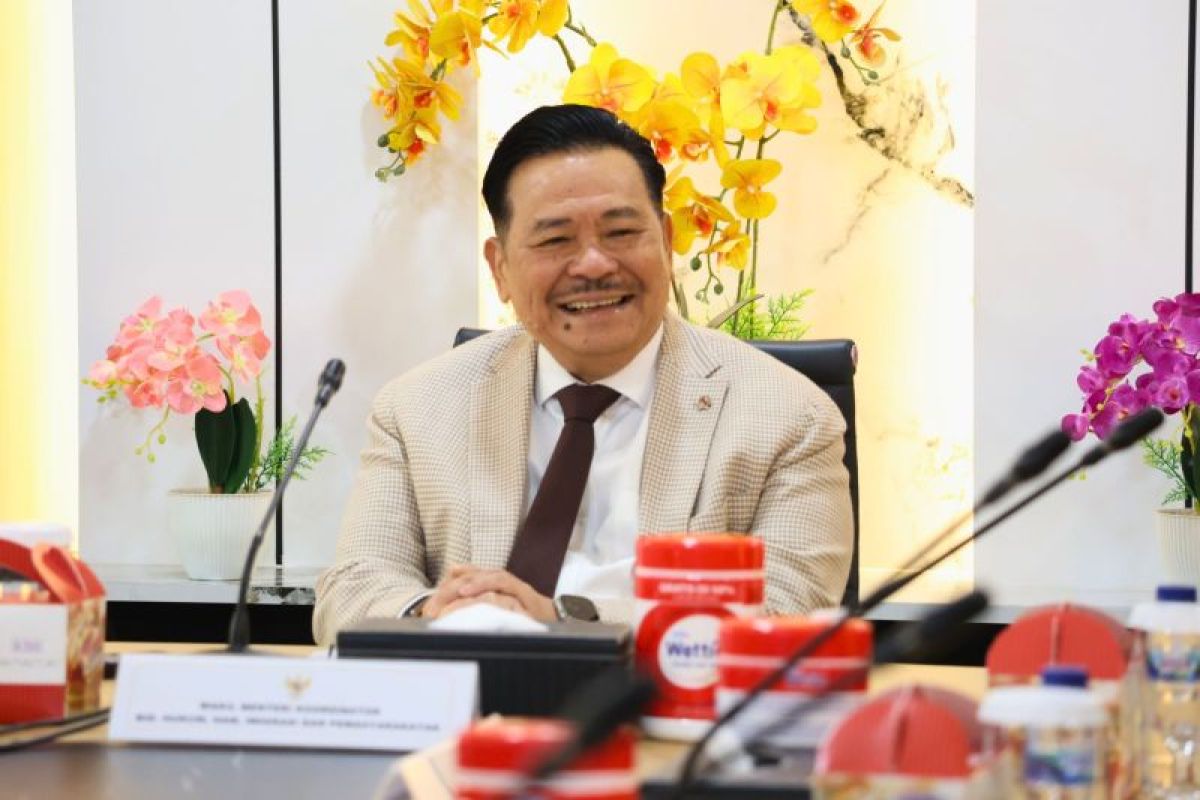
Jakarta (ANTARA) - Deputy Coordinating Minister for Legal Affairs, Human Rights, Immigration and Corrections Otto Hasibuan said that overcrowding in correctional facilities (lapas) and detention houses (rutan) cannot be viewed merely as a problem of limited residential capacity.
During an audience with the Business Cooperation Agency for the Rehabilitation of Honourable Citizens (BERSAMA) in Jakarta on Wednesday, he explained that prison overcrowding is closely linked to the inflow of cases, particularly narcotics offences.
“The solution must begin upstream, through prevention, rehabilitation, and more targeted law enforcement coordination,” said Otto.
As such, he said, overcrowding in prisons and detention houses is a matter requiring cooperation across ministries, agencies and elements of society.
The situation has led to occupancy levels exceeding capacity by 80 per cent. Of that number, convicts dominate with 217,512 people, or 79.16 per cent, while detainees number 57,249 people, or 20.84 per cent.
Narcotics remain a primary concern as they are still the largest contributor to the prison and detention house population.
Data show that narcotics cases account for 147,849 people, or 53.81 per cent, of the total inmate population. Between 2020 and 2025, narcotics cases have consistently accounted for more than half of the correctional population.
“We cannot work alone. Narcotics handling must be carried out together with the police, the prosecution service, relevant ministries and agencies, and with active community involvement,” he said.
The Deputy Coordinating Minister affirmed that the Coordinating Ministry for Legal Affairs, Human Rights, Immigration and Corrections will optimise its functions of coordination, synchronisation and policy control so that handling of prison overcrowding can proceed more comprehensively.
He said all parties need to ensure that medical rehabilitation, social rehabilitation and restorative justice for narcotics users can run more effectively.
Those who are not dealers, he said, need to be directed towards a recovery approach rather than simply adding to the burden of prison occupancy.
Therefore, he continued, handling the issue requires the active involvement of all elements of society.
Budiharjo also conveyed that his organisation has 1,000 Anti-Narcotics Militia (Laskar Antinarkoba) who serve as government partners in strengthening education, prevention and community awareness of the dangers of narcotics abuse down to the neighbourhood (RT and RW) level.
To strengthen the effectiveness of the programme, BERSAMA proposed that the Coordinating Ministry coordinate narcotics handling synergy involving nine ministries and one related agency.
He therefore expressed hope that the various programmes already under way can be integrated into a single national policy direction that is more focused, effective and sustainable.
The audience produced a shared view that narcotics handling must be carried out comprehensively by balancing law enforcement, prevention, rehabilitation, education and community empowerment.
Input from the meeting will serve as material for further coordination to strengthen synergy across ministries and agencies in narcotics handling.