
Origins of Space Debris in Lampung Revealed as China's Spent Rocket
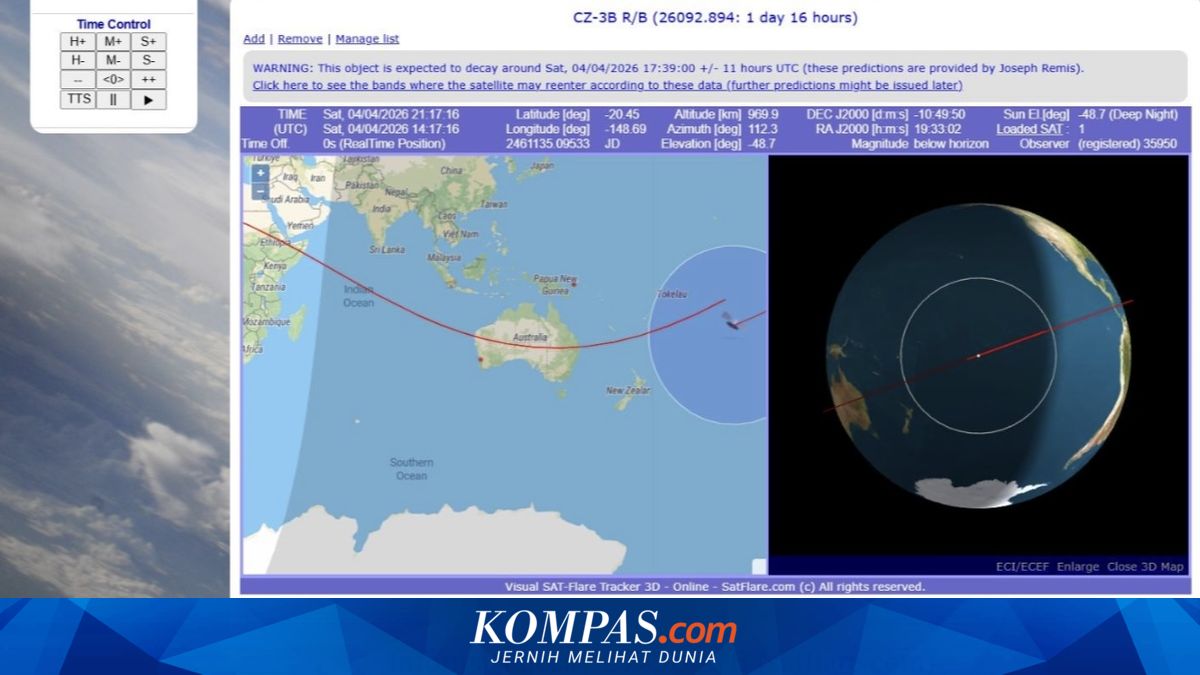
Residents in North Lampung, East Lampung, and South Lampung were shocked by the sight of a giant fireball passing through the sky on Saturday night, 4 April 2026, at 19:53 WIB. The phenomenon, also visible as far as Cilegon and Serang, triggered speculation on social media, ranging from a meteor to missile attack rumours. “That flash of light with fiery sparks was not a missile, even though it came from the northwest,” said space observer from the Ekliptika institute, Marufin Sudibyo, on Monday, 6 April 2025. Expert analysis confirms that the light flash was not a natural phenomenon but rather the re-entry of massive space debris. Based on checks using the SpaceTrack database via SatFlare, the object matches object 62805. “That is China’s spent rocket which has been in the sky for 14 months,” Marufin said. Marufin explained that object 62805 is actually the third stage (upper stage) of China’s Long March-3B/E rocket. This upper stage is 12 metres long with a total mass of 20 tons, of which 18 tons consists of fuel and oxidiser. “Once its mission is complete, all remaining fuel and oxidiser are expelled, leaving the space debris with a mass of just 2 tons,” Marufin told Kompas.com. The history of this “spent rocket” began on 23 January 2025. At that time, the 56-metre-tall giant rocket carried out mission flight Y105 to launch the military communications satellite TJS (Tongxin Jishu Shiyan)-14 into geostationary orbit. In its launch mechanics, this upper stage was responsible for providing the final thrust when the rocket reached an altitude of 150 kilometres to ensure the satellite reached its target orbit. “After completing its task, the upper stage becomes space debris that continuously rubs against air molecules in the upper atmosphere,” Marufin explained. After 14 months floating in outer space, the constant atmospheric friction caused the object’s speed and altitude to decrease dramatically.