
Organisational Transformation Strengthens Cooperatives' Steps Towards Becoming People's Corporations
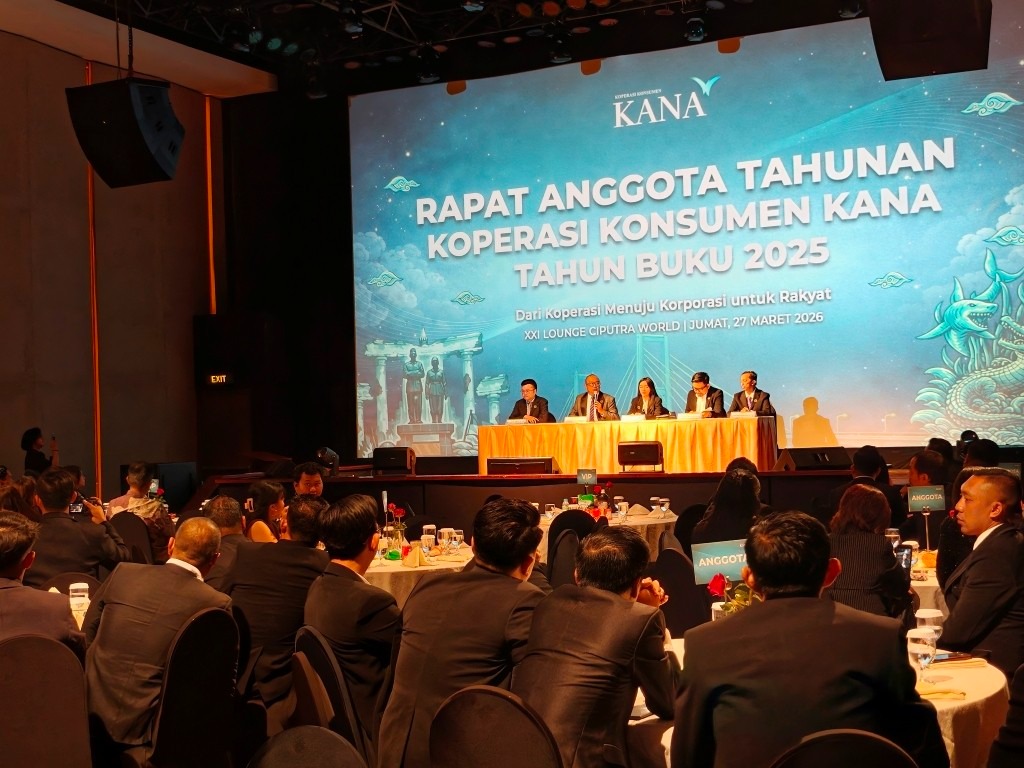
KOPERASI Konsumen Kana held its Annual Members’ Meeting (RAT) for the 2025 Book Year at XXI Lounge, Ciputra World Surabaya, East Java. With the theme From Cooperative to Corporation for the People, this RAT serves as a crucial moment for Kana to affirm the direction of its organisational and business transformation towards a stronger, more modern cooperative with broad societal impact.
Koperasi Konsumen Kana Chairman Jonathan Danang Wardhana stated that over the past three years, Kana has recorded significant growth. This includes membership rising from 44 in 2023 to 100 in 2024, and reaching 207 in 2025. Production capacity for palm sugar has increased from 15 tons per day in 2023 to 50 tons per day in 2024 and 70 tons per day in 2025.
Through the Sweet Cooperative Programme, Kana has also partnered with around 300 Village/Subdistrict Red and White Cooperatives (KDKMP) in 2025.
Jonathan said this growth forms an important foundation in strengthening Kana’s position as a cooperative ready to expand further.
“Kana’s growth over the past two years shows that we are not only building an organisation but also building business capacity, operational readiness, and business competitiveness. Moving forward, we want to take Kana further, from a growing cooperative to a sturdy, modern people’s corporation with broad impact,” said Jonathan on Friday (27/3/2026).
According to him, the transformation towards a people’s corporation does not mean the cooperative abandons its identity and core values. Kana instead aims to build a more professional, integrated business model grounded in members’ interests. “To that end, institutional strengthening and business development will continue to be carried out in a balanced manner through the development of various business lines within a mutually supportive ecosystem,” said Jonathan.
He added that as part of the 2026 roadmap, Kana targets strengthening business units and expanding partnership networks. This step is aimed not only at driving business growth but also at creating broader economic impact.
He is optimistic that with the continuously increasing number of members, rising business capacity, and maintained spirit of collaboration, Kana can continue to develop without abandoning its grassroots roots.
“Through the 2025 Book Year RAT, Kana affirms its commitment to continuously building a healthy, professional, and relevant cooperative, while presenting a people’s corporation that grows from members, is managed modernly, and provides benefits to the wider community,” he concluded.
Meanwhile, Deputy for Institutional and Digitalisation Affairs of Cooperatives at the Ministry of Cooperatives Henra Saragih assessed that the transformation steps taken by Kana are increasingly relevant amid contemporary challenges.
“The theme from cooperative to corporation for the people reflects the needs of the times. Cooperatives cannot just be large as organisations but must also be strong as business entities, modern in governance, and able to deliver real benefits to members and society,” Henra concluded. (H-2)
The consignment model provides ease in capital management, allowing cooperatives to move more quickly and flexibly.
In the past two years, Koperasi Kana has shifted its focus from financial services to becoming an exporter of Indonesia’s flagship products.
The acquisition of a rural bank is seen as a strategic step that will strengthen Koperasi Kana’s position in the financial industry.
This Surabaya-based cooperative in East Java operates in the sugar industry with a focus on exports to several countries, such as Hong Kong, Thailand, and Malaysia.