
Orchestrating Green Power Towards 8% Economic Growth
The target of 8 per cent economic growth is not merely a statistical ambition. For Indonesia, this figure is a strategic necessity to escape the middle-income trap before the demographic bonus loses its momentum.
However, in nearly every discussion on accelerating growth, one fundamental factor is often treated merely as a supporting sector, when it is actually the main foundation of all modern economic activity. That factor is energy.
There is no industrialisation without reliable electricity. There is no downstream processing without a competitive energy supply. There is no data centre, modern manufacturing zone, or electric vehicle ecosystem without a stable and efficient power system. When energy is disrupted, economic growth loses its driving force.
Therefore, Indonesia needs a major redefinition of its national energy perspective. Energy can no longer be viewed solely as an extractive commodity taken from the earth’s depths and sold on the global market. Energy must be positioned as an instrument for creating added value for the national industry and as the foundation for long-term economic competitiveness.
This is where the transformation towards green power becomes relevant. The energy transition is no longer just about fulfilling international environmental commitments. It has evolved into an economic strategy to compete for global investments, build new industries, and create more sustainable sources of growth. Countries that can provide clean energy at competitive prices will become the primary destinations for future industrial investments.
The question is no longer whether Indonesia needs to undertake an energy transition, but how to ensure that this transition becomes a catalyst for economic growth rather than a new fiscal burden. The answer lies in one key word: orchestration.
Orchestration means aligning energy policies, regulatory certainty, transmission development, industrial readiness, financing, and human resource development into one grand direction that supports the national economic growth target. Without orchestration, the energy transition will only be sectoral projects running independently. With orchestration, green energy can transform into Indonesia’s new growth engine.
The first step in this orchestration is to change the paradigm of renewable energy investment. So far, public debates have often stopped at the assumption that green energy is more expensive than fossil fuels. Yet global trends show the opposite.
The prices of solar panels, batteries, and energy storage technology have fallen significantly over the past decade. In contrast, fossil fuels are increasingly vulnerable to global price volatility, geopolitical pressures, and rising environmental costs.
This means the main question is no longer about cost but about who is more ready to leverage these technological changes as economic opportunities. If Indonesia can build a stable and predictable investment climate through a more progressive revision of the National Energy Policy, global capital flows will move in.
Currently, global investment funds are aggressively seeking projects that meet environmental, social, and governance (ESG) principles. Countries that can provide certainty in the direction of energy transition will become new investment magnets. In the Indonesian context, the influx of green investments will not only strengthen the energy sector but also fuel the pursuit of the 8 per cent economic growth target.
The second step is to ensure that energy transformation becomes the engine of industrial downstream processing. Indonesia has seen how nickel downstream processing creates far greater added value than simply exporting raw materials. However, the next phase must go further towards green downstream processing.
Global investors now increasingly consider carbon footprints when determining manufacturing locations. Industrial zones with access to clean energy will have a competitive advantage over those still reliant on carbon-intensive energy. In this context, green power is no longer just a source of electricity but an instrument of national industrial competitiveness.
Indonesia has a great opportunity to build green industrial zones in various strategic regions. These zones can become centres for battery manufacturing, electric vehicles, data centres, green petrochemicals, and other high-tech industries. When clean energy becomes part of the industrialisation strategy, the energy transition will directly connect to job creation, value-added exports, and national productivity improvements.
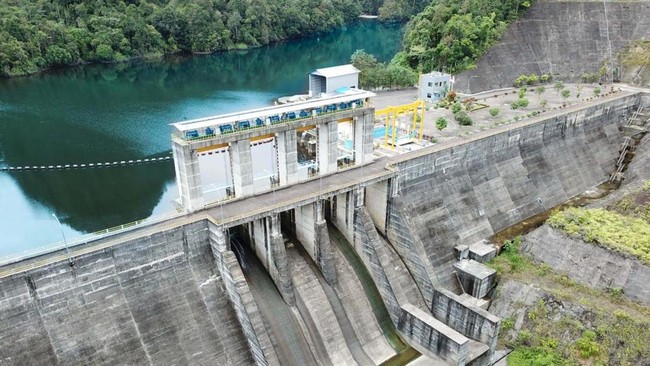
The third step is to maximise Indonesia’s domestic strengths as a source of green baseload power. Amid the development of intermittent solar and wind energy, Indonesia has an advantage rarely possessed by many other countries: large-scale geothermal and hydropower.
Indonesia has the world’s largest geothermal reserves and enormous hydro potential in Sumatra, Kalimantan, Sulawesi, and Papua. Both energy sources can supply stable electricity around the clock. In the national energy transition architecture, geothermal and hydropower must serve as the main anchors for power system stability.
Optimising these two resources is not only about energy resilience but also economic sovereignty. The greater the portion of domestic energy utilised, the smaller the dependence on energy imports. The impact is directly felt in the trade balance, exchange rate stability, and fiscal space for the country.
However, to realise this, Indonesia needs real breakthroughs in permitting, spatial planning, project financing, and transmission development. Many geothermal and hydropower projects…