
Opu Daeng Risadju: Colonial Resistance Activist and Champion of Islamic Learning
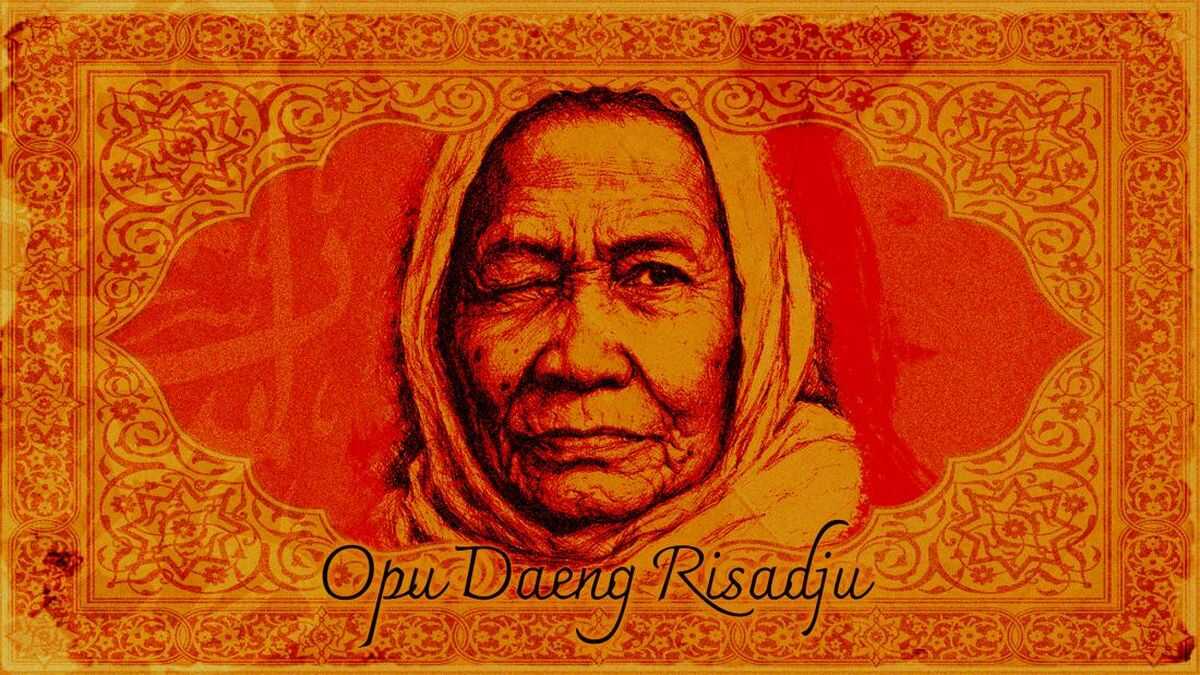
In 1880, a woman was born whose name would reverberate more forcefully against Dutch colonialism than any warning gong. The daughter of Muhammad Abdullah To Baresseng and Opu Daeng Mawellu, she was named Famajjah. Her name would later become renowned as Opu Daeng Risadju, with royal blood from the Luwu kingdom flowing through her veins. Her mother was a direct descendant of Bone’s 22nd Raja, La Temmasonge Matimoeri Malimongeng.
Opu Daeng Risadju was designated a national hero by the state on 26 February 1959.
Young Famajjah grew up surrounded by Islamic teachings and the melodious recitation of the Quran. Beyond Arabic and Bugis script, she also self-taught Latin letters with assistance from her brother Mudehang, who attended formal schooling. Though born to a noble family, Famajjah did not pursue formal education—consistent with Luwu tradition, where noble girls typically received only religious instruction and Quranic study.
When love found her, Famajjah married Haji Muhammad Daud, a religious scholar. This marriage transformed her name to Opu Daeng Risadju—a noble title spoken with reverence in Luwu society and carried as a symbol of dignity.
Despite her gender, Opu proved herself a formidable force in the nationalist movement. She became a pivotal figure in the anti-colonial struggle in Sulawesi, gaining prominence through her work with the Indonesian Syarikat Islam Party (PSII). Her activism alarmed the Dutch colonial authorities.
Initially, Opu served as a member of the Parepare PSII branch and gained recognition as leader of the Palopo PSII chapter. Following the PSII conference held in Parepare in April 1930, Opu travelled to Malangke to establish a party branch there. Her efforts sparked Dutch colonial concern. When Opu and dozens of fellow activists attempted to spread the seeds of freedom in Malangke, colonial authorities intervened.
The Controleur of Masamba eventually travelled to Malangke and arrested Opu alongside approximately 70 party members. She was accused of incitement and spreading hatred towards the government among the populace. This made her the first woman imprisoned by the colonial regime as a political detainee. However, the detention proved ineffective, prompting the Dutch to deploy propaganda to suppress PSII activities.
Beyond colonial pressure, Opu faced resistance from traditional authorities in her own homeland, who sought to sever her ties with the PSII. The customary council stripped her of her noble title. Yet the people never abandoned the name—they continued calling her “Opu” despite the formal withdrawal of her title.
Opu Daeng Risadju passed away on 10 February 1964 and was buried in the royal cemetery complex at Lokkoe, beneath the eastern sky that had witnessed her struggle.