
Optimising Virus Inactivation for the Production of Local Foot and Mouth Disease (FMD) Vaccines
Headline
The overdue payment of dues needs to be realised first while considering the economic conditions.
The overdue payment of dues needs to be realised first while considering the economic conditions.
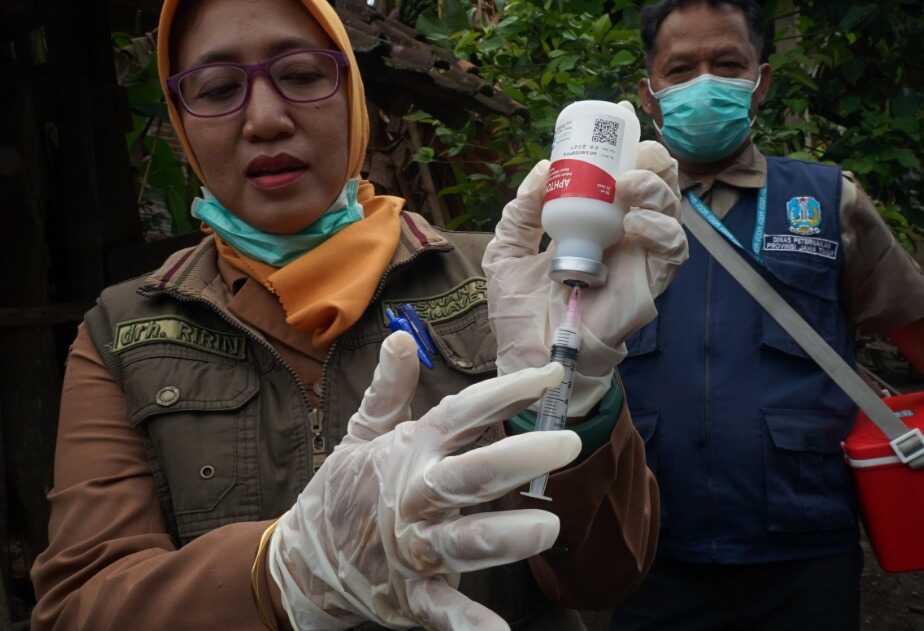
Foot and Mouth Disease (FMD) is a serious threat to cattle, goat, and pig farms due to its rapid transmission and potential economic losses and food security disruption.
Recent research in Indonesia shows that the outbreak since 2022 has driven the urgent need for vaccines suitable for local viruses.
Lecturer of Veterinary Medicine at Airlangga University (Unair) Fedik Abdul Rantam said that one of the important stages in the production of inactivated vaccines is virus inactivation, which is to kill the virus so that it does not cause disease, but still maintain the antigenic part that can stimulate animal immunity.
“If the virus is not properly inactivated, a safety risk arises; if the inactivation is too extreme, the antigen can be damaged and the vaccine becomes less effective,” said Fedik in his statement, Thursday (26/2).
The RCVTD-ITD Unair research team used local isolates of the FMD type O virus, strain GR12, obtained from the outbreak in Gresik, East Java. The virus was cultured on BHK-21 cells and then tested with four formulations of a combination of two inactivation chemicals: Formaldehyde (FA) and Binary Ethylenimine (BEI), with the following formulations: F1: 0.04% FA + 2 mM BEI
F2: 0.10% FA + 1 mM BEI
F3: 0.10% FA + 2 mM BEI
F4: 0.20% FA + 1 mM BEI
Inactivation was carried out at a temperature of 37 °C, with samples taken after 24 h, 48 h, and 72 h of the inactivation incubation period. Validation was carried out through three “blind passages” on cells to examine the cytopathic effect (CPE).
The results showed that all combinations began to show a reduction in the cytopathic effect after 48 h and 72 h. However, only formulation F4 (0.20% FA + 1 mM BEI) with a 72h incubation period successfully completely inactivated the virus, where there was no CPE after 72 h in the three passages.
Interestingly, increasing the concentration of BEI from 1 mM to 2 mM did not significantly accelerate or improve inactivation if the FA was too low. This confirms that the optimal combination of materials and doses is very important.
These findings provide a technical basis for the production of local FMD vaccines in Indonesia, namely that a combination of 0.20% FA and 1 mM BEI for 72 h at 37 °C can be a standard protocol for the GR12 strain. This allows for efficient production and increased vaccine safety.
Further research is needed to evaluate the integrity of the virus antigen or immune response after vaccination and to ensure that the resulting vaccine is effective in vivo.
In conclusion, with the right strategy for inactivating local viruses, FMD vaccination efforts can be more effective, safe and geographically relevant. For farmers and policymakers, this means one concrete step towards better controlling the outbreak and the sustainability of livestock production in Indonesia. (H-2)
820,000 buffalo, cattle, goats and poultry died or were swept away by floods. Then 58 animal slaughterhouses were damaged, 2,300 agricultural machinery tools were lost.
FMD vaccination aims to provide an anti-FMD booster or vaccine to prevent livestock from FMD transmission.
The Commission IV of the Indonesian House of Representatives encourages strengthening international standard laboratory facilities and fulfilling FMD disease identification tools.
The Provincial Government of Bengkulu received 19,500 doses of the Foot and Mouth Disease (FMD) vaccine allocation from the central government in January 2026.
AFFA held a peaceful action in front of the Hutan Kota, urging the Plataran Group luxury hotel company to immediately commit to a cage-free egg policy.
The Animal Health Service of Bengkulu Province has distributed 19,400 doses of the FMD vaccine from the central government to ten districts/cities as an effort to prevent outbreaks in livestock.
FMD vaccination aims to provide an anti-FMD booster or vaccine to prevent livestock from FMD transmission.
The Provincial Government of Bengkulu received 19,500 doses of the Foot and Mouth Disease (FMD) vaccine allocation from the central government in January 2026.
The Ministry of Agriculture ensures that it will continue to boost FMD vaccination as a strategic step in controlling FMD.
The injection of 33,525 doses of vaccine is prioritised for cattle, because cattle are the livestock that are most infected with FMD.
Copyright @ 2026 Media Group - mediaindonesia. All Rights Reserved