
Only in Indonesia: 157 Dead from Waste Landfill Collapse
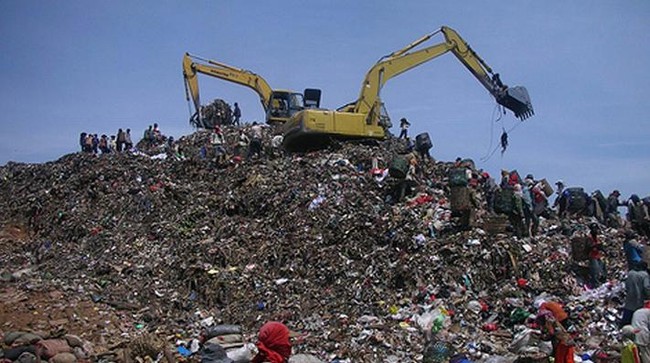
Jakarta — The Bantar Gebang waste disposal site (TPA) experienced a landslide on Sunday 8 March 2026. The collapse of the 50-metre-high “rubbish mountain” buried multiple individuals and resulted in four confirmed deaths.
Environment Minister Hanif Faisol Nurofiq stated that the landfill collapse serves as concrete evidence of systemic failure in waste management throughout Jakarta. The incident was widely regarded as deeply ironic, occurring merely two weeks after the observance of National Waste Care Day on 21 February.
National Waste Care Day is commemorated to remember the tragic landslide at the Leuwigajah TPA in Cimahi, West Java, on 21 February 2005, which ranks among Indonesia’s worst waste management disasters.
Prior to this tragedy, the Leuwigajah landfill served the greater Bandung region. Since its establishment in the 1980s, the waste pile at Leuwigajah had accumulated to hundreds of metres in height.
According to a report by Japanese researcher Itoch Tochija titled “The Leuwigajah Tragedy,” the waste mound suddenly ruptured on 21 February 2005. The explosion of the waste pile triggered a “waste tsunami,” burying homes and anyone in the surrounding area.
Throughout approximately 15 days of evacuation operations, rescue teams recovered only 157 bodies. Several hundred others remain unaccounted for. The majority of victims were waste pickers and residents living near the landfill site.
The disaster subsequently became recorded as one of the largest landfill disasters globally, surpassed only by a similar incident at the Payatas TPA in Quezon City, Philippines, on 10 July 2000, which killed more than 200 people.
It was later discovered that the Leuwigajah TPA, constructed during the 1980s, had substantially exceeded its designed capacity. A team of experts from the Bandung Institute of Technology identified a primary cause of the landslide: uncompacted waste material and a single-slope dumping system that was excessively steep, exceeding 45 degrees.
Additionally, hydrogeological surveys revealed underground springs beneath the northern section of the landfill. Heavy rainfall in the days preceding the disaster further destabilised the waste pile structure. The accumulation of methane gas within the waste mound subsequently ignited, triggering the explosion.
Remarkably, several warning signs had manifested before the catastrophe. Residents observed ground cracks, minor landslides, and detected odorous gas drifting towards settlements. However, these warnings were not addressed with adequate seriousness.
Following the disaster, the government closed the Leuwigajah TPA and promoted the implementation of safer waste management systems. The former landfill site has since been transformed into a greener area.
In commemoration of the tragedy, the government designated 21 February as National Waste Care Day.