
On the Brink of Hormuz
The world lately seems to converge on one narrow yet decisive name: the Strait of Hormuz. It is not merely a line of water on the map, but a knot where the anxieties of our time accumulate—a place where flows of oil, interests, and worries meet in tense silence. Every ship that passes seems to carry more than just cargo; it transports the possibility of crisis, shadows of conflict, and long-unresolved questions: who truly controls the direction of the world?
The name “Hormuz,” now known to us as a strait, once stood as a man: Hormuz. He was not merely a soldier, but the face of the long-standing Sassanid Empire, which had long believed that the world could be guarded through strength and order. Across from him stood a figure who came from a direction never truly accounted for by the great imperium: Khalid bin Walid, a man who brought not only a sword, but a conviction that changed the way humanity viewed power.
The account of their encounter flows from the pens of historians like Al-Tabari, Al-Baladhuri, to Ibn Kathir. Not all agree on the details, but they seem to concur on one thing: that on a morning in southern Iraq, amid the whirl of the Battle of Chains, two worlds once faced each other from a distance so close that it could be bridged by a single swing of the sword.
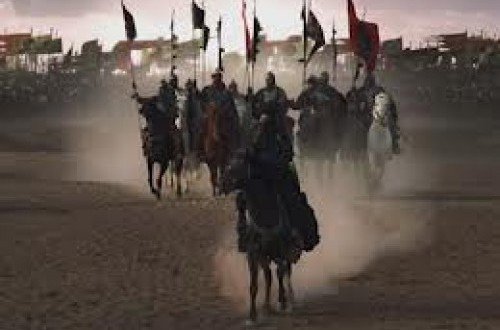
Imagine for a moment that land: wind carrying fine dust, ranks of Persian soldiers standing in rigid formation, some chained together to prevent retreat—a symbol of courage that also harboured fear. Before them, a lighter, more agile force, and somehow calmer. There was no excess luxury, but something harder to explain—a kind of steadfastness that did not depend on numbers.
Hormuz stepped forward first. He carried not only himself, but the honour of an empire that had long prevailed. His challenge was in the language known to that era: one against one, to prove who was worthy to lead the battle. And Khalid bin Walid accepted, without meaningful hesitation, as if he had been waiting for that moment since his first step onto the field.
When the two faced off, time seemed to hold its breath. No cheers, no roars—just two men standing between the past and the future. Swords were drawn, but what was truly being tested was not just the strength of their arms, but how each interpreted the world.
The first clash rang out briefly, but its echoes of meaning were long. Hormuz fought with the discipline inherited from generations of empire; Khalid fought with a new conviction that made him unwavering. Yet history, as we often find, rarely gives us clean and straight stories. In some accounts, as the duel unfolded, shadows moved from the Persian side—a breach of the agreement that should have been upheld. At that point, the field changed, from honour to chaos that nearly swallowed a name we now know as legend.
Then came Al-Qa’qa ibn Amr, not as a hero seeking the stage, but as part of an unstoppable flow of events. What happened next is told with variations by the writers, but the end is the same: Hormuz fell. And with the fall of one man, something greater cracked—the belief that a power would always endure simply because it had once been great.
We might be tempted to read this story as a victory of one side over the other. But if we pause a little longer, there is a quieter lesson, one more relevant to today’s world. That strength often does not crumble from external attacks, but because it can no longer comprehend the changes that arrive. That courage is not just about advancing forward, but also about reading the times honestly. And that every battle, no matter how small its form, always harbours consequences far beyond itself.
Today, as the name of the Strait of Hormuz echoes once more in global conversations, we are like watching a replay of an old stage with different actors. Once it was a duel of two men; now it is a tug-of-war of interests among many nations. Once swords spoke; now economics, energy, and strategies lock horns. But the basic pattern remains the same: there are those who wish to preserve, those who wish to change, and a narrow point that determines the direction of history.
Perhaps that is why the story of Khalid bin Walid and Hormuz never truly becomes the past. It merely waits to be read again, every time the world feels it is on the brink of something great. And from there, we are reminded in a subtle yet firm way: that every power, no matter how strong, will eventually reach a moment when it must confront—not just its enemy, but change itself.