
On H+2 of Eid, 51,000 Train Passengers Arrive in Jakarta
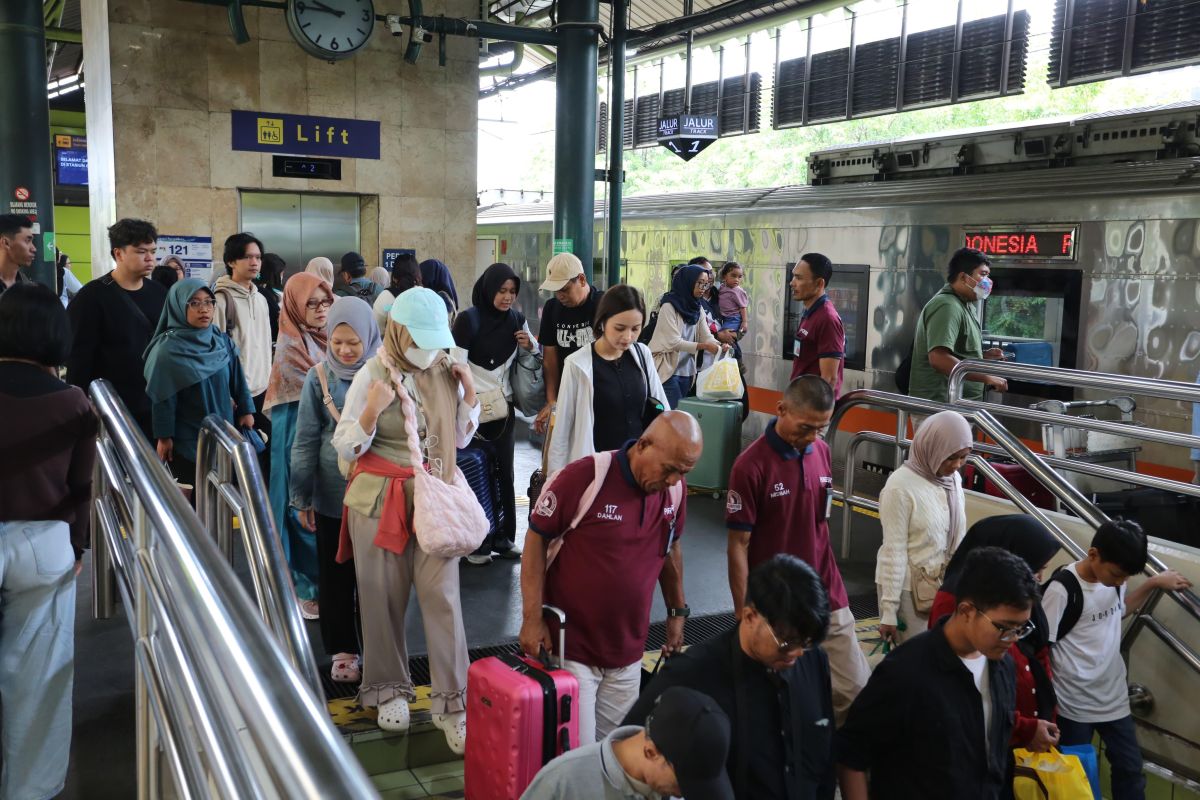
Jakarta - A total of 51,015 passengers arrived in Jakarta on Monday (H+2 Lebaran), which is higher than the departures that reached 43,992 people.
“This trend will continue until approaching the end of the Lebaran transportation period,” said the Public Relations Manager of PT Kereta Api Indonesia Daerah Operasi (KAI Daop) 1 Jakarta, Franoto Wibowo, in a statement in Jakarta on Monday.
He detailed that the passenger arrivals were concentrated at several major stations, including Pasar Senen Station with 16,945 people, Gambir Station with 16,404 people, Bekasi Station with 8,210 people, and Jatinegara Station with 5,480 people.
“The rest are at other stations in Daop 1 Jakarta,” he said.
Franoto stated that the highest number of passenger arrivals is estimated to occur starting from this Monday until 29 March 2026, with daily volumes ranging between 48,000 and 51,000 passengers.
“This figure will gradually decrease until 1 April 2026, but will remain at a significant volume,” he said.
The passenger arrivals during this return flow period originate from cities in Central Java, East Java, the Special Region of Yogyakarta, and West Java, such as Semarang, Yogyakarta, Surabaya, Jember, Purwokerto, Bandung, Malang, Solo, and Kutoarjo.
During this return flow period, KAI Daop 1 Jakarta is operating a total of 88 long-distance train services, consisting of 68 regular trains, 13 additional trains from Gambir Station, and seven additional trains from Pasar Senen Station.
During the Lebaran transportation period from 11 March to 1 April 2026, KAI Daop 1 Jakarta provided a total of 1,083,623 long-distance train seats.
To date, 802,501 tickets have been sold, with an average occupancy rate of 74 percent.
Meanwhile, for the return flow period from 23 March to 1 April 2026, there are still 276,487 seats available for the public to utilise.
“We urge the public who have not yet obtained tickets to make reservations immediately, as seat availability is still sufficient, especially for journeys after the peak return flow dates,” Franoto added.