
OJK: Formal Education Plays a Crucial Role in Building Financial Capacity
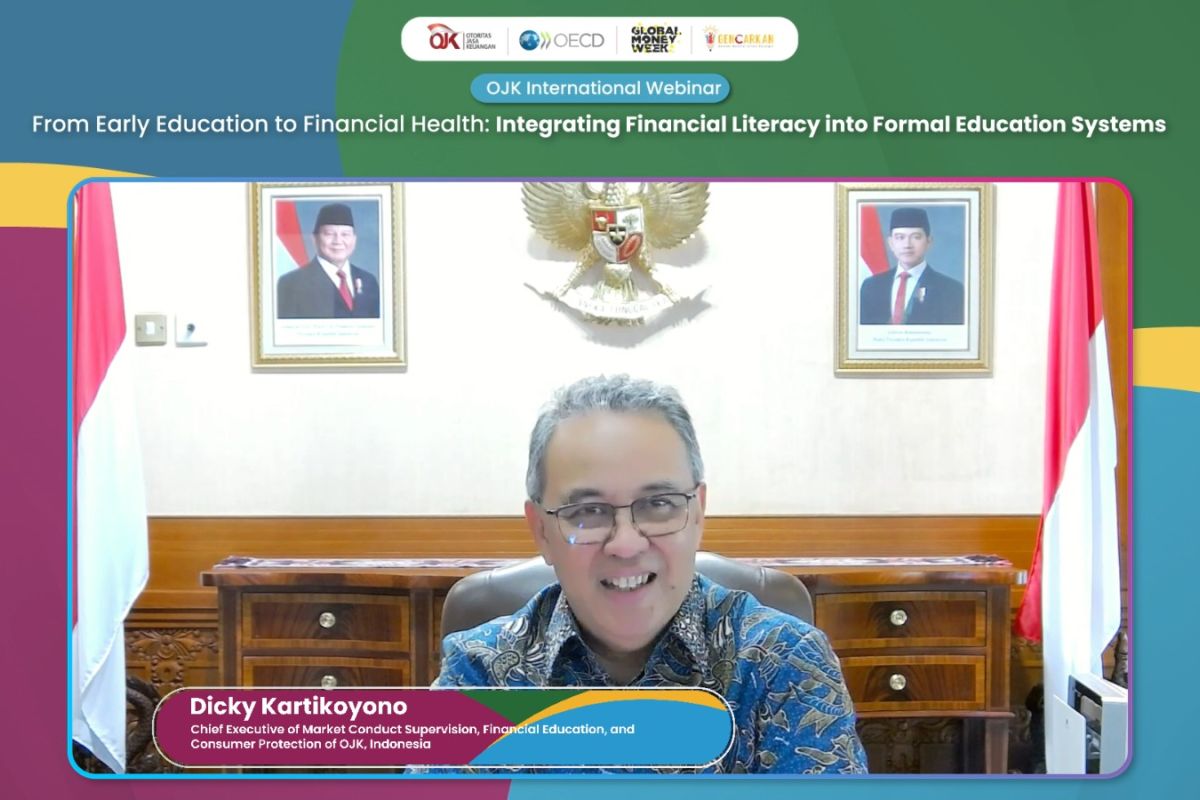
Jakarta (ANTARA) - The Financial Services Authority (OJK) views formal education as holding a central role in building the financial capacity of society from an early stage through strengthening knowledge, practical skills, and their application in real life.
The Executive Head of Supervision for the Behaviour of Financial Services Business Actors, Education, and Consumer Protection at OJK, Dicky Kartikoyono, stated that by integrating financial literacy into the formal education system and curriculum, Indonesia is building a strong foundation so that every individual can make wise financial decisions throughout their life.
“This effort requires ongoing collaboration between regulators, educators, industry, and communities,” said Dicky in a statement received in Jakarta on Friday.
OJK also views that financial education needs to extend beyond the classroom, including through digital platforms, national campaigns, and the involvement of various stakeholders in building a strong and inclusive financial literacy ecosystem.
The regulator continues to promote strengthening financial literacy among the younger generation through financial education pathways in the formal education system to shape a society with awareness and financial resilience from an early age.
“Financial literacy must be realised as financial health. This is not only related to knowledge but also resilience, the ability to make the right decisions, and long-term financial well-being, especially for the younger generation,” said Dicky.
On Friday, OJK together with the Organisation for Economic Co-operation and Development International Network on Financial Education (OECD/INFE) organised an international webinar as part of the Global Money Week 2026 commemoration.
Chair of the OECD International Network on Financial Education, Magda Bianco, conveyed that education and financial literacy are essential capital for society to utilise opportunities while minimising risks in financial management.
“The ease of access to information, the emergence of various new investment instruments, and the prevalence of investment information from not always credible sources present both opportunities and risks. Therefore, financial competence needs to be built from an early age,” said Magda.
According to her, one of the main reasons why financial competence needs to be taught from school age is that knowledge acquired early is more easily ingrained and mastered into adulthood.
In addition, early learning can help reduce gaps due to differences in socio-economic backgrounds, so that every student has a more equal opportunity in facing the future.
Magda also emphasised that various empirical evidence shows that financial competence can increase individual resilience in facing shocks.
The shocks referred to include the risk of fraud, helping to manage debt wisely, avoiding excessive debt, and encouraging more rational investment decisions through understanding risks and returns.
Overall, improving financial literacy is seen not only to support individual well-being but also to contribute to the stability of the financial system, the effectiveness of monetary policy, and the reduction of social inequalities.