
OJK Boosts Law Enforcement and Synergies to Maintain Financial Sector Stability
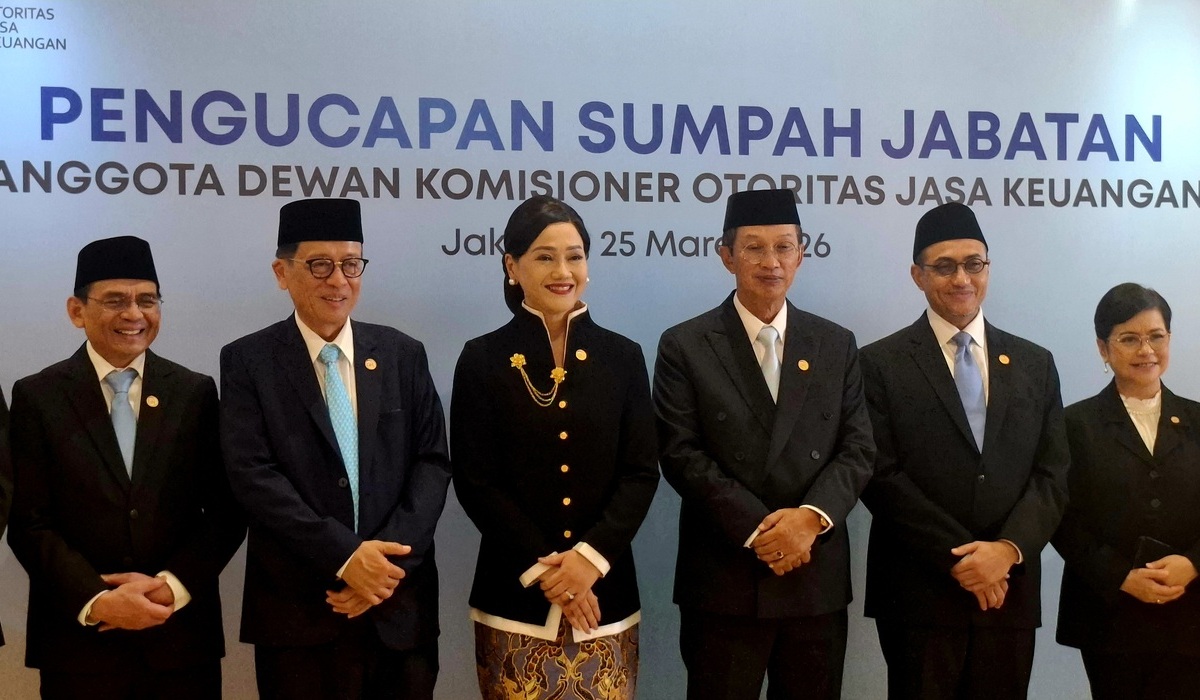
The Financial Services Authority (OJK) continues to strengthen law enforcement and cross-stakeholder synergies to maintain financial sector stability. Amid pushes for growth and innovation in the financial services industry, OJK Commissioner Council Chair Friderica Widyasari Dewi underscored the importance of balancing industry expansion with consumer protection and firm resolutions of various cases.
This reinforcement is expected to create a healthy, trustworthy, and resilient financial system to support the national economy. This was stated by Kiki, as Friderica is affectionately known, following the oath-taking of OJK Commissioner Council members at the Supreme Court Building in Jakarta on Wednesday (25/3).
“How can the financial services sector continue to grow and innovate while prioritising protection for consumers and the public? We will also continue to enforce the law and reinforce efforts that we will intensify further,” she said.
She added that OJK will ensure the resolution of various financial sector cases proceeds more firmly, while strengthening collaboration with stakeholders.
“How we will resolve cases in the financial sector and, of course, we will continuously carry out synergies and collaborations,” she stated.
From the market perspective, OJK is also preparing steps to increase liquidity through various policies, including raising the portion of circulating shares (free float) in the Indonesian capital market. Additionally, transparency is being strengthened through disclosures of share ownership, particularly for shareholders holding more than 1%.
“So it’s fine for everything to be open, so we know who owns these shares,” said Kiki.
OJK is also promoting the disclosure of Ultimate Beneficial Owners (UBO) or ultimate beneficial owners for shares in Indonesia. On the other hand, investor data classification at the Indonesian Central Securities Depository (KSEI) is being refined to provide a clearer picture to investors regarding the ownership profile of a share.
Strengthening is not only taking place in the capital market but also through improvements in risk management across the entire financial services sector. This is important amid global geopolitical challenges and world economic uncertainties.
Kiki likened the situation to an aircraft journey in bad weather. Although external conditions cannot be controlled, safety can still be maintained as long as the aircraft’s condition and leadership remain solid. According to her, the resilience of the financial services sector is the top priority to face various global turbulences.
Meanwhile, the Executive Head of OJK’s Capital Market, Derivatives Finance, and Carbon Exchange Supervision, Hasan Fawzi, stated that OJK will gradually increase the minimum free float requirement to 15%.
Additionally, governance strengthening is being carried out through mandatory education for directors, commissioners, and boards, as well as verification by public accountants of listed companies’ financial reports.
“Today, alhamdulillah, we have conveyed our approval to the Exchange with notes on adjustments to several points,” said Hasan.
He explained that the implementation of the rules will be carried out gradually, involving a joint working team between OJK and Self-Regulatory Organisations (SROs), as well as market players from the sell side and buy side, including domestic and global investors. This team will periodically evaluate issuers’ readiness and market absorption capacity before entering each stage of free float increase.
“So March is the deadline for the first stage, then the second year and so on,” said Hasan.
For new shares or companies conducting initial public offerings (IPOs), the 15% minimum free float requirement will apply directly after the regulation is effectively issued.