
OJK Bank Levy Abolition Plan Stalls, P2SK Law Revision Decision Delayed
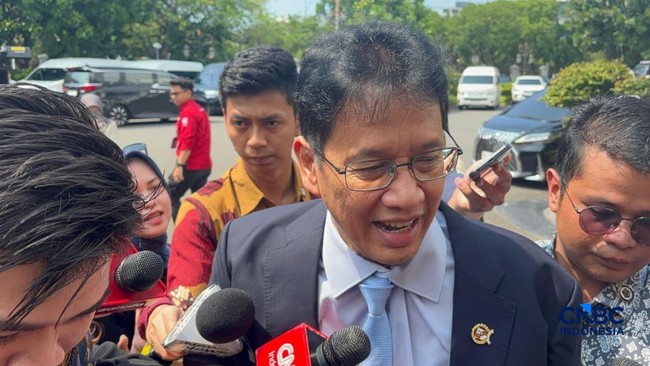
The planned ratification of revisions to Law No. 4 of 2023 on the Development and Strengthening of the Financial Sector (P2SK Law) this week is likely to be delayed.
This was directly stated by Finance Minister Purbaya Yudhi Sadewa when met in the State Palace area, Jakarta, on Wednesday (8/4/2026).
“It seems it will be postponed until the next session,” said Purbaya.
One of the reasons for the delay in ratifying the P2SK Bill is the protracted plan to abolish bank levies by OJK, which would be established through the new bill.
“That is still being discussed in the DPR between the government, BI, OJK, and LPS,” Purbaya emphasised.
He said the point of abolishing bank levies by OJK is crucial because it forms one of the main reasons for revising the P2SK Law.
“It was changed to regulate that. We don’t know. The results are still being discussed. It’s still going back and forth. Positions are changing,” said Purbaya.
Chair of Commission XI of the DPR, Mukhamad Misbakhun, revealed the reasons why the DPR wants to abolish the provisions on levies from the financial services industry by the Financial Services Authority (OJK) through revisions to Law No. 4 of 2023 on the Development and Strengthening of the Financial Sector (P2SK Law).
Misbakhun explained that the main reason for the abolition is to reduce costs in the financial services industry that have so far affected profits, such as net interest margin (NIM). NIM is typically used to measure a bank’s ability to manage interest rate-related risks.
“It’s being discussed and is an interesting discussion. Because our basic thinking is to reduce pressures from costs that impact the net interest margin in the banking world,” said Misbakhun in the Bank Mega Tower area, Jakarta, on Tuesday (7/4/2026).
In addition, previously, Deputy Chair of Commission XI of the DPR RI, Fauzi Amro, stated another main reason behind the plan to abolish financial services industry levies by OJK is to avoid potential conflicts of interest in OJK’s role as supervisor of the financial services industry.
“We hope OJK has independence. How can it supervise and also collect levies? We see that its independence is lacking there. It means it’s fraught with interests,” said Deputy Chair of Commission XI of the DPR RI, Fauzi Amro, in the DPR RI Building area.
To date, levies from the financial services industry have been OJK’s main source of revenue.
Referring to OJK’s 2024 Annual Financial Report audited by the Financial Audit Board, the levy revenue value as of 31 December 2024 reached Rp 8.37 trillion, up from the previous record as of 31 December 2023 of Rp 8.12 trillion.
The 2024 levy revenue realisation even exceeded its target of Rp 8.07 trillion. Not surprisingly, for 2025, OJK has again raised the levy revenue target to Rp 8.52 trillion, although the realisation has not been disclosed due to the absence of the 2025 OJK Annual Report publication.
As a replacement for those levies, the DPR proposes options for OJK’s revenue to come from Bank Indonesia (BI) surpluses and Deposit Insurance Corporation (LPS) surpluses.
“Well, the idea from colleagues is, for example, how about we offer the idea that the levies be taken from BI surpluses and LPS surpluses. BI surplus is around Rp 78 trillion, LPS surplus around Rp 42 trillion. So if combined, it’s almost Rp 115 to Rp 120 trillion,” he revealed.