
Oil Spill from US-Iran War Visible from Space
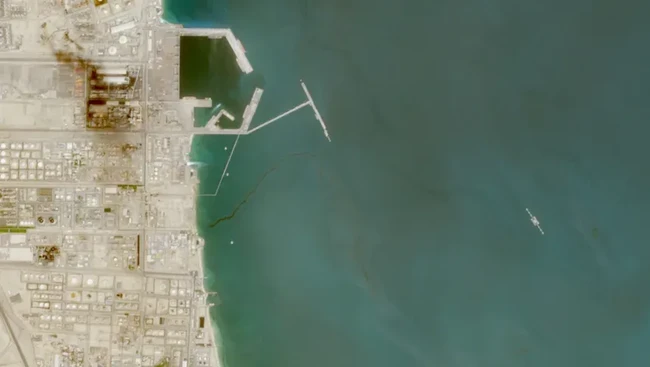
A large oil spill has been detected from space following attacks between Iran and the US-Israel alliance that struck energy facilities and ships in the Persian Gulf region. Experts warn that this incident could trigger a widespread and long-lasting environmental disaster. Satellite imagery shows significant damage at several points, including areas with vulnerable biodiversity. The oil spill threatens marine life as well as the livelihoods of coastal communities along the Persian Gulf. One image taken on 7 April shows the oil spill stretching more than 8 kilometres in the Strait of Hormuz, near Iran’s Qeshm Island. A spokesperson for Greenpeace Germany, Nina Noelle, said the leak came from the Iranian ship Shahid Bagheri, which was previously attacked by US forces on 28 February. “The impacts could be very extensive, affecting the entire ecosystem, from microorganisms to fish, birds, and sea turtles,” Noelle said, as quoted by CNN International on Wednesday (22/4/2026). Another image shows an oil spill around Lavan Island, following an attack that Iranian state media described as an act by the “enemy” against oil facilities in the area. Circulating video footage also shows a large fire at an Iranian oil refinery. Wim Zwijnenburg, project leader at the Dutch peace organisation PAX, described the attack on Lavan as a “major environmental emergency.” He revealed that at least five locations on the island suffered severe damage, causing oil leaks into the sea. “This spill has now even reached Shidvar Island, which is a protected area with various protected species,” he said. Shidvar Island is known as an important habitat for turtles and seabirds. The spread of the spill to that area increases the risk of deeper ecosystem damage. Not only in Iran, satellite imagery also shows an oil spill off the coast of Kuwait on 6 April. Iran’s Revolutionary Guard claimed attacks on energy facilities in the Gulf region, including Kuwait, as retaliation for strikes on their petrochemical complexes. In the worst-case scenario, thousands of coastal residents could be affected, particularly in terms of economy and food security. Marine pollution could damage fish stocks that are the main source of livelihood for communities. In addition, the oil spill also threatens marine animals such as turtles, dolphins, and whales. Oil can be ingested or trap these animals, increasing the risk of death. Another equally serious impact is the potential disruption to desalination facilities. Around 100 million people in the Gulf region rely on these installations for clean water. To date, the scale of the damage is still difficult to measure. However, the risk of escalation remains high, especially if the conflict continues and more tankers are affected. Greenpeace notes that around 75 large tankers are in the area carrying nearly 19 billion litres of crude oil. Noelle emphasised that cleaning up the oil spill in a conflict zone is a major challenge. “The complexity of the structure, limited access, and dangerous working conditions make handling almost impossible while the conflict is ongoing,” she said.