
Oil Refinery on Track for Sustainable Low Emissions
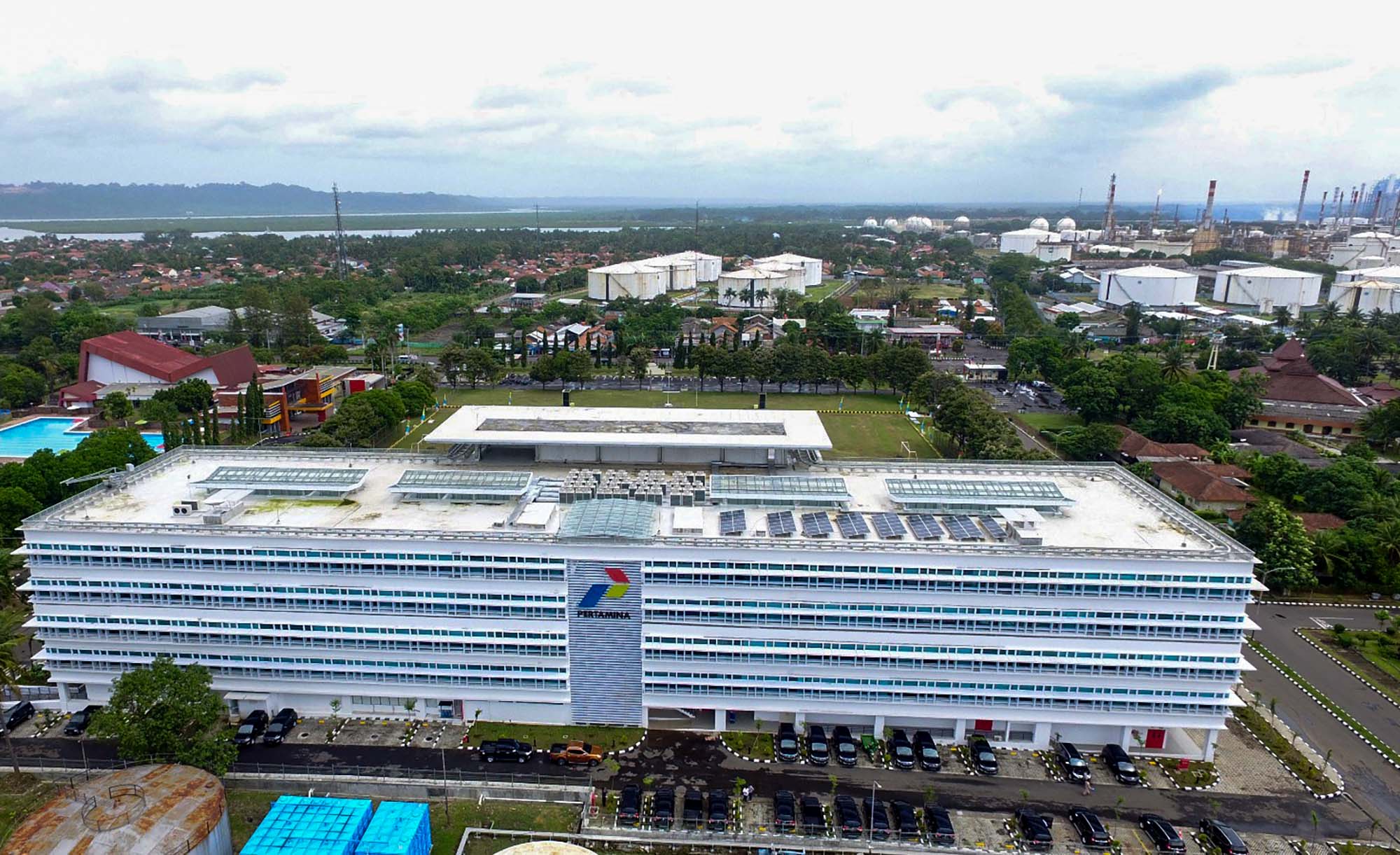
Atop a grand building in Cilacap, Central Java, covering 7,257 square metres, there are solar panels lined up. The building is the head office (HO) of Pertamina Patra Niaga Refinery Unit (RU) IV. Looking west, the refinery building with massive tanks is clearly visible, and there are crude oil tankers docking. The question remains: why would a fossil-fuel producing refinery like Pertamina Cilacap build a solar power plant (PLTS)? Moreover, Cilacap refinery is the largest in Indonesia for processing crude into fuel oil (BBM) with a production capacity of 348,000 barrels per day, supplying 34% of national demand or 60% of demand on Java Island. Area Manager Communications, Relations & CSR RU IV Cilacap Agustiawan said Pertamina fully supports government programmes to reduce emissions. “What Pertamina is doing, among other things, is developing PLTS in the refinery complex to reduce emissions by 30% by 2030 and Net Zero Emission by 2060,” Agustiawan told Media Indonesia on Tuesday (18/5). According to Agustiawan, the rooftop HO itself hosts a PLTS of 18 kilowatts peak (KWp). The HO electricity system is connected with the RU IV Cilacap Housing PV system, with a total capacity across the housing electrical system of 3.6 MWp. “PLTS at RU IV is currently an on-grid facility, so absorption is only in the morning and late afternoon, when its peak can meet demand. But at night it does not generate electricity. So overall the PV can meet around 10-16 percent of the electricity needs of housing and offices,” he said. “Agustiawan said the construction of PV is an important part of the energy transition towards low emissions. Pertamina has calculated that with the energy transition, emissions can be reduced by around 140-150 CO2 equivalent (eq) every month.” “Thus in a year, emission reductions are roughly 1,680-1,800 CO2 eq. If calculated by planting trees, this is equivalent to planting about 35,196 trees. This effort will continue as a company committed to reducing emissions,” he emphasised. According to him, not only green energy generation is being promoted, but green energy products are also boosted. Cilacap refinery has been established as a green refinery unit as part of the national strategic programme (PSN) by producing biofuels. As a Green Refinery, Cilacap can meet the demand for more environmentally friendly products by producing Hydrotreated Vegetable Oil (HVO) fuel with byproducts such as bionafta and biojet fuel or Sustainable Aviation Fuel (SAF) derived from crude palm oil, processed together with fossil aviation kerosene through co-processing. Production reaches 6,000 barrels per day of HVO, SAF, and Bionafta derived from Used Cooking Oil (UCO).” “Additionally, the products from this green refinery will positively support the government’s energy-mixing programme and achieving reductions toward Net Zero Emission (NZE) 2060. Even Pertamina SAF has met international standards ASTM D1655 and DefStan 91-091. For green diesel, the feedstock is RBDPO (Refined, Bleached and Deodorised Palm Oil), refined to remove free fatty acids and decolorise to eliminate colour and odour.” “Pertamina, with the International Sustainability and Carbon Certification (ISCC) certificate, uses palm oil as feedstock, with a production capacity of 6,000 barrels per day. Meanwhile, green aviation fuel (aviation fuel) is produced as a blend of RBDPO with kerosene, delivering a fuel that is much more environmentally friendly than conventional fuels. Its advantage lies in its low sulfur content, which can reduce harmful emissions.” “Transition energy commitments are not only demonstrated in the company’s products or renewable energy infrastructure within the refinery, but are also developed at the community level. Pertamina RU IV Cilacap designs and transforms energy systems in several areas to be accessible and sustainable with renewable energy.” “We have built a hybrid electricity plant (PLTH) that combines solar and wind power in Bondan Hamlet, Ujung Alang Village, Kampung Laut District. In that hamlet, PLTH can light up 74 homes and a clean water processing facility. Its capacity is 16,200 Wp,” said Agustiawan. “Other areas include Panikel Village, Kampung Laut, with PV capacity of 10,000 Wp. There, PV is used for eel farming.”PV drives a waterwheel for 24 hours a day. A group of 40 people no longer incurs electricity costs because it is supplied from PV,” he said. “Meanwhile, the PV in Kalijaran Village, Maos District, Cilacap is used by farmers to pump water. Its capacity is 19,140 Wp. The power is combined with a wind power plant. The supply of clean energy is used for irrigation and for driving rice production machinery.” “Chairman of Gapoktan Margo Sugih, Kalijaran Village, Priyatno, said that with the PV, his group no longer depends on fossil energy. ‘We usually use a water pump to irrigate rice fields with fossil fuels. But since the PV, we no longer buy fossil fuels because it is supplied by PV. In addition, we save money and can utilise the paddy fields year-round. If the rice season is in the rainy season, in the dry season we could …’