
Oil Prices Plunge 10%, Investors Growing Weary of Trump's Manoeuvres
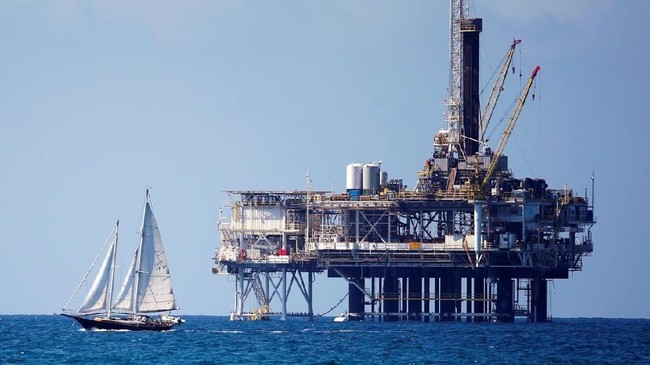
Global crude oil prices cooled after US President Donald Trump delayed a planned attack on Iran’s energy infrastructure for five days and stated that productive talks with the country were underway.
According to Refinitiv, Brent crude oil closed on Monday (23/3/2026) at US$99.94 per barrel, down 10.92%. Monday’s closing price ended the Brent oil price level at US$100, which had held for seven trading days since 12 March 2026.
Meanwhile, WTI crude oil closed on Monday (23/3/2026) at US$88.13 per barrel, falling 10.36%. This price marks the lowest since 11 March 2026.
Although prices weakened yesterday, gold prices strengthened again today.
On Tuesday (24/3/2026) at 07:25 WIB, Brent crude oil surged 1.02% to US$100.95 per barrel, while WTI crude oil jumped 2.2% to US$90.07 per barrel.
Oil prices collapsed following Trump’s announcement. The decision to delay the attack is seen as an effort to stabilise oil prices. Trump even stated that oil prices would fall like a stone once a deal is reached.
However, Tehran denies that any negotiations are underway, while Israel continues its attacks on Iran.
Currently, markets are beginning to factor in the possibility of reopening the Strait of Hormuz, after the conflict effectively closed this vital global route. Around 20% of the world’s oil supply typically passes through this route, so its closure has forced Middle Eastern producers to significantly cut production.
Iran itself still maintains strong control over the narrow strait, with only a limited number of ships able to pass, depending on existing alliances.
“It is unclear how far back-channel talks have progressed or whether the IRGC is in a position to resolve the current conflict, given their strong control over the Strait of Hormuz,” wrote analysts from RBC Capital Markets LLC, including Helima Croft, referring to the Islamic Revolutionary Guard Corps (IRGC), quoted from Reuters.
“Ships, not statements, are likely to be the main determinant for the physical market,” she added.
The oil market is now beginning to price in the possibility of the strait’s reopening in the near future. Investors are said to be highly focused on the potential resumption of activity on the route.
A small number of ships have successfully exited the Persian Gulf in recent days, although most traffic on this vital route remains practically halted. The first giant tanker carrying Iraqi crude oil through the strait since it was nearly closed has also been tracked.
Over the weekend, Trump threatened to bombard Iran’s energy infrastructure if the Strait of Hormuz was not fully opened within 48 hours. His decision to hold back the attack is viewed as an attempt to control oil prices by those familiar with the course of diplomacy, and Trump acknowledged the link on Monday.
The repeated changes in messaging from the US president have fatigued investors, pressuring trading volumes as market participants must sift through a nearly constant stream of news that is sometimes contradictory.
“The outcome of negotiations may be the best of a series of bad options available to President Trump,” said Will Todman, senior researcher in the Middle East Program at the Center for Strategic and International Studies.
However, Iran will enter these talks with high scepticism, fearing that Trump is merely buying time until more military assets arrive in the region.