
Oil Exporters Scramble for Alternative Routes Beyond the Strait of Hormuz, But Options Are Limited
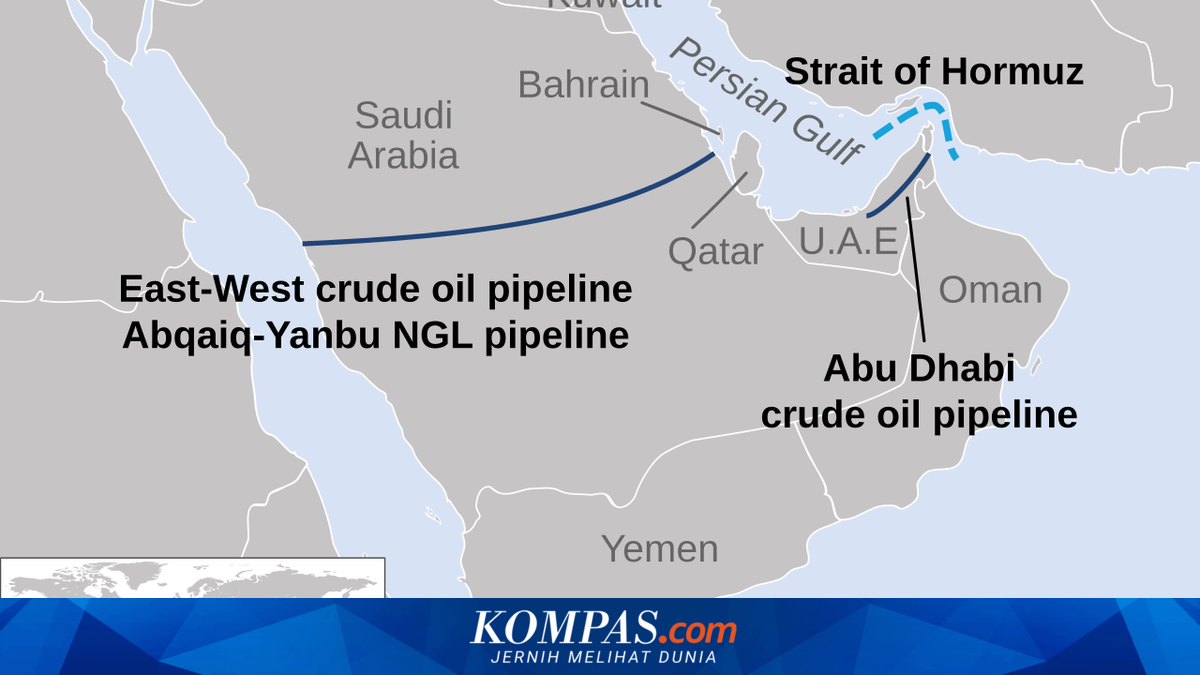
Middle Eastern oil-exporting countries are competing to find alternative routes to ship their oil and gas. This effort comes after the main route through the Strait of Hormuz has been practically closed to commercial traffic for nearly the last two months.
The closure of this strategic route has triggered a global energy supply crisis. To date, there is no clarity on when the conflict between the United States (US) and Iran will end.
Both parties are also using the Strait of Hormuz—a vital route previously carrying around 20 percent of the world’s oil supply—as a bargaining tool in stalled peace negotiations.
Quoted from CNBC on Friday (24/4/2026), the Executive Director of the International Energy Agency (IEA), Fatih Birol, said this situation should have been anticipated long ago. He assessed that dependence on a single narrow route is highly risky for the global economy.
“The $110 trillion global economy can be held hostage by a few hundred armed individuals in a 50-kilometre strait. This is unreasonable. We need alternative routes,” he stated.
The risks in the Strait of Hormuz have actually been understood for a long time. However, according to Maisoon Kafafy, a senior advisor at the Atlantic Council for the Middle East programme, the closure in February 2026 proves that old assumptions can collapse.
Additionally, factors such as economic interdependence and conflict prevention systems made a total closure seem unlikely.
The current war has changed those calculations. Gulf countries, which have long relied on the Strait of Hormuz, are now seriously seeking new export routes to reduce dependence.
Meanwhile, Oxford Economics economist Lucila Bonilla said the conflict is accelerating efforts to divert export routes. This situation also has the potential to weaken Iran’s strategic position in the long term.
At the start of the conflict, Iran’s strategy of closing access to the Strait of Hormuz initially provided advantages.
By controlling that route, Iran became the only country able to export hydrocarbons for several weeks, amid a surge in oil prices approaching $120 per barrel.
Nevertheless, Gulf countries still face obstacles because they cannot export oil and liquefied natural gas (LNG) through the strait.