
Oil and Gas Production Reaches 1 Million Barrels per Day in 2025; PHE Reveals 2026 Strategy
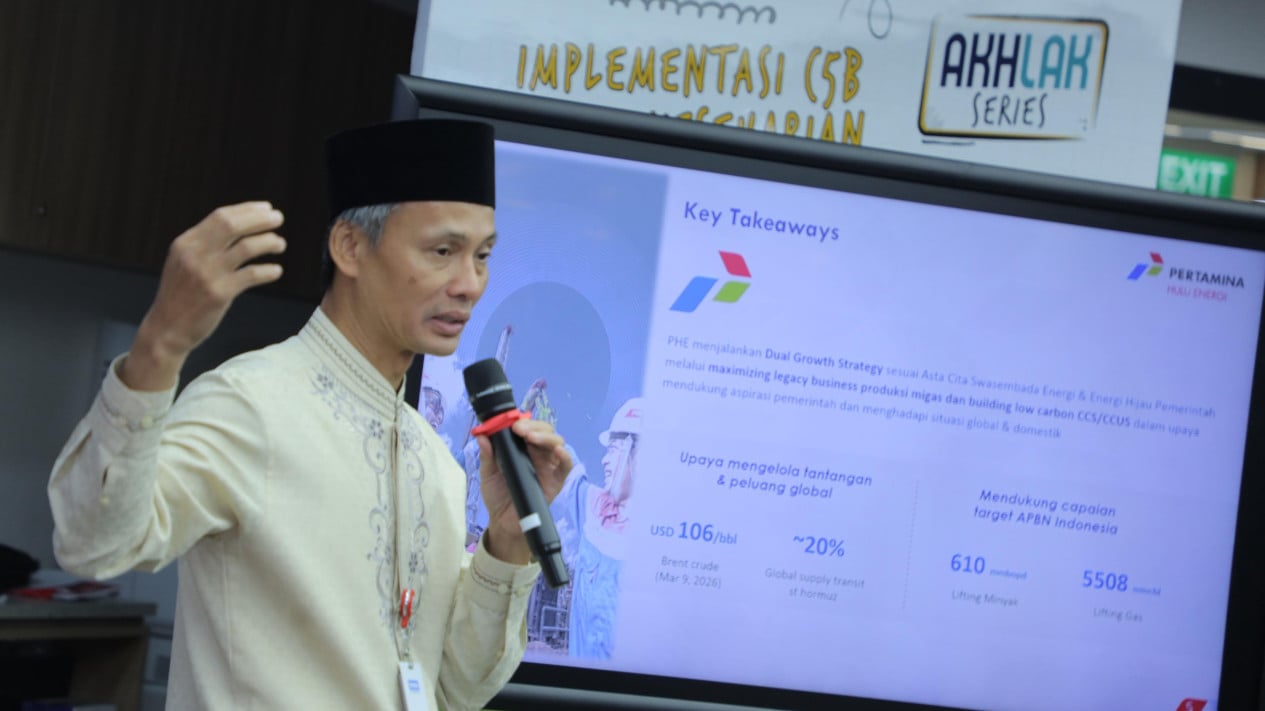
Pertamina Hulu Energi (PHE), the upstream subsidiary of Pertamina, has reaffirmed its commitment to continuing to boost national oil and gas production whilst developing low-carbon energy business amid global energy industry challenges.
Edi Karyanto, Director of Strategic Planning, Portfolio and Commercial at PHE, stated that PHE currently manages approximately 27 per cent of Indonesia’s oil and gas working areas and makes a significant contribution to national production.
“In 2025, PHE contributed approximately 65 per cent of domestic oil lifting, or around 396,000 barrels of oil per day (MBOPD), as well as 35 per cent of domestic gas lifting of 1.8 billion cubic feet per day (BCFD),” Karyanto said during the ‘Media Engagement Upstream Pertamina Subholding’ event at his office in the TB Simatupang area, South Jakarta, on Tuesday, 10 March 2026.
He stated that PHE continues to drive various strategic programmes to maintain the sustainability of national oil and gas production, amid challenges from geopolitical conditions and increasingly complex operational requirements.
“Strengthening exploration, optimising existing fields, developing and implementing production enhancement technology will be key factors in maintaining the sustainability of national oil and gas production, whilst also unlocking the potential of new resources in various oil and gas basins across Indonesia,” he said.
Throughout 2025, PHE’s oil and gas production reached approximately 1 million barrels of oil equivalent per day (MMBOEPD), comprising 557 MBOPD and 2.8 BCFD.
Beyond maintaining production performance, PHE also recorded several strategic achievements, including the discovery of resources totalling 1 billion barrels of oil equivalent (BBOE) as well as the implementation of various production enhancement technologies such as multistage fracturing, steam flooding, and chemical enhanced oil recovery (CEOR).
In 2026, PHE is preparing several programmes to manage natural decline, increase production and oil and gas resources nationally.
These programmes include drilling 16 exploration wells and 800 production wells, accompanied by 1,284 workover operations, 2D seismic surveys covering 904 kilometres (km), 3D seismic surveys covering 1,660 square kilometres (km²) and well intervention well service (WIWS) operations reaching 33,000 jobs.
“The strategy to increase production is also carried out through the development of existing fields (brownfield), development of new fields (greenfield), and the implementation of EOR technology to increase hydrocarbon recovery from already producing fields,” he said.