
Oh No, the Godzilla El Niño Is Really Coming to Indonesia—How Bad Will the Impact Be?
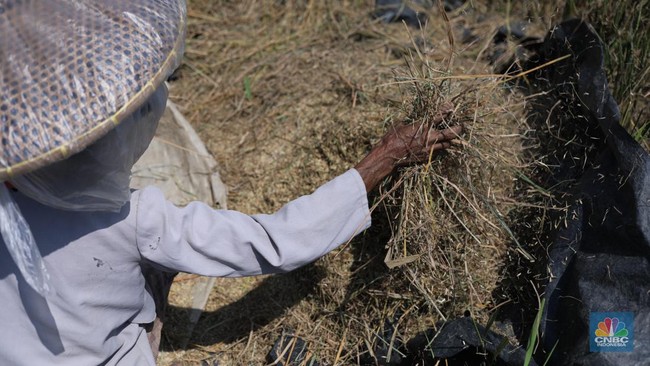
Jakarta, CNBC Indonesia - The National Research and Innovation Agency (BRIN) has released a prediction of extreme weather in the form of the Godzilla El Niño, which has the potential to strike Indonesia during the dry season in 2026. In response, agricultural observer Eliza Mardian from the Center of Reform on Economics (CORE) has urged vigilance against the impacts that could arise from this climate phenomenon, namely the potential rise in rice prices amid threats to domestic production. This is because, she continued, Indonesia’s agricultural structure remains highly vulnerable to climate change, particularly drought. “Our agricultural structure is still very dependent on rainfall, with many rain-fed paddy fields, and the irrigation system is not yet fully capable of anticipating large-scale droughts,” Eliza told CNBC Indonesia on Thursday (26/3/2026). This situation is exacerbated by the uneven adoption of technology and superior seeds at the farmer level. “The adoption of drought-resistant varieties and cultivation technology is also not widespread. Many of our farmers still use seeds released 20 years ago, compounded by the small scale of farming, as the majority of our farmers have land less than 0.5 hectares, making intensification difficult to implement quickly,” she said. In an extreme El Niño scenario, Eliza assesses there is potential for production declines, particularly due to shrinking planted areas. Historically, the El Niño phenomenon has indeed impacted national rice production, though within limited ranges. “El Niño does reduce Indonesia’s rice production by around 1%-3% nationally, and could reach 2%-5% in more extreme conditions,” she stated. However, Eliza also warns of much larger impacts that often occur at the regional level, as well as changes in production patterns. “These figures often mask much larger impacts at the regional level. In areas with water scarcity, production declines can be far deeper due to drought and crop failure. Moreover, the biggest impact of El Niño is not just on production volume, but on the disruption of the production calendar,” Eliza explained. She added that delays in planting periods could trigger temporary supply shortages in the market. “As a result, many farmers delay planting, causing harvests to be postponed and creating temporary supply gaps in the market. Like the 2023 El Niño, its effects were felt into 2024,” she said. This situation is seen as highly likely to drive up domestic rice prices. “This condition is very likely to push up rice prices. In Indonesia’s consumption structure, rice has highly inelastic demand, so even slight supply disruptions can immediately trigger price increases. Additionally, market expectations play a role, where traders tend to hold stocks when there is potential production disruption, amplifying price pressures,” she clarified. If not anticipated, the impacts could extend to food inflation and people’s purchasing power. “If this is not anticipated soon, it will directly affect food inflation and pressure people’s purchasing power, especially for low-income groups,” she concluded. Previously, BRIN predicted that Indonesia would face a strong intensity El Niño phenomenon, often dubbed ‘Godzilla’, this year. This condition has the potential to make the dry season longer and drier, especially in western and southern Indonesia. El Niño itself is a phenomenon of warming sea surface temperatures in the equatorial Pacific Ocean that impacts reduced rainfall in Indonesia. In its strong phase, this phenomenon is called ‘Godzilla’ because it can trigger significant climate anomalies. “El Niño is a phenomenon of warming sea surface temperatures in the equatorial Pacific Ocean. The El Niño phenomenon, including the potential strong variation ‘Godzilla’, causes the dry season in Indonesia to become longer and drier,” wrote Erma Yulihastin, researcher at BRIN’s Center for Climate and Atmospheric Research, quoted from the official Instagram post @brin_indonesia, Saturday (21/3/2026).