
Official! UK Announces Deployment of Fighter Jets and Warships to the Strait of Hormuz
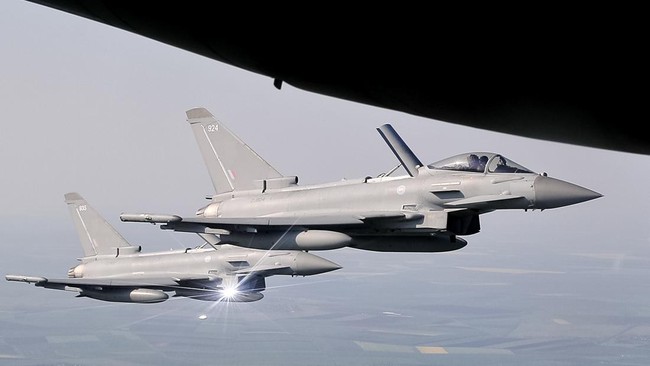
Jakarta, CNBC Indonesia - The United Kingdom has officially announced the deployment of drones, fighter jets, and warships to join a multinational mission to secure shipping lanes in the Strait of Hormuz, an area that has become one of the hottest spots in the Middle East conflict.
The announcement was made by UK Defence Secretary John Healey during a virtual meeting of defence ministers on Tuesday (12/5/2026). The move comes amid ongoing disruptions to global energy trade flows due to tensions between Iran, the United States (US), and Israel.
The UK government stated that its military contribution package includes autonomous systems for detecting and clearing sea mines, unmanned drone ships, and Typhoon fighter jets for air patrols.
More than 40 countries are said to be involved in the mission. Healey said the operation would begin when conditions allow.
“Together with our allies, this multinational mission will be defensive, independent, and credible,” Healey said in a statement, as reported by the BBC.
For months, Iran has controlled the Strait of Hormuz in retaliation for attacks by the US and Israel. On the other side, Washington has imposed a blockade on Iranian ports to pressure Tehran into accepting US demands.
The US action has provoked Iran’s anger and heightened tensions in the strategic sea route.
The Strait of Hormuz is one of the world’s busiest energy shipping lanes. Around 20% of global oil and liquefied natural gas supplies pass through the area. Disruptions to the route have triggered surges in global energy prices in recent months.
Although a ceasefire between the US and Iran has been in place since April, US President Donald Trump previously described the situation as being on “massive life support” or highly fragile.
Both sides have also accused each other of carrying out attacks in the strait area.
The UK Ministry of Defence stated that more than 1,000 British military personnel are currently deployed in the Middle East region as part of ongoing defence operations, including anti-drone teams and fighter jet squadrons.
According to the ministry, the international mission announced last month by the UK and France is “purely defensive” and aims to restore confidence in commercial shipping in the Strait of Hormuz.
The UK government has also allocated new funding of £115 million for procuring mine-hunting drones and anti-drone systems.
In the operation plan, the air defence destroyer HMS Dragon, currently heading to the Middle East, is said to be “ready for any mission” to secure the Strait of Hormuz.
The UK Ministry of Defence added that another military vessel, RFA Lyme Bay, is being upgraded with new equipment if needed for operations in the area.
This announcement of military force deployment comes amid domestic political pressure facing UK Prime Minister Keir Starmer.
Healey publicly expressed his support for Starmer after dozens of Labour Party MPs called for the prime minister to resign.
In a post on platform X, Healey said Starmer is leading the UK in facing “global conflicts and crises that loom large.”
“Further instability is not in Britain’s interests. Our full focus now must be on tackling the urgent economic and security challenges,” Healey wrote.
In Tuesday’s cabinet meeting, Starmer reportedly did not discuss calls for his resignation. The main focus of the discussion was instead on the impact of the Middle East conflict.
A Downing Street spokesperson said the ministers agreed that “the number one priority remains to reopen the Strait of Hormuz so that international shipping can resume.”
So far, Starmer’s position on the Iran-US conflict remains unchanged. He has emphasised that the UK will not be “dragged” into that war.
Starmer previously also stated that the UK does not support the US blockade of Iranian ports, even though that policy continues to be enforced by Washington to this day.