
Office Work Only 3 Days, BKN Head: Saves Fuel - Boosts Productivity
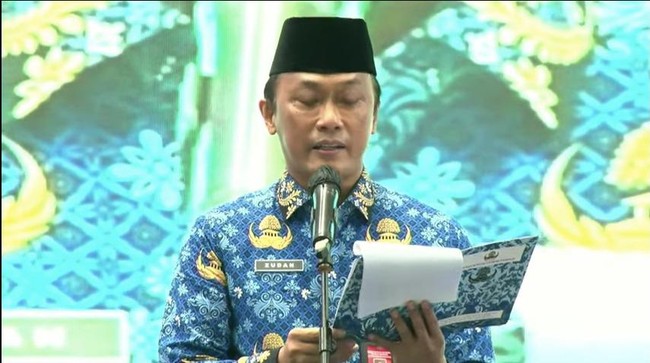
Jakarta, CNBC Indonesia - The Head of the National Civil Service Agency (BKN), Zudan Arif Fakrulloh, has revealed that the implementation of a policy requiring office work only three days a week at his institution has yielded numerous benefits and produced excellent work results.
He stated that the positive impacts of applying work from anywhere (WFA) for two days at BKN range from saving transportation costs such as fuel, working more effectively and efficiently, to increasing employee productivity.
“Friends no longer need to spend on transport, no need to buy petrol, no need to pay tolls for those two days, and also no time wasted on commuting to and from the office, so they can work more productively,” Zudan said on the BKN Instagram account, quoted Wednesday (25/3/2026).
Due to the substantial benefits of WFA at BKN, which is conducted on Mondays and Wednesdays, with office work only on Tuesdays, Thursdays, and Fridays, many institutions employing civil servants (ASN), including other civil servants, according to Zudan, want to adopt a similar policy.
“Many have asked me how BKN organises work from anywhere for two days a week or just three days in the office,” Zudan explained.
Nevertheless, he emphasised that at least three factors make WFA at BKN run effectively. First, the nature of BKN’s work, where 95% of tasks focus on serving civil servants (ASN).
Second, BKN has fully digitised services for civil servants over the past year, so the BKN service system is entirely digital-based, allowing it to be handled or served from anywhere.
The third factor, according to Zudan, is that BKN has implemented a daily E-Performance system, so all 3,400 BKN employees fill out the daily E-Performance every day.
“So we have prepared the tools so we can work from anywhere, clearly we work more efficiently, more effectively, and productivity increases,” Zudan said.
As is known, the government is currently formulating a work-from-home (WFH) policy for one day per week for several business sectors. There are specific criteria for business sectors that cannot implement WFH, including those directly involved in public services.
“This applies to civil servants (ASN) and as a recommendation for the private sector, especially those not related to public services,” said Coordinating Minister for the Economy, Airlangga Hartarto, some time ago.
The implementation of this WFH policy is planned after the 2026 Eid holidays. The technical details are currently being studied by the Ministry of Manpower and the Ministry of Home Affairs.
“It will be detailed, but after Eid we will implement it,” Airlangga asserted.
On another occasion, State Secretary Minister Prasetyo Hadi said this policy will also apply to certain business sectors that allow remote work.
“To avoid misunderstanding, for example, service, industrial, and trade sectors may not be part of this policy,” Prasetyo said at the Merdeka Palace, Jakarta, last Saturday.
This WFH policy is a directive from the President in the full cabinet meeting before the 2026 Eid as an effort to promote efficiency in the work environment, including reducing fuel needs amid escalating tensions in the Middle East war between Iran, the United States, and Israel.
“As conveyed by the President during the full cabinet plenary session that we are formulating several policies in order to realise that we all must together make ourselves more efficient in working,” Prasetyo said.
Nevertheless, he emphasised that this policy is not designed because fuel supplies in Indonesia are disrupted. “As we continue to convey, insya Allah, fuel supplies have no issues, fuel supplies are safe,” he stressed.