
Observer: Board of Peace Has Potential to Strengthen Global Peace Governance
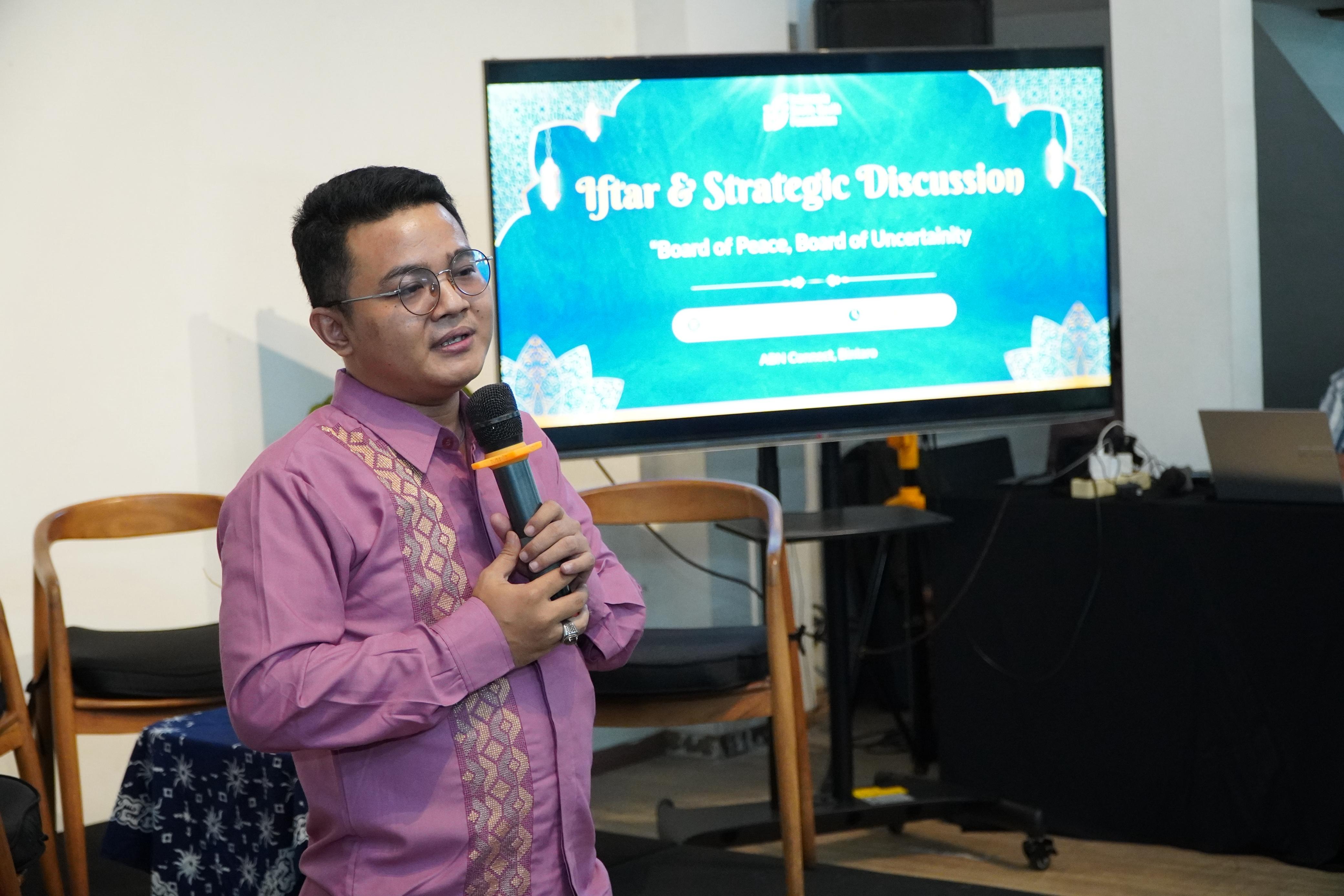
The emergence of the Board of Peace (BoP) has the potential to strengthen global peace governance amid increasingly complex international geopolitical dynamics. This view was expressed by Muhammad Makmun Rasyid, Leader of the Central Board of the Association of Nahdlatul Ulama Scholars, during a forum titled “Board of Peace, Board of Uncertainty” organised by Indonesia South-South Foundation (ISSF) in South Tangerang on Tuesday, 16 March.
Makmun emphasised that diplomacy with various parties, including those with differences or past conflicts, is a practice firmly grounded in Islamic tradition. “In Islamic tradition, for example, diplomacy with different parties, even those with whom there have been conflicts, is not unfamiliar. Prophet Muhammad once negotiated with the Quraysh in the Treaty of Hudaybiyyah, despite them being adversaries of Islam at that time. Islamic scholars subsequently explained that negotiation does not always mean agreement with the other party, but can be a strategy to achieve greater welfare. Islamic jurisprudence also asserts that the means follow the rule of the objective,” said Makmun.
He further assessed that Indonesia’s involvement in the Board of Peace initiative has broad strategic dimensions, both diplomatically and geopolitically. According to him, Indonesia’s position as the world’s largest Muslim-majority nation provides both moral and political legitimacy in promoting conflict resolution, particularly in the Middle East region.
Makmun also emphasised that Indonesia’s participation has the potential to strengthen its diplomatic position as an important actor in global peace efforts, whilst reinforcing Indonesia’s image as a democratic, moderate nation consistently promoting peaceful conflict resolution. Additionally, he believed that involvement within a framework like the Board of Peace opens opportunities for broader cooperation, not only in political aspects but also in humanitarian affairs, post-conflict reconstruction, and economic diplomacy. In this context, Indonesia’s role extends beyond Gaza-related issues to how to position itself within an evolving global order.
Nevertheless, Makmun acknowledged that the existence of the Board of Peace has not escaped various criticisms, including concerns about the potential domination by major powers and its relationship with existing multilateral mechanisms such as the United Nations (UN). Therefore, he believed that critical examination remains necessary to ensure this initiative operates inclusively and fairly. “In this context, Indonesia’s presence becomes important, as a representation of developing nations and the Muslim world to ensure that the peace process remains grounded in principles of justice and sovereignty,” he said.
He also expressed support for President Prabowo Subianto’s policy in responding to the Gaza conflict. “I support President Prabowo Subianto’s policy, which consistently promotes conflict resolution through a two-state solution approach, as stated in various international forums, including at the UN. This approach represents a realistic pathway to create two states living peacefully side by side, namely Israel and Palestine,” he said.
According to him, this approach aligns with the spirit of the Board of Peace as a new instrument in global peace diplomacy that emphasises dialogue, negotiation, and international cooperation.
Meanwhile, Khairy Fuady, Board of Advisor of Indonesia South-South Foundation (ISSF), stated that the forum was presented as an intellectual space to promote constructive discourse regarding various new initiatives in global peace governance. “We present this forum to understand the latest developments in global peace diplomacy. The emergence of the Board of Peace should be viewed as part of the collective effort of the international community in seeking new approaches to maintain global stability and peace,” he said.
The forum was part of efforts to enrich the examination of the Board of Peace’s role as a new instrument in international diplomacy and to encourage intellectual contributions from various quarters in strengthening global peace.