
Nusantara Five Satellite Secures Operating Licence, Ready to Reach 3T Regions
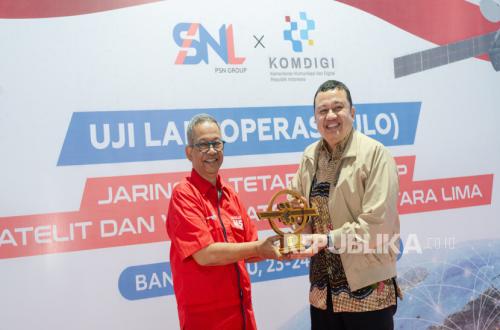
REPUBLIKA.CO.ID, JAKARTA — The Nusantara Five (N5) satellite has officially obtained the Closed Fixed Network Based on Satellite (JARTUPSAT) and Very Small Aperture Terminal (VSAT) permits from the Ministry of Communication and Digital after passing the Operational Fitness Test (ULO). This licensing paves the way for the commercial operation of the satellite to strengthen national connectivity capacity, especially in underdeveloped regions.
The operational fitness test was conducted at the Banjarbaru Gateway in South Kalimantan on 23–24 April 2026 by the telecommunications services team from the Ministry of Communication and Digital. The testing covered satellite network readiness, transmission system reliability, network security, and compliance with telecommunications service regulations.
With a capacity of up to 160 Gbps, the N5 Satellite is projected to add to the national bandwidth supply, which has long been a major challenge in equalising internet access in the Outermost, Remote, and Underdeveloped (3T) areas.
President Director of PT Pasifik Satelit Nusantara, Adi Rahman Adiwoso, stated that passing the ULO is a crucial stage before the satellite services are operated commercially for the public.
“We are ready to carry out the next major mission while supporting the realisation of the Asta Cita programme to accelerate the equalisation of connectivity and eliminate internet access gaps in the remotest parts of the Archipelago,” said Adi in a press release on Monday (11/5/2026).
The implementation of the ULO was also inspected by senior officials from the Ministry of Communication and Digital, including Director General of Digital Ecosystem Edwin Hidayat Abdullah. The government assesses that additional satellite capacity is necessary to accelerate connectivity equalisation while supporting targets for increasing national internet speeds.
“The government continues to push for the acceleration of connectivity equalisation across Indonesia. The passing of the N5 Satellite ULO proves that this infrastructure is technically ready to support the grand agenda of national digital transformation. We hope that the presence of this 160 Gbps capacity can be optimally utilised soon to strengthen public services in areas that have previously had limited digital access,” said Edwin.
Chairman of the Telecommunications Services Working Group, Falatehan, stated that all testing stages were carried out thoroughly to ensure the satellite system can be operated safely and in accordance with regulatory provisions.
“The examination process we conducted at the Banjarbaru Gateway covers various critical parameters, from transmission reliability to VSAT network security in accordance with standards and regulations. The results show that the N5 Satellite system has performance that is fit for commercial operation. This assurance of feasibility is very important to protect the rights of telecommunications service users in the future to receive quality and reliable services,” he explained.
The Nusantara Five Satellite is a Very High Throughput Satellite (VHTS) with 160 Gbps capacity using Ka-band spot beam technology, designed to expand high-speed internet services across Indonesia, including areas not yet reached by terrestrial networks. The operation of this satellite is expected to become one of the main pillars in strengthening the national digital infrastructure.