
Nurses beyond borders: The Philippine dilemma – wanted worldwide, needed at home
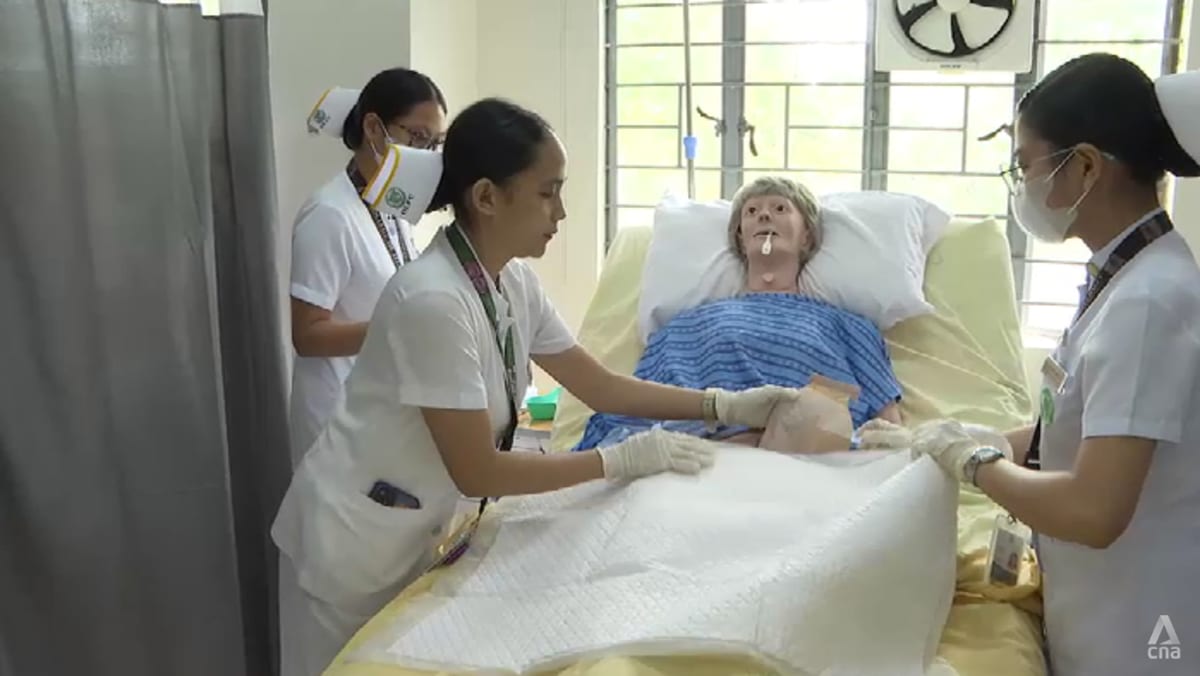
Nurses beyond borders: The Philippine dilemma – wanted worldwide, needed at home
Filipino nurses are highly trained and recruited overseas, but this exodus is straining hospitals at home. In the first of a four-part series, CNA looks at the global nursing shortage and how countries are holding on to their healthcare staff.
MANILA: For 18 years, nurse Ralph Ching has worked at the Dr Jose N Rodriguez Memorial Hospital and Sanitarium, a public facility in Caloocan City, Metro Manila.
But the 39-year-old will soon leave the Philippines, in search of a healthier work-life balance.
He applied for a job in the United States through an agency that specialises in recruiting nurses. It did not take him long to find one.
“They were hiring so fast. I was fortunate enough to find an employer willing to finance (my move). They financed everything – from review to registration, including the visa processing,” he told CNA.
Ching’s story is not unusual. Across the Philippines, both veterans like him and newly licensed nurses are weighing their options.
For many, the profession is still a noble calling – but it is also seen as a ticket to a better life abroad.
PAIN POINTS AT HOME
The pressures Filipino nurses face at home are well known: modest pay, long hours, heavy workloads and uncertain job stability.
Entry-level nurses in public hospitals earn around 40,000 pesos (US$700) a month, while overseas positions can offer several times that figure – a temptation that many say is hard to ignore.
In public hospitals, permanent government positions – known as plantilla posts and highly sought after – are limited and tied to budget allocations.
Hospitals often hire nurses on contract arrangements to fill immediate gaps. These roles may provide an income, but do not always come with the same long-term security or benefits as plantilla posts.
Last year, Ralph Garcia, 24, passed the Philippine Nurse Licensure Examination, the national nursing board exam, and is well aware of the profession’s demands.
He is not planning to build his career at home.
“The quality of life that I could have abroad is going to be better than staying here in the Philippines,” he said.
Educators said this mindset is common among nursing students.
“Times have changed. When I interview students, ‘What is your primary motivation? Why do you want to take up nursing?’
“They usually say they want to help their family, and helping their family means they have to leave the country,” said John Lorena, dean of St Luke’s College of Nursing at Trinity University of Asia in Quezon City.
“I cannot do anything about it because that’s the sad reality.”
Global nursing shortage
A global health challenge is intensifying.
Demand for nurses – the backbone of healthcare systems – is growing. While headline figures show supply is also expanding, a deeper look reveals widening gaps, uneven distribution and mounting pressure on poorer regions.
Nurses make up roughly more than 40 per cent of the global health workforce, according to numbers from the World Health Organization (WHO).
Any shortage doesn’t just affect hospitals – it weakens entire healthcare systems, from primary care clinics to emergency response networks.
The numbers: growth on paper
According to the State of the World’s Nursing 2025 report by the WHO and International Council of Nurses (ICN):
In 2023, there were about 29.8 million nurses worldwide.
By 2030, that number is projected to rise to 35.9 million.
At first glance, this appears to signal progress.
But by 2030, those nurses will need to serve a projected global population of 8.5 billion people, stretching systems that are already under pressure.
Not all regions are affected equally.
The African and Eastern Mediterranean regions are expected to face the most severe shortages in the coming years. These are also regions with some of the greatest healthcare needs.
On the move
Migration is now central to global healthcare staffing. According to the WHO and ICN report, about one in seven nurses works outside the country of their birth.
This reflects how heavily many healthcare systems depend on migrant labour. But the challenge is not simply about overall supply – it is about distribution.
About 78% of the world’s nurses are concentrated in countries that account for less than half of the global population.
Across much of Asia, the outflow of nurses to wealthier economies is straining local healthcare systems.
A GLOBAL EXPORT
The Philippines has supplied nurses to the world for decades.
Today, about 300,000 to 350,000 Filipino nurses are working overseas, according to the Department of Health, but the country is short of about 160,000 nurses.
Health Secretary Teodoro Herbosa says the country did not arrive at this point overnight.
Large numbers began going to the US in the 1960s, particularly after changes in US immigration laws increased demand for foreign-trained healthcare workers.
In the decades that followed, recruitment expanded to the Middle East, Singapore and other English-speaking countries, Herbosa noted.
Today, demand has widened. “Even non-English speaking countries want our nurses,” he said.
Herbosa attributes that demand to the Philippines’ decades-old nursing education system, taught in English and shaped by American healthcare standards – a combination that makes Filipino nurses readily deployable overseas.
“Our nurses are globally accepted, and it seems that most countries that are developing health systems try to hire Filipino nurses … I now consider it not a problem, but our soft power,” he added.
That global demand has translated into significant economic flows for the country.
In 2024, Filipinos abroad sent home a record US$38.34 billion in personal remittances, according to central bank data.
There is no official breakdown for healthcare workers, but groups such as Filipino Nurses United estimate that nurses contribute around US$8 billion annually.
THE COST AT HOME
While remittances strengthen the economy, the outflow o