
Numerous 'Zombie' Ships Emerging in the Strait of Hormuz, What's Happening?
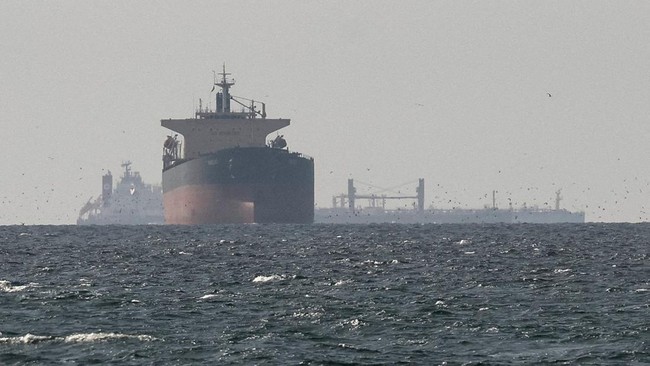
Jakarta, CNBC Indonesia - The Strait of Hormuz remains closed by Iran to this day. The impact of this closure has threatened the global distribution of oil. Only a few countries’ oil tankers are permitted to pass through the Strait of Hormuz. Those countries are China, India, and Japan.
Iran is reported to have allowed large quantities of crude oil tankers to China via the Strait of Hormuz. This high-risk move continues amid the raging war between the United States (US)-Israel and Iran, which has crippled energy supplies along this global shipping route.
Based on data from TankerTrackers, Iran has sent at least 11.7 million barrels of crude oil through the Strait of Hormuz since the war broke out on 28 February 2026. All of this black gold cargo is known to have one main destination: China.
TankerTrackers co-founder Samir Madani revealed that TankerTrackers continues to monitor ship movements using satellite imagery. This technology enables the detection of ships attempting to ‘go dark’ by turning off their tracking systems after threats from Tehran.
“Many ships have ‘gone dark’ after Tehran threatened to attack any vessel attempting to pass through that waterway,” Madani told CNBC International, as quoted on Tuesday (24/3/2026).
In line with these findings, shipping intelligence provider Kpler estimates that around 12 million barrels of crude oil have passed through the strait since the war began. Although identifying the final destination has become increasingly difficult, China remains the primary suspect recipient of these supplies.
“Given that China has been Iran’s main crude oil buyer in recent years, the majority of these barrels are likely headed there in the end,” said Kpler crude oil analyst Nhway Khin Soe.
In addition to China, India is also mentioned as a country now free to pass through the Strait of Hormuz. Iran’s Ambassador to India, Mohammad Fathali, has indicated that Indian ships can expect safe passage through the Strait of Hormuz amid the ongoing Middle East conflict.
Quoting the Russian RT website, Fathali said Tehran views New Delhi as a friend and important partner. He emphasised that there are interconnected interests between the two countries.
“Yes, because India is our friend. You will see it in two or three hours,” he said.
The Iranian ambassador’s statement was also made a few hours after high-level officials from both countries held a telephone conversation. Indian Prime Minister Narendra Modi spoke with Iranian President Masoud Pezeshkian last Thursday and expressed concern over the “escalating tensions, loss of civilian lives, and damage to civilian infrastructure”.
In a separate conversation, Indian Foreign Minister S. Jaishankar spoke with Iranian Foreign Minister Abbas Araghchi. During the discussion, Tehran outlined its position following the US-Israel attacks and requested support from BRICS countries, while India emphasised cooperation and regional stability.
In addition to China and India, Iran is also prepared to allow Japanese-related ships to cross the Strait of Hormuz. Iranian Foreign Minister Abbas Araghchi revealed that discussions on this policy have begun between the two countries.
This was stated in a transcript of Araghchi’s interview with Kyodo News, uploaded via his Telegram account last Saturday. He said the issue had also been discussed in a telephone conversation with Japanese Foreign Minister Toshimitsu Motegi last Tuesday.
Speaking on a television programme on Sunday, Motegi was reluctant to detail the content of the talks. However, he stated that the discussions focused on the importance of maintaining smooth trade.
“I emphasised that the safety of these ships is very important from Japan’s perspective, because so many ships are involved, we believe it is crucial to create a situation where all those ships can pass through,” Motegi said, quoted from the Japan Times on Monday (23/3/2026).
Emergence of ‘zombie’ ships
Amid the limited ships passing through the Strait of Hormuz, several ‘zombie’ ships are troubling maritime traffic in the Strait of Hormuz. A ship suspected of using the false identity ‘Nabiin’ was detected passing through the Persian Gulf and Gulf of Oman on Sunday (22/3/2026) and Monday (23/3/2026).
Bloomberg reported that the real Nabiin ship was scrapped in Bangladesh five years ago, implying that the ship appearing now is an illegal entity operating under the identity of a legitimate ship that has been decommissioned. This incident reflects systematic efforts to avoid surveillance and sanctions amid geopolitical tensions.
The emergence of this ‘zombie’ ship is not the first, following the previous monitoring of the Jamal ship operating in a similar manner after being documented at a scrapping site in India last year.
This modus operandi, which often involves falsifying identities and disabling geolocation signals, poses major challenges for maritime authorities in enforcing regulations and security in international waters.
Severe electronic disruptions to ship transmission signals add complexity to tracking, allowing these ships to transport cargo—likely crude oil—without clear destinations or adequate oversight.
The activity of these ‘zombie’ ships is highly linked to efforts by ship owners to send cargo through the effectively closed Strait of Hormuz following the US-Israel attacks on Iran.