
Number of Indonesian Air Passengers Forecast to Drop by This Much Due to Rising Ticket Prices
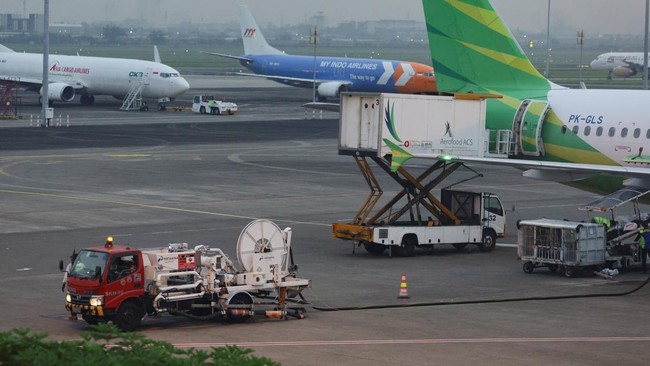
The government has opened the door for airlines to increase domestic ticket prices by 13-15% amid mounting operational cost pressures. This policy comes as jet fuel prices surge due to global geopolitical dynamics, especially conflicts in the Middle East. The government recognises that the aviation industry is currently under significant strain.
“The Directorate General of Civil Aviation of the Ministry of Transportation understands the dynamics faced by the national aviation industry as a result of global geopolitical developments that affect the rise in jet fuel prices, exchange rate fluctuations, and airline operational costs,” said Director General of Civil Aviation Lukman F. Laisa, quoted on Monday (13/4/2026).
On the other hand, the government emphasises that the policy taken is not solely in favour of business players but also considers the interests of the public as users of air transportation services.
“We emphasise that every policy taken will prioritise a balance between the sustainability of the aviation industry and consumer protection, so that air transport services remain maintained in terms of safety, security, affordability, and national connectivity,” Lukman stated.
With this policy, domestic flight ticket prices are allowed to rise in the range of 9% to 13%. However, this tariff increase is expected to directly impact passenger demand in the near term. This is because the public’s purchasing power has not fully recovered, which will exacerbate the impact of the ticket price rise.
“With a 9-13% increase, the passenger projection will certainly be pressured by 10-15%, especially given the current uncertain economic conditions,” said Transportation Observer from the Indonesian Transportation Society (MTI), Revy Petragradia.
The jet fuel price increase has become the dominant factor driving up flight ticket prices. Its contribution even reaches around 40% in the cost structure, with prices jumping from Rp13,656 to Rp23,551 per litre.
The government itself has tried to mitigate this pressure by eliminating several cost components, including the admin fee for online ticket bookings. However, this step is considered not significant enough to hold back the overall price increase.
“The admin fee might have a slight impact, but it’s not significant. Airlines will more heavily adjust their base fare (basic price),” Revy said.
To curb further impacts, the government is rolling out several incentives for airlines. These include setting fuel surcharges up to 38%, government-borne VAT of 11%, and the elimination of import duties on aircraft spare parts to zero percent.
These steps are deemed appropriate because they target the main components forming ticket tariffs, from fuel surcharges and base ticket prices to taxes and operational costs such as airport tax. Nevertheless, future challenges are seen as not easy. Airlines are required to maintain efficiency while adapting to uncertain market conditions.
“It’s not just about selling tickets, but also combining them with hotel and tourism services in travel packages to make them more attractive and effective,” he concluded.