
NTB Provincial Government's Strategies to Achieve Rp64 Trillion Investment Target Amid Geopolitical Conflicts
The West Nusa Tenggara (NTB) provincial government is targeting investment realisation of Rp64 trillion in 2026, an increase of Rp2.9 trillion from the 2025 realisation of Rp61.10 trillion.
Investment realisation in NTB in 2025 is still dominated by the mining sector, followed by tourism and the creative economy. Based on location, the largest investment was realised in West Sumbawa Regency, a mining area, reaching Rp46 trillion, followed by Central Lombok Regency and Mataram City.
Head of the One-Stop Integrated Investment and Licensing Service Agency (DPMPTSP) Irnadi Kusuma explained that the investment target is quite high and must be realised through the right strategies.
One of the NTB provincial government’s strategies is to actively promote investment through various channels, including investment exhibitions, national and international investment forums, and cross-sector collaborations such as with the Tourism Office and Bank Indonesia.
“Together with the Tourism Office, we are forming a joint promotion platform because the tourism sector cannot grow without investment. In addition, we are utilising many national investment forums,” Irnadi told Bisnis on Sunday (5/4/2026).
The NTB provincial government is also targeting new countries as sources of Foreign Direct Investment (FDI) such as countries in the European region, Oceania, East Asia, and several Southeast Asian countries.
This differs from previously, when the NTB provincial government targeted many Middle Eastern countries as sources of foreign investment or FDI.
According to Irnadi, the Middle East war between Iran vs. US-Israel has forced them to seek new FDI investors from countries outside the Middle East.
To facilitate investors, the NTB provincial government has prepared an investment profile in one document called Investment Project Ready to Offer (IPRO). The document covers seven flagship sectors of NTB, including locations that are already clear and ready.
Irnadi acknowledged that limited promotion budget due to investment is a challenge for direct investment promotion abroad or participating in many forums.
“Due to budget limitations, we are also utilising digital channels,” said Irnadi.
BI Supports Investment Entry into NTB
Meanwhile, Head of Bank Indonesia NTB Province Representative Hario K. Pamungkas explained that BI is actively encouraging investment inflows through the Regional Investment Relation Unit (RIRU), a functional institution that promotes investment projects in NTB and supports national priority sectors in a targeted manner based on market intelligence.
One effort to be carried out in 2026 is to carry out synergy and collaboration with local governments through the Sasambo Investment Challenge, a curation, mentoring, and promotion platform for regional investment projects. The series of Sasambo Investment Challenge activities includes capacity building, incubation, and summit in collaboration with related Regional Work Units (OPD).
“The aim of this activity is to capture and improve the quality of potential investment projects originating from local governments, regional-owned enterprises (BUMD), or other project owners so that they are ready to be offered to national or global investors. In addition, the BI NTB Province Representative Office periodically publishes various potential investment projects in NTB through a presentation book accessible via the Sasambo website,” Hario told Bisnis.
Hario explained that priority investment sectors based on market intelligence include the new renewable energy (EBT) sector. EBT projects in NTB Province, for example, include Solar Power Plant (PLTS) located in Central Lombok Regency and East Lombok Regency, Micro Hydro Power Plant (PLTMH) located in Central Lombok Regency, and Waste-to-Energy Power Plant (PLTSa) located in Kebun Kongok, West Lombok.
Then, the industrialisation and downstreaming sector, the development of industrialisation and downstreaming in NTB Province is directed to increase the added value of leading regional commodities, both in the mining sector and the agricultural sector.
Bank Indonesia also offers investments in strategic infrastructure sectors which include the Mandalika Bypass Road project, Gili Mas Port managed by PT Pelindo, and other strategic infrastructure projects.
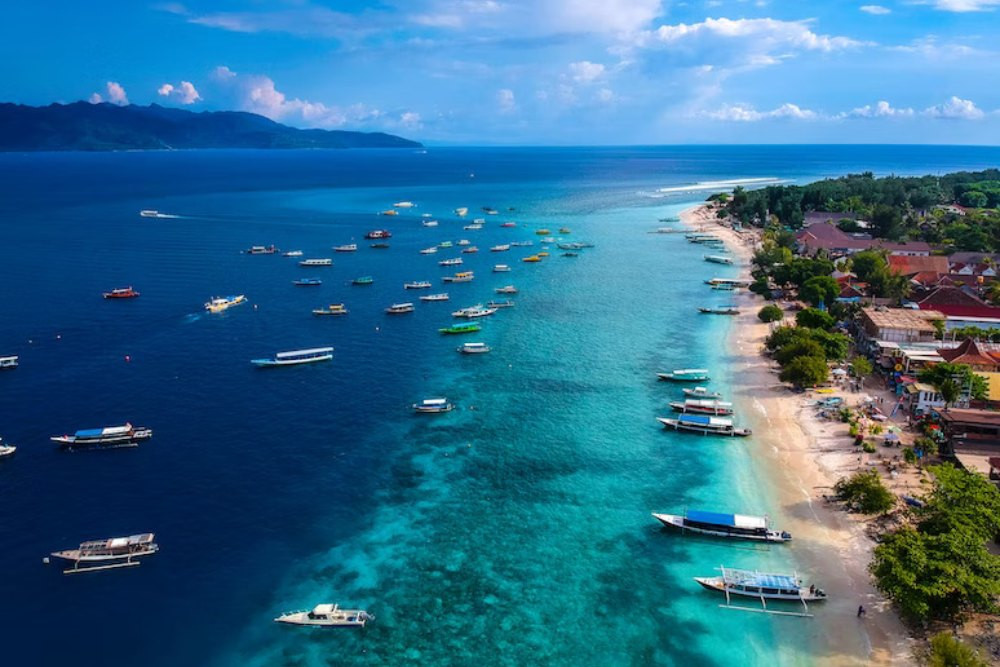
NTB also has main tourism objects such as the Mandalika Special Economic Zone (KEK) (including the circuit), Gili Trawangan, Meno, Air (Gili Tramena), Whale Shark Tourism, Mount Rinjani which each have their own attractions. One of them is directed through quality tourism.
According to Hario, so far the sectors most sought after by investors in West Nusa Tenggara Province include renewable energy, tourism, and processing industries based on local resources.
Interest in the renewable energy sector continues to increase, in line with the energy transition commitment and NTB’s great potential, especially in the development of PLTS and waste-based energy projects (waste-to-energy)/Waste-to-Energy Power Plant (PLTSa).
“In this context, the PLTSa Kebun Kongok project in West Lombok has attracted interest from investors from several countries such as Singapore, Turkey, and the Netherlands,” said Hario.
In the tourism sector, investment is still concentrated on developing flagship destinations and strategic tourism areas, including developing access, facilities, and supporting attractions directed towards sustainable and quality tourism.
The downstreaming and processing sector of fisheries products and leading regional commodities is also starting to show increasing interest (vannamei shrimp, tuna, and seaweed) in line with efforts to encourage added value and regional exports.
Economist from Mataram University Firmansyah explained that to attract more investor interest, the government must prepare incentives and policy instruments that facilitate investors.
“The government needs to prepare policy instruments that comprehensively facilitate investment. Then map investment areas along with incentives for investors,” said Firmansyah.