
NTB Provincial Government Offers Collaboration via Bank NTBs Programme with IRIJ on PMI Issues
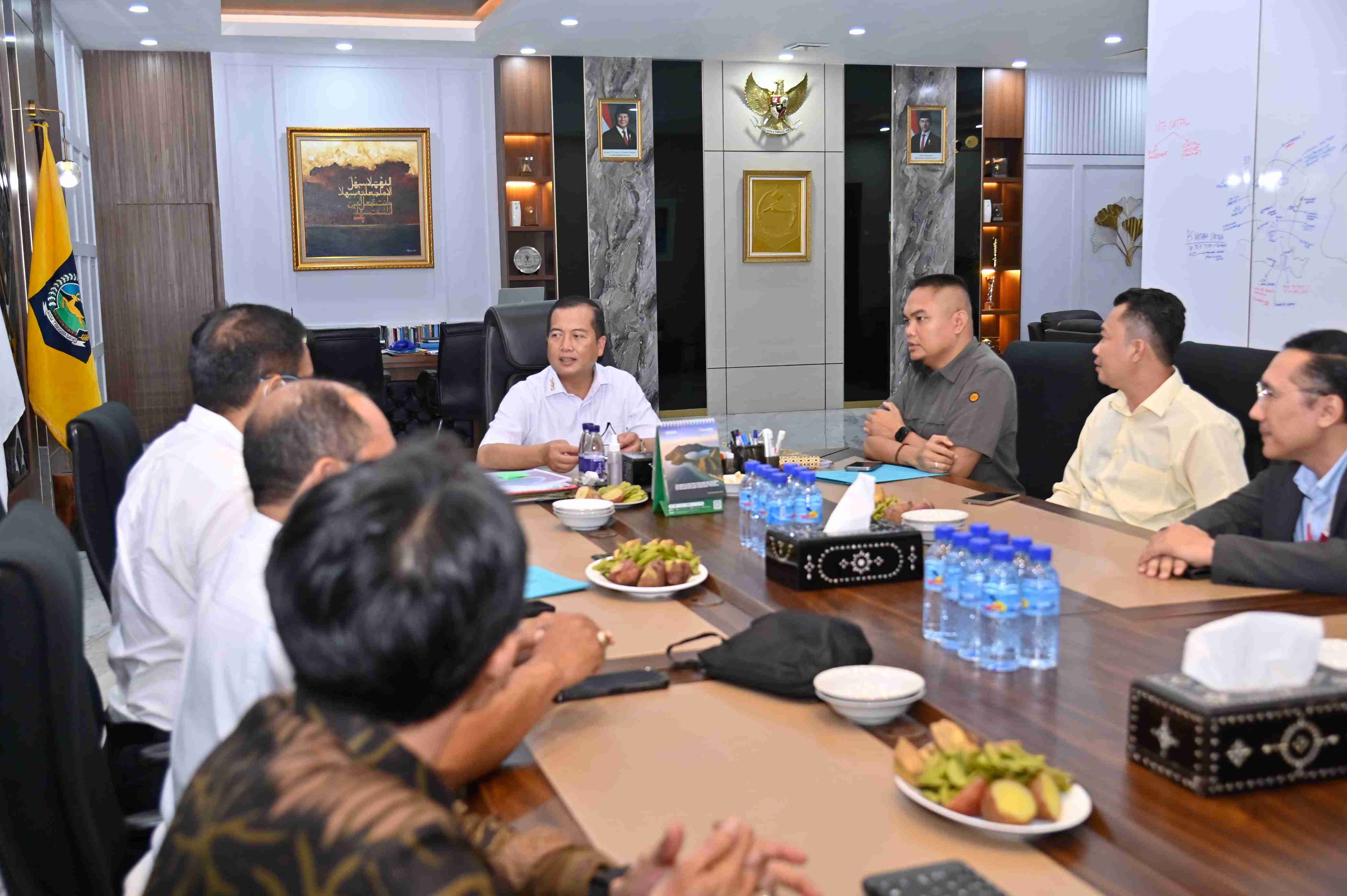
Mataram - 15 April 2026 — The Governor of West Nusa Tenggara received an audience from the Indonesia Research Institute Japan (IRIJ) regarding the readiness of NTB’s workforce through job skills training, language skills, and Japanese business partners for NTB, as well as collaboration with schools/vocational training institutions (LPK). This took place in his office on Wednesday (15/4/2026).
During the meeting, the Governor, familiarly known as Miq Iqbal, stated that the approach to PMI is through international obligations, including protection, welfare, and others.
“We in NTB now approach it through international obligations, which actually provide protection to civilians, not just workers, but also to families, both pre-placement, during placement, and after placement,” he explained.
Additionally, he explained that regarding the job training scheme in NTB with financing through Bank NTB Syariah, it applies division at the vocational high school (SMK) level prepared for the workforce, and high school (SMA) students are directed towards university or work.
“We design the programme together with Bank NTB Syariah; the approach is zero cost for going abroad through upfront financing payments; the recruiting company will reimburse Bank NTBs, and in the near future with Malaysia, it will start to be implemented,” he continued.
Bank NTB Syariah provides a special financing model for Prospective Indonesian Migrant Workers (CPMI) through an integrated People’s Business Credit (KUR) scheme with sharia principles.
“The model is that workers working in Malaysia will create one account, which can be accessed in the work area and in the home area through Bank NTB Syariah, so that after going through this procedure, upon returning to the home area, the workers already have capital and through the special Bank NTBs programme for PMI (Indonesian Migrant Workers), workers can choose business investments available in NTB.”
Regarding PMI to Japan and Korea, the NTB Governor hopes to implement this scheme, with inter-bank collaboration, so that workers receive protection and ease.
“This scheme can be developed for Korea or Japan. Collaboration between banks there with our NTB Syariah,” he clarified.
In NTB, IRIJ will open collaboration through research, business, and education/training that will collaborate with Japan. This aligns with the institution’s goal of supporting Japan and Indonesia to grow together.
This was explained by Dr. Dendi Muhamad, Ph.D., who serves as Vice President and Chief Research Officer (CRO) in Tokyo.
“Our institution was established in 2011 in Tokyo; for the last three years, we have been trusted as the institution representing Tokyo for Indonesia. We indeed operate in the research field because every Japanese company/institution that wants to go to Indonesia certainly has research. Then it developed with more company establishments, partner searches, workforce, and so on,” he explained.
He added that in 2018 and 2019, many companies that became IRIJ partners requested workforce.
“Many companies go bankrupt not because of lack of money, but because of workforce issues; many companies ask us to prepare workforce,” he added.
IRIJ is managing ten schools (Vocational Training Institutions - LPK) and is involved in developing teacher needs by building relations with various universities, related to language skills training and workforce readiness in Indonesia.
“We have represented the Tokyo government for three years, trusted as the research institution representative in Indonesia. Now, it has reached 300 people from 2021 to 2022 who were sent as workforce to Japan through skills and Japanese language training,” he said.
IRIJ has collaborations with several universities in Bandung, both through selection for engineering and Japanese language training to obtain job opportunities in construction companies in Japan.
“In NTB, we request support for collaboration in designating institutions that will conduct language training, skills, and building business partners with companies in Japan in various fields,” he concluded.