
NTB Journalists Storm Governor's Office, Demand End to Censorship and Violence
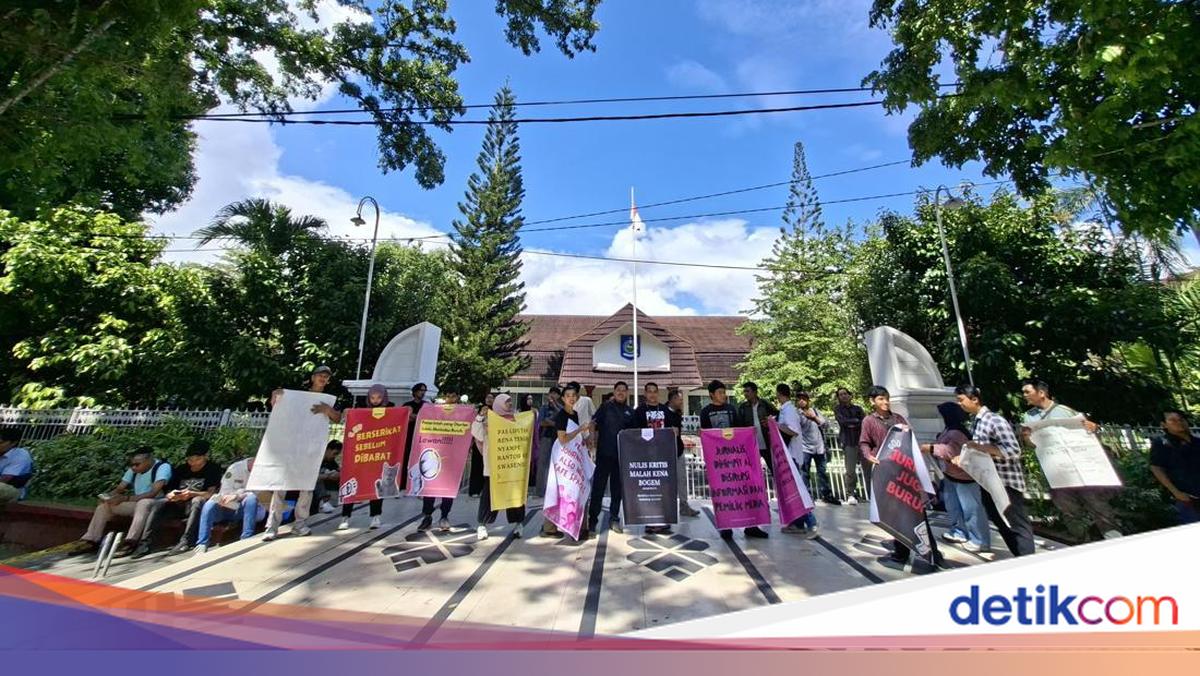
A crowd of journalists from various press organisations and media companies held a demonstration in front of the Nusa Tenggara Barat (NTB) Governor’s Office in Mataram City on Tuesday (5/5/2026). They highlighted the increasing violence against journalists, censorship practices, and welfare issues that are deemed to be worsening.
This solidarity action included an open forum, poetry readings, and the setting up of a reading stall to commemorate World Press Freedom Day, which falls on 3 May each year.
The action involved AJI Mataram, PWI NTB, AMSI NTB, IJTI NTB, KKJ NTB, SPLM NTB, FJPI NTB, JMSI NTB, Yayasan Santai, Walhi, PKBI NTB, Simpul Hub NGO Indonesia Timur, Teman Baca, Forwaprov NTB, Forwakot Mataram, Persma Mataram, and the NTB Anti-Sexual Violence Coalition.
The General Coordinator of the action, who is also the Chair of AMSI NTB, Hans Bahanan, stated that this action serves as a reminder that threats to journalists have not subsided.
“We raise three main issues so that all parties understand that press freedom must be upheld. If not voiced, incidents of violence will continue to occur. Even though it is voiced every year, in reality, violence against the press is increasing, as is the wave of layoffs (PHK),” said Hans Bahanan.
Declining Index, Increasing Pressure
The Chair of AJI Mataram and the on-site action coordinator, Wahyu Widiyantoro, stated that the state of press freedom in Indonesia continues to deteriorate. Violence against journalists, he said, occurs in various forms, from physical to digital.
AJI Indonesia recorded 91 cases of violence against journalists throughout 2025. Meanwhile, the Reporters Without Borders (RSF) report places Indonesia at rank 129 out of 180 countries in 2026, down from position 127 in 2025, in the ‘difficult’ category.
In addition, censorship and self-censorship practices are said to be strengthening again.
“Many journalists and editorial teams are forced to self-censor by limiting themselves, avoiding sensitive issues, or altering the substance of coverage due to considerations of political pressure, legal threats, or economic interests,” he said.
Pressure also comes in the form of requests to delete news, change content, and threats to terminate cooperation or advertising.
Violence and Welfare Highlighted
The Chair of PWI NTB, Ahmad Ikliluddin, highlighted a case of violence against journalists in Central Lombok that has not yet been resolved.
“We hope that case is resolved soon to serve as a benchmark for facing similar cases in the future. In addition, non-physical threats such as doxing and attacks on critical media also pose real potential threats,” explained Ikliluddin.
The Chair of the NTB Journalist Safety Committee (KKJ), Haris Mahtul, recorded five cases of violence against journalists throughout 2025. He emphasised that threats now also extend to the digital space.
Haris also highlighted the importance of journalist welfare, including wages and allowances, so they can work optimally amid high risks.
“There is still much homework on welfare and human rights violations. The press in Indonesia, especially in NTB, must remain united. We show the public that the press remains consistent in defending the interests of society,” he stressed.
Demand to End Impunity and Censorship
In their statement of position, NTB journalists and press freedom activists urged the state to guarantee the safety of journalists and to resolve every case of violence transparently and independently.
They also demanded an end to impunity and censorship practices.
“Stop censorship practices. The government and business institutions must understand that an independent press is the fourth pillar of democracy. Feel free to place advertisements or cooperate with media, but do not censor news,” stressed Haris.
In addition, they called for an end to self-censorship in editorial rooms and the criminalisation of journalists.
“Stop the criminalisation of journalists and lawsuits to silence media or SLAPP (Strategic Lawsuit Against Public Participation). Submit press disputes to the Press Council and strengthen journalist and media solidarity. Attacks on one journalist/media are attacks on the entire profession or press,” concluded Haris.