
Note This: The Reason Indonesia Joined the BoP
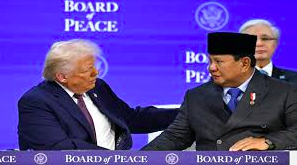
President Prabowo Subianto has explained the reasons why Indonesia and other Muslim-majority countries have joined the Board of Peace (BoP). During a discussion with several experts and senior journalists in Hambalang, Bogor, West Java—the video recording of which aired on Thursday (19/3)—Prabowo stated that Indonesia’s decision to join the BoP was made after careful consideration, with the aim of supporting full Palestinian independence. In that instance, Prabowo explained that Indonesia’s involvement in the formation of the BoP began on 23 September, when he delivered a speech at the UN General Assembly. At that time, Prabowo affirmed support for Palestinian independence while promoting a two-state solution. A few hours later, he continued, Prabowo, along with seven leaders of Muslim-majority countries in the Group of Eight—such as Saudi Arabia, the United Arab Emirates, Jordan, Turkey, Pakistan, Qatar, and Egypt—was invited by US President Donald Trump to a meeting. In that meeting, Trump reportedly asked those countries to support the 21-point plan, a proposal to create sustainable peace in Gaza. According to Prabowo, the details of those points were read out one by one by the US special envoy Steve Witkoff. Prabowo then listened carefully to the proposal and was interested in points 19 and 20, which explain that Palestine will be given a path to become an independent nation capable of determining its own future. Additionally, there is a point that the US will facilitate dialogue between Israel and Palestine so they can live side by side peacefully. The content of the proposal was deemed aligned with Indonesia’s view on the Palestinian issue, that long-term peace can be achieved through a two-state solution. ‘So, we see that these (points) 19 and 20 offer an opportunity (for Palestinian independence) even though we know it’s limited. Finally, we eight (Muslim-majority country leaders) discussed, do we support this or not? Finally, in the lobbying, we said we support it,’ said Prabowo. Subsequently, the leaders appointed Qatar’s Emir Tamim bin Hamad Al Thani as their spokesperson to convey to Trump that those countries support the plan’s points. ‘We like your plan. But the problem is not us. The problem is Israeli Prime Minister Netanyahu,’ said Prabowo, recalling the moment. A short while after that meeting, according to him, the idea emerged to form the BoP, which was simultaneously adopted in UN Security Council Resolution 2803. In response to this development, the eight Muslim-majority countries, later referred to as the Group of Eight, held further deliberations on whether to join it or not. Based on the deliberation results, they assessed that joining the BoP would provide greater space to influence policy directions in favour of Palestinian interests. This, said Prabowo, is far more realistic and concrete in advocating for Palestinian independence than choosing not to join the BoP. ‘If we’re inside, we might be able to influence and help the Palestinian people,’ said the President. ‘If outside (the BoP), we can’t (advocate for Palestine). So finally, we decided to join,’ he added. Nevertheless, the Head of State said Indonesia would not hesitate to withdraw from the BoP if its decisions do not align with Indonesia’s or Palestine’s interests. In fact, according to him, Indonesia could exit the council without needing to consult other Group of Eight members first. ‘As long as we’re in the BoP and can help the Palestinian struggle, we’ll try. Once we conclude there’s no hope and it’s counterproductive, we assess it’s a waste of time, energy, and not beneficial to Indonesia’s national interests, we’ll leave,’ he added. Prabowo hopes that Indonesia and the other Group of Eight members can contribute positively to long-term peace in Palestine. ‘So, I’m carrying out the Indonesian nation’s longstanding struggle. We have always defended Palestinian independence,’ said the President.