
Not Vulnerable: The Facts Show Indonesia's SMEs Are Strong
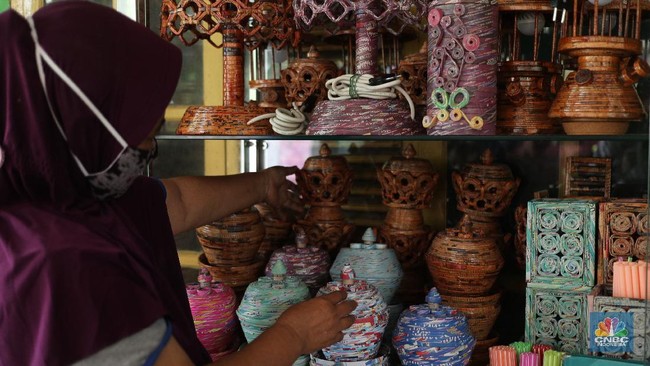
Jakarta, CNBC Indonesia - The role of Micro, Small, and Medium Enterprises (UMKM) is vital in driving the economy, particularly amid current global challenges. Considering the significant contribution of UMKM in maintaining the economy and creating jobs.
The substantial role of UMKM has led the government to continuously strengthen its commitment to promoting equitable and resilient national economy through bolstering UMKM and the people’s economy. On the other hand, UMKM have proven resilient in facing upheavals since the 1998 and 2008 crises.
“Our UMKM have little connection to exports and imports. Their market is domestic, and raw materials are largely sourced from within the country. Thus, it is no surprise that during the 1997-1998 global crisis, UMKM could still survive even though many also went bankrupt,” stated Nailul Huda, Director of the Digital Economy at the Center of Economics and Law Studies (Celios), to CNBC Indonesia on Friday (17/4/2026).
Nailul even explained that in many cases, UMKM serve as a “lifeline” for those laid off (PHK) from large industries. Many of them engage in trading to meet their needs.
“Up to now, more than 55% of Indonesia’s economy is generated from UMKM. Many workers are also absorbed by UMKM,” he clarified.
A similar view was expressed by Piter Abdullah, Policy and Program Director at Prasasti Center for Policy Studies. He assessed that the role of UMKM, particularly micro and small enterprises (UMK), is very significant to Indonesia’s economy, especially in absorbing labour.
“Micro and small enterprises or UMK are said to be tough and crisis-resistant because there are almost no barriers to entry, so new UMK always emerge even in the midst of a crisis,” said Piter.
Individually, according to Piter, UMK tend to be vulnerable or not tough and experience bankruptcy at any time. However, at the same time, new UMK emerge to replace those that fail.
“Therefore, in aggregate, UMK appear unaffected. This is why UMK are called crisis-resistant,” he emphasised.
Based on this, the ability of UMKM to continuously adapt to economic conditions makes them the most resilient business segment in the country. It is known that UMKM still have a strategic role in driving national economic growth. With their distribution in remote areas, rural regions, and urban peripheries, UMKM absorb local labour, helping to reduce unemployment and poverty at the village or sub-district level.
Based on BPS data, the number of UMKM is recorded at 65.5 million business units. Meanwhile, UMKM’s contribution to gross domestic product is 61.9%, making UMKM the largest contributor to the national output formation process. This scale of contribution illustrates that micro, small, and medium enterprise activities are not merely a complement to the economic wheel, but the foundation of production activities in various sectors.