
Not Rattan, Used Newspapers in Tirtayasa's Hands Become Beautiful Tissue Box-Bokor
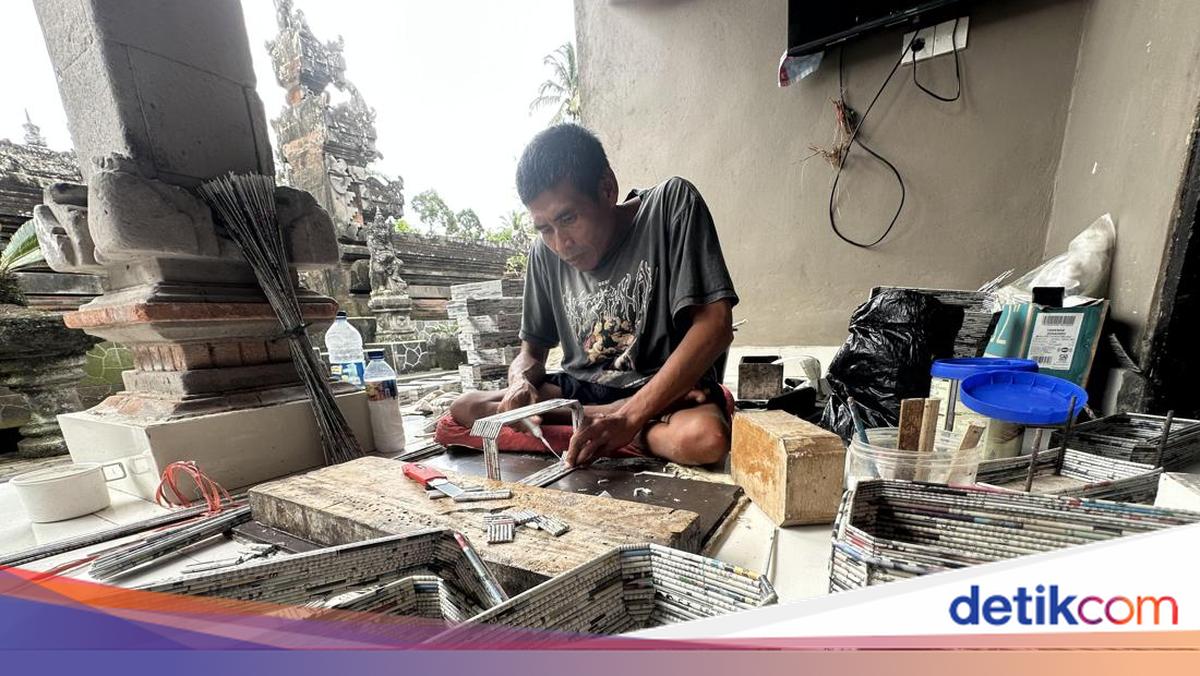
On the simple terrace of his home in Banjar Beng, Desa Carangsari, Badung, Ketut Tirtayasa sits cross-legged, diligently weaving rolls of newspaper. Dozens of newly glued tissue box frames are neatly lined up in the yard to dry, right next to the wheelchair that always accompanies his daily activities.
This 40-year-old man is the fourth of five siblings with physical disabilities. Despite his limited mobility, he remains enthusiastic about his daily life as a recycler artisan, relying on his dexterous fingers to make a living.
“I started making tissue boxes with this newspaper in 2017, after previously working as a shoe and sandal repairman so that neighbours in the village didn’t have to go far for repair services,” said Tirtayasa, recounting the beginnings of his business on Sunday (26/4/2026).
That afternoon, his fingers were nimble in finishing a pile of paper frames as he was rushing to meet an order target for offices in Puspem Badung. In no small feat, he had to complete more than 200 tissue boxes single-handedly to fulfil a request from the wife of the number two official in Badung Regency.
“Thank goodness yesterday I was ordered by the Deputy Regent’s wife of Badung; she ordered 200 tissue boxes at once. Before that, orders were usually plentiful, like 50 or 100 pieces, but since I work alone, it usually takes 2 to 3 months to finish everything,” said Tirtayasa.
This waste processing activity began as a whim in making crafts that caught the attention of local residents. Since seriously pursuing it at the end of 2017, he has diligently attended various trainings to expand his network and improve the quality of his handicraft products.
“At first, I made crafts out of curiosity, and it turned out many people found out until neighbours asked me to help with their children’s school assignments. I made tissue boxes and bokor, which are usually used by Balinese people for worship purposes, with whatever tools I had, but the results were quite good. From there, I started joining exhibitions to add to my network as well as to learn so that my products become better known,” he explained.
To maintain smooth production, he relies on supplies of used paper collected from government offices to subscribers who still get printed newspapers. However, Tirtayasa admits that the biggest current challenge is the dwindling availability of raw materials due to the shift in information trends to digital media.
“Lately, finding newspaper paper has been quite difficult because people rarely buy physical newspapers anymore. Fortunately, there are still some government offices and residents who are willing to collect their newspapers for me to take as the main raw material,” he said regarding the raw material constraints.
His creative process starts by cutting the black-and-white printed newspaper lengthwise using a mould to roll it with the help of wire and a special wooden mallet until it forms paper strands. These rolls are then arranged following a wooden mould to ensure consistent sizes before being strengthened with a layer of liquid glue.
“So that my products don’t turn out haphazard, I started making my own standards and moulds from wood, including the rolling tools. For one tissue box, it takes several days of work because I deliberately work alone so the results are neat and the technique remains consistent,” he said, explaining why he doesn’t involve others in the production process.
Tirtayasa is very detailed in aesthetics; he even specifically collects colour patterns from newspaper paper to create decorations in the form of flowers, leaves, and stems. After the basic frame dries and is decorated, he applies a varnish layer so the paper colours don’t fade and it looks shiny like rattan or wood.
“For example, making red flowers or green leaves, I look for those patterns from coloured newspaper paper so the colours come out naturally and not haphazardly. Besides tissue boxes, I also make bokor and keben for worship purposes for PKK mothers or personal and office orders,” said the man whose work was once bought by Sandiaga Uno when he was Minister of Tourism and Creative Economy.
Tirtayasa’s perseverance has paid off with orders from various government agencies, villas, and personal collections of regional officials in Bali. Although his production is limited because it is done manually without machines, the handmade crafts from Carangsari have been recognised through various MSME exhibitions.
“The prices vary; tissue boxes start from Rp150,000 to Rp170,000, while small bokor can be Rp300,000 each because the process is quite complicated. Sometimes I feel bad if there are large orders of up to 100 pieces because it takes two to three months to complete,” he concluded with a smile, reminiscing about preparing souvenirs for the G20 some time ago.
Tirtayasa’s consistency in pursuing the recycling world is also driven by a noble intention to provide environmental education to the wider community. He hopes his works can serve as real proof that piles of newspapers often considered rubbish can be transformed into highly aesthetic and functional items.