
Not Just Imports: Balongan Refinery Underpins Fuel Supply for Jakarta-West Java
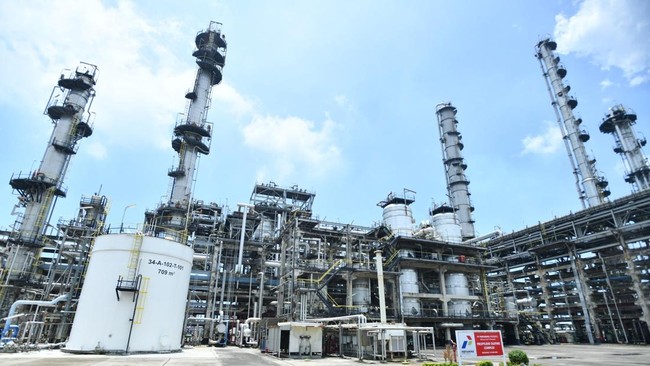
Fuel supply for the Jabodetabek and West Java regions does not rely solely on imports. A major support for energy needs in the region comes from the Balongan Refinery owned by PT Pertamina (Persero) in Indramayu, West Java.
This was reinforced by Laode Sulaeman, Director General of Oil and Natural Gas at the Ministry of Energy and Mineral Resources, during a working visit to Balongan Refinery on Thursday (12 March 2026). The visit aimed to ensure that Balongan Refinery was prepared to support the implementation of the Ramadan and Eid al-Fitr Task Force (RAFI) in 2026.
According to Laode, based on reports from Pertamina, the condition of energy supply through the RAFI period remains secure. Fuel oil, liquefied petroleum gas (LPG) and crude oil supplies are assured to meet public requirements.
“We have already received a report from Pertamina that the condition through the fulfilment of our needs, whether for fuel oil, LPG or crude oil, all can be supplied properly,” said Laode when met at the Balongan Refinery complex on Friday (13 March 2026).
Based on historical data and projections from 9 March to 1 April 2026, petrol demand in West Java is expected to increase by 9.6% due to increased private vehicle mobility during the exodus to hometowns, whilst demand for avtur (aviation fuel) is expected to rise slightly by 0.5%.
LPG demand is also expected to increase by 2.86% owing to increased household activities during Ramadan. Demand for industrial fuel oil is rising by 7.9%. Meanwhile, diesel demand is expected to decline by 27.3% due to restrictions on logistical vehicle operations during the exodus and return periods.
Refinery Unit (RU) VI Balongan has crude oil processing capacity of 150,000 barrels per stream day (MBSD). Balongan Refinery also has a Nelson Complexity Index (NCI) of 11.9, making it the crude oil processing unit with the highest complexity in Indonesia.
The vast majority, or 82%, of Balongan Refinery products are distributed to the Jakarta and West Java regions via the Integrated Terminal Balongan, Fuel Terminal Cikampek and Integrated Terminal Jakarta (Plumpang). Distribution to other regions accounts for 12%, whilst exports of decant oil to Singapore comprise 6%.
“Products from Balongan Refinery are sent directly via pipeline to Plumpang Depot. So they are sent directly there; the position is therefore very strategic for meeting fuel needs in West Java through DKI. Like that,” said Laode.
According to data from the Ministry of Energy and Mineral Resources, Balongan Refinery is the fourth largest fuel oil refinery in Indonesia with a capacity of 150,000 barrels per day (bpd).
The largest oil refineries currently are the Refinery Development Master Plan (RDMP) Balikpapan with a capacity of 360,000 barrels per day (bpd), followed by Cilacap Refinery with a crude oil processing capacity of 348,000 bpd, and Dumai Refinery in Riau of 170,000 bpd.
Total crude oil refining capacity in Indonesia currently stands at 1.28 million bpd.