
Not a Burden, Labour Ministry Says Collective Homecoming is Investment in Employee Productivity
The tradition of mudik ahead of Eid is often viewed as a social necessity for workers to return to their hometowns. However, the Ministry of Labour views company-facilitated collective homecoming programmes as important investments in preserving worker morale and productivity following the Eid holiday break.
Indah Anggoro Putri, Director-General of Industrial Relations Development and Labour Social Security at the Ministry of Labour, considers company support for collective mudik activities to be good practice in building harmonious industrial relations.
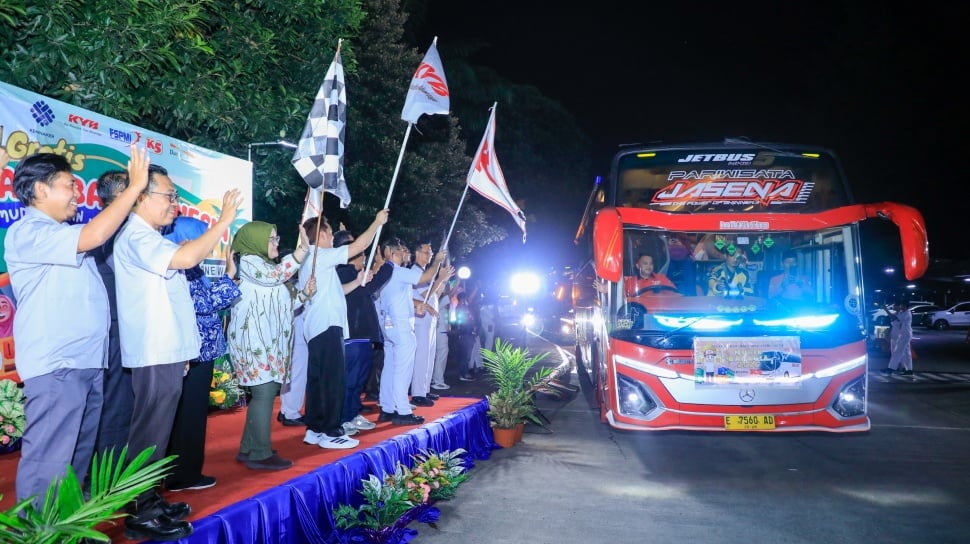
“We appreciate companies like PT Kayaba Indonesia that consistently facilitate worker and family homecoming. This is good practice in harmonious industrial relations and should be emulated by other companies,” Putri said while sending off participants in PT Kayaba Indonesia’s Collective Homecoming programme in Cikarang, Bekasi, on Friday, 13 March 2026.
She noted that workers are essential to business continuity. When companies support workers to return to their hometowns safely and peacefully, the benefits extend beyond the workers and their families to the company itself.
Putri emphasised that collective homecoming programmes should not be viewed as a cost burden for companies. Rather, such initiatives can be seen as long-term investments in maintaining employee motivation and work spirit.
She added that whilst the government does not provide budgetary support, the Labour Ministry encourages companies to introduce various innovations in facilitating worker welfare, including through mutual cooperation schemes.
“We do not assist with budgets, but we encourage companies to facilitate worker welfare through creative approaches like this collective effort. By involving cooperatives and banking partners, the financial burden of homecoming is distributed fairly so no one party bears the load,” she said.
In PT Kayaba Indonesia’s collective homecoming programme this year, financing and implementation were conducted through collaboration between company management, the K5 workers’ cooperative, and support from banking partner Bank Danamon.
Beyond welfare considerations, the Labour Ministry also places great emphasis on the safety of homebound travellers. Through supervision by the Directorate-General of Labour Supervision and Occupational Safety and Health, health checks were conducted on primary and backup drivers, conductors, and bus fleet roadworthiness inspections.
“We also check the health of primary and backup drivers, including conductors. Bus quality is also verified to ensure the journey is safe, comfortable, and secure so everyone can return to work with renewed enthusiasm,” she explained.
This year, PT Kayaba Indonesia facilitated homecoming for 236 workers by providing four bus fleets to various cities in Central Java and the Special Region of Yogyakarta.
Baron Tanaka, Director of PT Kayaba Indonesia, said that collaboration with the workers’ cooperative was one of the keys to the success of the collective homecoming programme.
He hopes all participants can enjoy the journey safely and return to work in good health and with renewed spirit.
“We urge participants to look after their health and not hesitate to remind drivers to always follow traffic regulations. We hope this journey is smooth and safe until everyone reaches their respective hometowns,” he concluded.