
Nostradamus of American Defeat
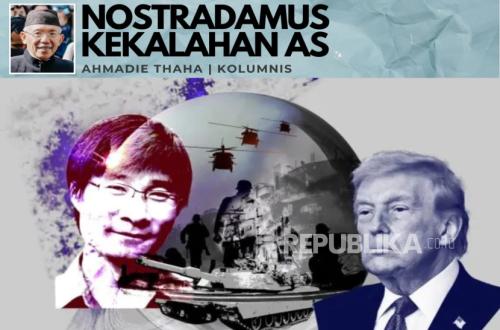
In an age when people trust zodiac forecasts more than intelligence reports, a professor has suddenly made the geopolitical world feel like a giant chessboard. His name is Prof Jiang Xueqin, an educator, writer and YouTuber holding Canadian citizenship.
This Guangdong, China-born academic (1976) is not a fortune-teller reading coffee grounds, but an academic who claims to use game theory to read the direction of history. His predictions about Trump becoming President and the United States going to war with Iran have already proven accurate, earning him the nickname “Nostradamus”.
The world now watches the third prediction of this Yale College graduate (1999) with a degree in English literature with mixed expressions of curiosity, concern and a touch of mischievous intrigue: will the United States, this century’s greatest empire, truly lose war against a nation long dismissed as a “walking economic sanction”?
Jiang Xueqin spent considerable time in China’s elite education sector. He served as Deputy Principal at Shenzhen Middle School, Programme Director at Peking University High School International Division, and Deputy Principal at a school affiliated with Tsinghua University.
Since teaching at Moonshot Academy in Beijing (2022), he has become widely known through his YouTube channel “Predictive History”, where he combines historical analysis, game theory and structural patterns to read the direction of global geopolitics. One of his lectures in 2024 became viral for predicting America would lose war against Iran.
Jiang’s prediction method sounds simple yet somewhat alarming to those devoted to slogans. He reads conflict as a long-term strategic game, not as a television drama dependent on presidential speeches or social media trends.
In his analysis, America’s war against Iran is not a duel of advanced technology versus developing nation. He sees it as a war of attrition in which advantage is determined not by who possesses the most expensive weapons, but by who can endure longest.
Ironically, herein lies a modern paradox. America’s military system is designed to win high-tech wars at extraordinary cost. A single interceptor missile can be worth tens of millions of dollars, whilst enemy drones cost only tens of thousands. It is like trying to swat a mosquito with a golden hammer. The mosquito may die, but the wallet faints first.
In Jiang’s analysis, Iran operates at a different strategic level. Their calculation does not stop at the military dimension, but is comprehensive. They are not merely facing American military might, but pressuring the global economic system that underpins American power, particularly capital from Muslim nations.
Should Gulf energy infrastructure be disrupted, should oil routes be obstructed, should petro-dollar investment weaken, then it is not merely ammunition that runs out, but the economic foundation that begins to crack. From this point, he dares to say something that almost sounds like a geopolitical heresy: American defeat is not merely military, but systemic.
Yet the more interesting question is not whether the prediction will come true, with signs already being read. The more important question is how a professor dares to make such a historical prediction.
Here the shadow of Ibn Khaldun emerges from the 14th century, as if smiling from behind the pages of the Muqaddimah. That great historian long explained that power does not fall because of one battle, but because of repeating social laws.
Ibn Khaldun noted that every empire is born from strong solidarity—which he termed ’asabiyyah—then becomes prosperous, then comfortable, then lazy, then fragile. He even explained in greater detail the causes of that collapse.
According to him, when a dynasty has ruled for a long time, the succeeding generation no longer lives in the simplicity of its founders. They grow up in palaces, accustomed to luxury, and slowly lose the moral resilience that once gave birth to that power.