
Northern and Southern Routes to Jakarta Still Congested on Saturday Night
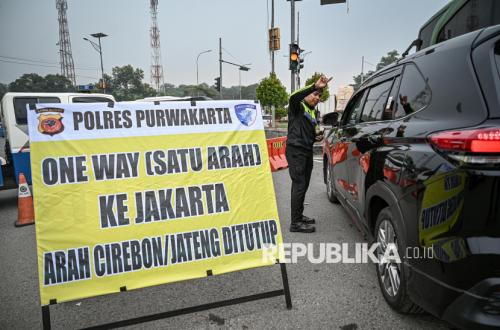
REPUBLIKA.CO.ID, CIKAMPEK – The Chief of the National Police Traffic Corps, Irjen Pol Agus Suryonugroho, has reminded holidaymakers returning to Jakarta to be wary of congestion on arterial routes, particularly Pantura and the southern route. The police are still managing the return flow on toll and non-toll roads.
Agus assured that the Traffic Corps is paying special attention to arterial routes. After monitoring safe conditions on the Banten toll corridor to Jakarta, the focus of security has been strengthened on arterial roads that serve as passages for vehicles from various regions.
“Arterials are indeed quite congested but we have managed them well,” said Agus at the Rest Area KM 62 of the Jakarta-Cikampek Toll Road on Saturday night (28/3/2026).
According to him, management on arterial routes is carried out directly by police personnel in the field. Two main Traffic Corps officials have been instructed to conduct checks, followed by strengthened traffic regulation by Provincial Police Chiefs, Regency/Municipal Police Chiefs, and Traffic Unit Chiefs in their respective areas.
Congestion is particularly occurring in the Pantura corridor and the southern route, which remain important passages for return vehicles. This situation is also related to the implementation of precision stage one and stage two local one-way schemes on toll roads, so vehicle distribution on arterial routes must still be maintained to avoid new slowdowns.
“Provincial Police Chiefs, Regency/Municipal Police Chiefs, Traffic Unit Chiefs are all deployed to manage arterials, especially Pantura including the South Coast,” said Agus.
On toll roads, the Traffic Corps is still maintaining local one-way stage two from KM 263 to KM 70. A one-lane contraflow traffic engineering from KM 70 to KM 55 towards Jakarta is also still in effect because the volume of vehicles heading to Jakarta remains quite high into the night.
Agus explained that conditions on the main toll roads have so far been monitored as quite well managed. The Traffic Corps had considered extending the one-way scheme eastward, but that plan has not been taken because the flow of vehicles from Central Java is still deemed steady.
“Therefore, the intervention of local one-way stage two from kilometre 263 to 70 is still in place, not pulled eastward,” explained the two-star general.
Agus added that vehicle flow from southern regions is also being anticipated because not all can be monitored from the Kalikangkung Toll Gate parameters. For this, police are preparing additional interventions through functional routes such as the Japek II South Toll and Bocimi if there is a surge in flow the following day.
At the same time, the Traffic Corps continues to crack down on three-axle vehicles to ensure the return journey of holidaymakers is not disrupted. This enforcement is deemed important to maintain smoothness on arterial routes, which on that night were still congested, though starting to become more controlled.
“Tonight it still persists because we checked that arterials are indeed quite congested but we have managed them and three-axle vehicles have almost been fully regulated,” said Agus.
He also mentioned that tourist areas are gradually easing, so vehicle pressure is slowly shifting to the main return routes. Police personnel remain fully on standby in the field to monitor the situation and carry out quick interventions if new blockages arise towards Jakarta.