
North Maluku Governor Offers Food Investment Opportunities to Bugis-Makassar Merchants
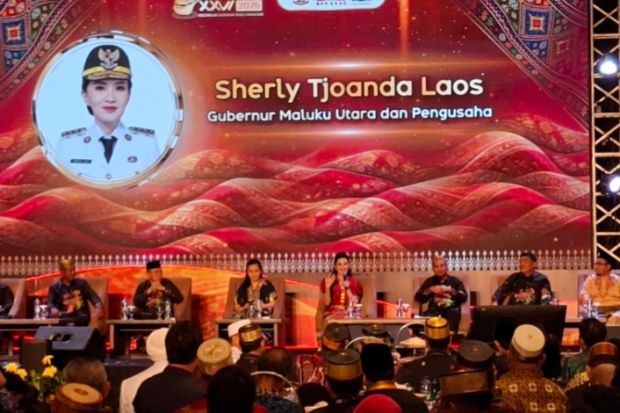
Makassar - North Maluku Governor Sherly Tjoanda has invited entrepreneurs and investors, particularly from South Sulawesi, to invest capital in the food, logistics, and maritime transport sectors in her region.
The invitation was extended by Sherly during her speech in a discussion session titled Success Story and Business Matching at the 26th Meeting of Bugis Makassar Merchants (PSBM) at Hotel Claro, Makassar, on Thursday (26/3/2026).
According to Sherly, North Maluku still heavily depends on supplies from outside the region. Around 80 per cent of the local population’s food and logistics needs are still met from other areas.
“80% of all North Maluku’s needs are still sourced from outside North Maluku. Therefore, I am here as the Governor of North Maluku to invite the Bugis merchants present, who may have expertise in eggs, chickens, shipping, supply chains, and logistics, to explore the potential in North Maluku,” said Sherly.
She assessed that this situation simultaneously opens up significant opportunities for businesses to develop investments in supply chains, livestock, and maritime logistics.
Sherly exemplified business opportunities in the cut chicken commodity. With a population of around 1.4 million people, North Maluku’s chicken needs are estimated at 25,000 tonnes per year.
“For example, with a population of around 1.4 million, we have a chicken requirement of about 25,000 tonnes per year. At a price of around Rp40,000 per kilo, the potential is nearly Rp1 trillion. And it should be noted that in North Maluku today, the price of chicken per kilo is around Rp50,000 to Rp55,000, due to quite high logistics costs,” she continued.
In addition to cut chicken, the egg livestock sector is also seen to have significant economic potential. Based on calculations of community consumption needs, the economic turnover value from the egg commodity is estimated to reach hundreds of billions of rupiah every year.
“Thus, the opportunity to establish chicken farms in North Maluku is still very high. The same applies to eggs; assuming one resident consumes three eggs per week, the annual requirement would be around 400,000 tonnes of eggs, and at a price of Rp2,000 each, the potential is Rp800 billion. It should be noted that in North Maluku, the average egg price is Rp2,500, so the potential remains vast,” she stated.
On the other hand, Sherly revealed that North Maluku recorded the highest economic growth in Indonesia in 2025, at 34 per cent year-on-year.
“The good news is that the winds in North Maluku are favourable. So, North Maluku, with permission from the Minister, reports the highest economic growth in Indonesia last year, year-on-year at 34%, the highest nationwide,” she explained.
However, she noted that this growth has not yet been felt evenly by the community. This is because the regional economy still relies on the nickel downstreaming sector.
“Because of nickel downstreaming. North Maluku produces approximately 40 or 50 per cent of Indonesia’s nickel, or about 20 per cent of the world’s nickel. And the growth is not inclusive; there is no even distribution,” she said.
Sherly explained that this disparity is also influenced by limitations in human resource capacity and the suboptimal performance of the agriculture, livestock, and fisheries sectors in her region.
“Why? Because human resources, agriculture, livestock, and fisheries in North Maluku have not yet achieved self-sufficiency. The infrastructure is not ready, and currently, everything is still sourced from outside, from North Sulawesi and South Sulawesi,” she disclosed.
Therefore, the regional government is opening opportunities for collaboration with businesses to develop the food and logistics sectors so that North Maluku’s economic growth can be more evenly distributed.