
North Barito Archives and Library Service Displays Ancient Islamic Manuscripts
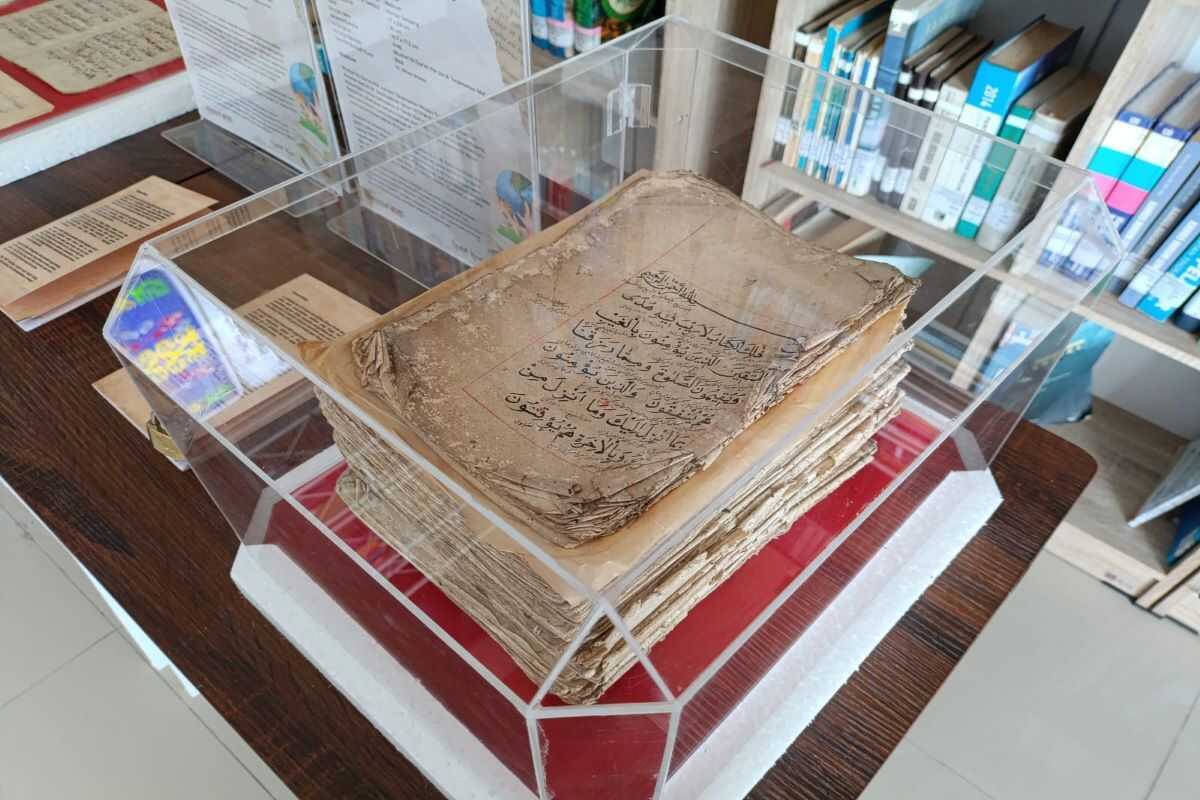
Muara Teweh (ANTARA) – The Archives and Library Service (Dissiptaka) of North Barito Regency, Central Kalimantan (Kalteng), is holding an exhibition of ancient manuscripts that are of significant importance to local and national culture, history, and science.
“This activity aims to introduce, preserve, and educate the public, especially the younger generation, about the noble values, culture, and national identity contained in the intellectual heritage of the past,” said the Head of Dissiptaka North Barito, Fakhri Fauzi, in Muara Teweh, Wednesday.
The exhibition, held at the North Barito Regional Library, will run from 24 February to 13 March 2026, or from Monday to Thursday from 08.00 to 15.00 WIB and Friday from 08.00 to 15.30 WIB.
Two ancient manuscripts of Eid al-Fitr/Eid al-Adha sermons, written in Arabic script or language, will be on display. The first manuscript was handwritten by H Abdullah bin H.M Saleh, a native of Muara Teweh, and was copied on Saturday, 4 November 1933, or 15 Rajab 1352 Hijri.
The second manuscript was written by H Abdul Aziz bin H Abdurrahim, who was known as the Penghulu Landraat of Barito in Kalimantan, as well as the Imam and Khatib of the Jami Mosque in Muara Teweh, and who passed away in 1943.
“The sermon manuscript written by H Abdul Aziz is 83 years old, and the sermon manuscript written by H Abdullah is 93 years old,” said Fakhri, accompanied by Firdausi Nuzulla, a Senior Librarian at Dissiptaka North Barito.
Fakhri said that the two ancient manuscripts of the Eid al-Fitr and Eid al-Adha sermons owned by H Ubaidillah Ahmad bin H A Bahagia have been registered on the Khasanah Pustaka Nusantara (Khastara) digital portal of the National Library of the Republic of Indonesia and have received a national registration number.
“The Al-Quran is in the process of being digitised for registration on Khastara of the National Library,” he said.
Khastara is the official website of the National Library of the Republic of Indonesia, which functions as a digital library specifically for rare collections and ancient manuscripts.
“After the digitisation process is complete, the physical manuscripts will be returned to their owners in a cleaner and better-preserved condition,” he said.
He explained that digitisation is necessary because the physical ancient manuscripts are fragile and easily damaged when touched. Digitisation has the benefit of preserving the content of the manuscripts from extinction so that future generations can still access the information contained in them.
One of the main objectives of digitisation is to increase accessibility. With digital digitisation, ancient Nusantara manuscripts that were previously only accessible in certain libraries or museums can now be accessed globally via the internet.
Digital platforms such as Khastara, launched by the National Library of the Republic of Indonesia, are an example of how digitisation can expand public access to ancient Nusantara manuscripts.
“This also opens up opportunities for researchers, academics, and the general public to study, research, and utilise ancient manuscripts without having to visit the location where they are stored,” said Fakhri.
He stated that the definition of ancient manuscripts in Law Number 43 of 2007 is all written documents that are not printed or reproduced by other means, whether located inside or outside the country, which are at least 50 years old, and which are of significant importance to national culture, history, and science.
“This activity serves as a means of appreciation, a source of historical education, and an effort to save manuscripts from extinction,” said Fakhri Fauzi.