
Non-Subsidised LPG Prices Surge Sharply, Beware of Mass Migration to 3 Kg!
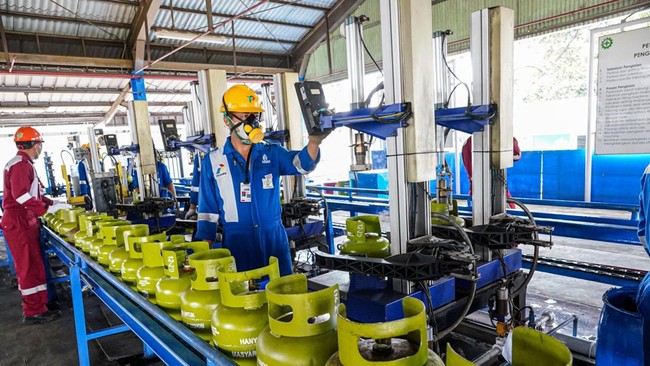
Jakarta, CNBC Indonesia - Economist from the Center of Reform on Economics (CORE) Indonesia, Yusuf Rendy Manilet, has warned of the potential migration of Liquefied Petroleum Gas (LPG) users from non-subsidised to subsidised LPG. This follows the current surge in prices.
Yusuf explained that the price of Bright Gas 12 kg has risen to around Rp248,000 per cylinder, making the price per kilogram nearly three times that of the subsidised 3 kg LPG. This creates a very strong economic incentive for the public to switch to subsidised LPG.
“This creates a very strong incentive for migration, and unlike fuel, LPG distribution is much harder to monitor. There is no SPBU system, no real-time recording, and oversight largely relies on the retailer network,” Yusuf told CNBC Indonesia on Monday (20/4/2026).
In terms of behaviour, middle-class households are still considered capable of sticking with non-subsidised LPG. However, small businesses such as eateries and catering services are more likely to have stronger economic pressures to switch.
“At this point, the risk of the subsidised LPG quota being exceeded is actually higher than for fuel, because controls are weaker while the migration incentive is very strong,” he said.
Furthermore, Yusuf assessed that, at a more structural level, this shows a classic issue in policy economics: commodity-based subsidies are losing effectiveness when price differentials become too large.
According to him, the wider the gap between subsidised and market prices, the stronger the push for mis-targeting, either due to economic needs or systemic loopholes. On the other hand, monitoring costs can never keep up with the speed of such distortions.
“In conditions like this, the subsidy design is approaching its limits. Theoretically, a more efficient approach is direct subsidies to individuals, not to commodities,” he said.
In this way, energy prices can better reflect market conditions, while vulnerable groups remain protected through direct transfers. The infrastructure for this is already starting to form, but the transition is not simple as it involves social and political stability.
Therefore, for the short term, the most realistic approach remains hybrid. Commodity subsidies are still maintained, but tightened through restrictions and digitalisation.
“At the same time, the foundation for closed subsidies continues to be strengthened. Without that, every time there is a global energy price shock, the same pattern will repeat: disparities widen, migration increases, and fiscal pressure re-emerges,” Yusuf stated.
As is known, PT Pertamina (Persero) has officially raised the price of non-subsidised Liquefied Petroleum Gas (LPG) for 5.5 kg and 12 kg cylinders. The price adjustment has been effective since 18 April 2026 across Indonesia.
Based on information from the official Pertamina Patra Niaga website, the price increase applies to several regions, including Java, Bali, and West Nusa Tenggara. For the 5.5 kg LPG size, the price is set at Rp107,000 per cylinder, an increase of Rp17,000 from the previous Rp90,000 per cylinder.
Meanwhile, for the 12 kg LPG in areas from Banten to Bali, it is now priced at Rp228,000 per cylinder, up Rp36,000 from the previous level of Rp192,000 per cylinder.
In Sumatra and parts of Sulawesi, the 5.5 kg LPG price is now set at Rp111,000, while the 12 kg cylinder is sold for Rp230,000. These prices apply uniformly from Aceh, North Sumatra, Riau, Lampung, to Central Sulawesi and South Sulawesi.
For Kalimantan and North Sulawesi, the 5.5 kg LPG price is set at Rp114,000, with the 12 kg cylinder reaching Rp238,000 per cylinder. Specifically for the Free Trade Zone (FTZ) in Batam, prices are lower at Rp100,000 for 5.5 kg and Rp208,000 for 12 kg.
Meanwhile, the highest prices are in Maluku and Papua, where 5.5 kg LPG now reaches Rp134,000 and 12 kg LPG is priced at Rp285,000 per cylinder. For North Kalimantan, particularly Tarakan, the 5.5 kg LPG is recorded at Rp124,000 and the 12 kg size at Rp265,000.