
No Regions Awarded Adipura 2026 Honour, Environment Minister Provides Explanation
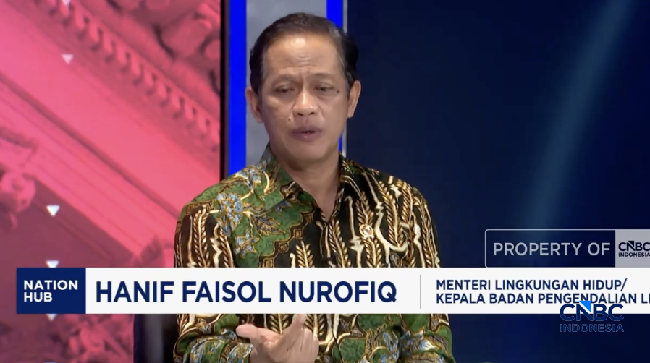
Jakarta, CNBC Indonesia - The Ministry of Environment and Forestry this year has not granted the highest Adipura award to any city or regency due to unresolved waste management governance issues.
“Alhamdulillah, up to today, not a single city has received the Adipura,” said Environment Minister Hanif Faisol Nurofiq on the CNBC Indonesia Nation Hub programme, quoted Saturday (25/4/2026).
Faisol explained that the prestigious award now has a more selective legal basis, namely Presidential Regulation No. 183 of 2024 on the Environmental Control Agency.
In the regulation, Faisol explained, local governments are not only required to ensure cleanliness on the front porches of their cities but to create comprehensive waste management governance extending to peripheral areas.
“Because the granting of Adipura is truly conveyed only as a symbol of appreciation from the government to regencies and cities that have successfully provided clean cities for their people. So far, none have achieved this,” said Hanif.
Nevertheless, he acknowledged that several cities are nearly meeting the criteria for the Adipura, namely those in the category approaching clean city status. Among them are Surabaya, Balikpapan, and Ciamis.
“The highest scores are from the city of Surabaya, the city of Balikpapan, and Ciamis Regency. These three have high scores but have not yet reached Adipura status. Hopefully next year they can. The assessment is continuously monitored,” said Hanif.
To receive the Adipura predicate, Hanif said, at least three main parameters must be met by regencies and cities, starting from instruments and funding for waste management, human resources and infrastructure with capability, to tangible results of overall clean cities.
“We assess Adipura not just figuratively. Not just on the spot. No. We directly inspect the field to see if sorting is in place, if there is waste management on the ground, and so on,” Hanif stated.
The next important assessment, according to Hanif, is the success of local governments in building a clean waste culture among the community, including each individual’s ability to sort waste.
“The second issue is that this culture has not yet been established among the community. For nearly 10 years, there has been a pursuit of cheap costs despite significant environmental risks. So, waste is just dumped; people feel they have paid the levy and don’t want to sort, then local governments don’t handle it, just collect it with trucks and bury it in the landfill,” he explained.
In 2026, Hanif emphasised, the central government will be firmer in managing waste at final disposal sites (TPA) to encourage a waste-sorting culture. One measure is banning organic waste from entering TPAs.
“Ultimately, organics will be sorted at the source, and whether they like it or not, the circular economy ecosystem will be built,” he elaborated.