
No More LPG: A Bekasi Eatery Is Now Using CNG Gas
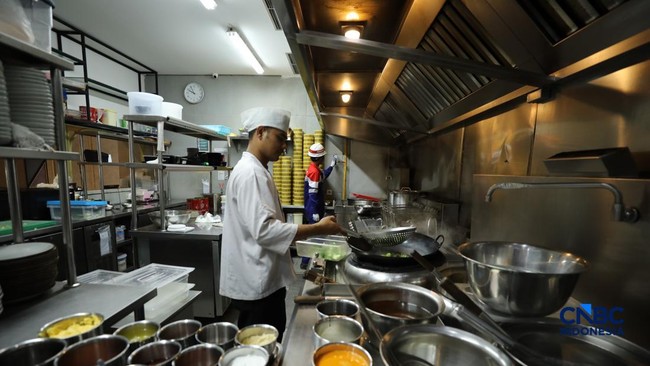
Officials are filling compressed natural gas (CNG) into high-pressure cylinders (up to 200 bar, about 3,000–3,600 psi) at a Gas Fuel Filling Station (SPBG) owned by PT Perusahaan Gas Negara Tbk (PGN) in Pondok Ungu, Bekasi, West Java, on Monday, 18 May 2026. The government is continuing to formulate strategic steps to optimise domestic gas use in order to achieve energy independence. One domestic energy option under study is the use of CNG to substitute Liquefied Petroleum Gas (LPG), which is largely imported. Energy and Mineral Resources Minister Bahlil Lahadalia said that the plan to use CNG for households is still under discussion; they will finalise soon to realise energy independence. CNG has already been widely used by various industries, such as hospitality, restaurants, and a number of SPBGs, with feedstock sourced domestically. Therefore, the government intends to optimise domestic energy use. CNBC Indonesia observed in Bekasi, West Java, that several restaurants are using CNG as a cooking fuel. Officials were inspecting the pressure and volume of CNG at a restaurant in Bekasi on Monday, 18 May 2026. By reference to the Presidential Regulation No. 64 of 2012 on Provision, Distribution, and Pricing of Gas for Road Transportation, CNG is gas sourced from natural gas with methane content (C1). According to PT PGN Tbk’s official site, natural gas itself consists of a blend of hydrocarbons including methane (C1), ethane (C2), propane (C3), and butane (C4). CNG consists of about 95% methane and is largely from domestic oil and gas production. In contrast, LPG contains C3 and C4. Moreover, domestic oil and gas production fields no longer produce much C3 and C4. The variety of natural gas components means its processing and utilisation differ. Natural gas can be processed into LPG, LNG, and also into CNG. Understanding CNG also entails understanding LPG and LNG, but note that CNG, LPG, and LNG are three different things. The main difference between CNG, LPG and LNG lies in their physical state and storage pressure: CNG is stored as gas at high pressure, LPG as a liquid at moderate pressure and temperature, LNG transported as a liquid at very low temperature.