
'No invasive intent': Indonesia's first aircraft carrier not for combat but for disaster relief, says defence ministry
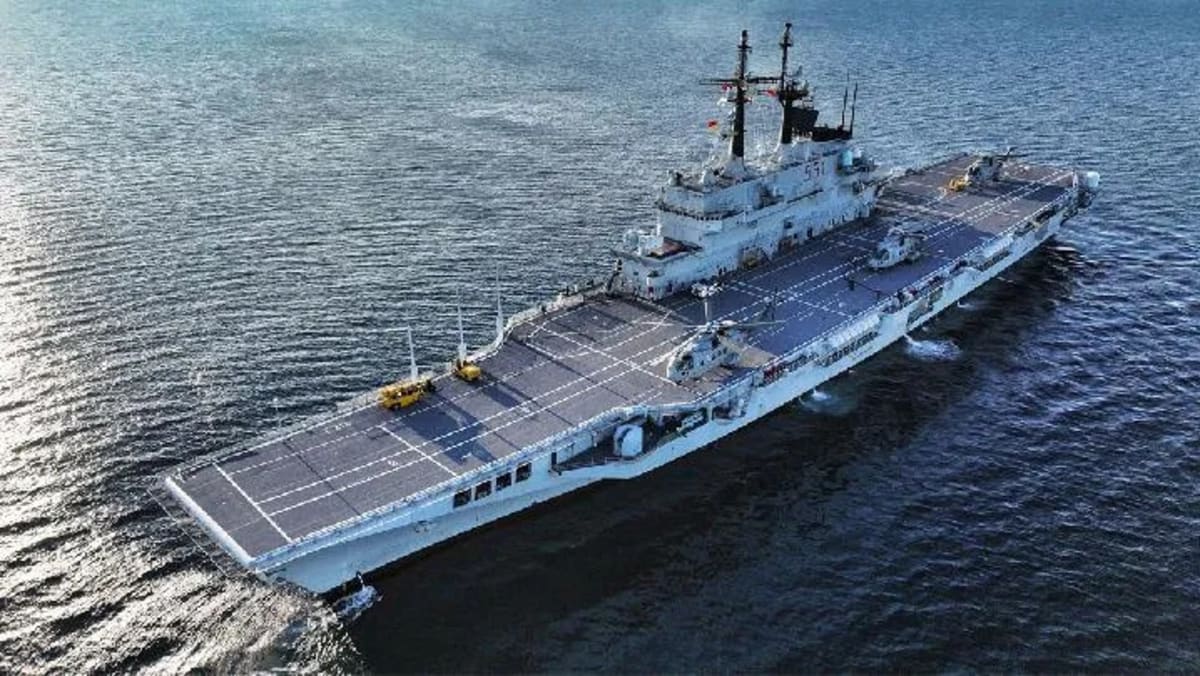
‘No invasive intent’: Indonesia’s first aircraft carrier not for combat but for disaster relief, says defence ministry
The acquisition of the Italian-made Giuseppe Garibaldi makes Indonesia the second Southeast Asian country after Thailand to operate an aircraft carrier.
JAKARTA: Indonesia’s plan to acquire its first aircraft carrier is not for offensive purposes or to invade any territory, but to support non-combat military operations, according to its defence ministry.
“There is no intention on the part of our nation, the Indonesian nation, to be aggressive by owning an aircraft carrier like this … so there is no invasive intent,” said head of the defence ministry’s information bureau, Rico Ricardo Sirat on Wednesday (Feb 25), as quoted by local news outlet Kompas.
He added that the Italian-made aircraft carrier, Giuseppe Garibaldi, will be used in military operations outside of war, particularly in disaster relief.
The 180m-long carrier, which local news platform Antara reported is equipped with radar jammers and weapons such as anti-aircraft missiles, has a top speed of 30 knots and can travel up to 7,000 nautical miles.
The acquisition makes Indonesia the second Southeast Asian country after Thailand to operate an aircraft carrier. Across Asia, only China, India and Japan currently field their own carriers.
The Giuseppe Garibaldi is viewed as part of President Prabowo Subianto’s broader push to modernise Indonesia’s armed forces and expand its capabilities, an initiative he began during his tenure as defence minister from 2019 to 2024.
However, the decision to acquire the carrier only came after he assumed his presidency in late 2024.
The decommissioned vessel, which served the Italian Navy from 1985 until 2024, is expected to arrive ahead of the Indonesian National Armed Forces anniversary on Oct 5.
“Because it has a helideck, it can accommodate up to six helicopters or even more on its deck,” Rico said, as quoted by Kompas.
He added the aircraft carrier would also allow smaller vessels in the surrounding area to refuel and distribute logistical aid more efficiently and effectively.
Indonesia navy’s chief of staff Muhammad Ali previously told reporters on Feb 6 that the carrier will likely be used primarily for humanitarian missions.
Ali also said on Feb 12 that the defence ministry is in ongoing negotiations and administrative processes with the Italian navy and shipbuilder Fincantieri, which built the aircraft carrier.
Under the deal, Indonesia is expected to bear the cost of restoring the decommissioned ship to operational condition. The defence ministry will allocate a budget for retrofitting or adjustments which span the ship’s systems, safety standards and operational requirements of the Indonesian navy, said Ali.
The grant-and-refit deal, combined with a foreign loan to fund acquisition and related systems including transport and carrier-optimised utility helicopters, will amount to about US$1 billion, according to defence and security news platform Defence Security Asia.
Aircraft carriers are large warships seen to demonstrate military and naval power and are part of a carrier strike group, an operational formation that includes the aircraft and an escort fleet of other ships.
Analysts previously told CNA that Indonesia’s geography as a vast archipelagic nation with numerous waterways and busy chokepoints justifies its need for an aircraft carrier, but limitations such as having no vertical-landing aircraft for the carrier limit the ship’s role in combat.
The vessel was designed to cater mainly to helicopters, jet and propeller aircraft capable of landing vertically such as the Harrier or the MV22 Osprey.
However, the aircraft carrier could also be repurposed to deploy drones for various purposes, including carrying deadly payloads, experts noted.
Khairul Fahmi of the think tank Institute for Security and Strategic Studies (ISESS) previously told CNA that the carrier can extend the reach of small drones with a range of up to 160km, as well as larger drones that can remain airborne for over 24 hours and travel thousands of kilometres.
He added that drones can also carry weapons, a tactic proven effective in the Russia-Ukraine war.
“A swarm of inexpensive drones can easily overwhelm an enemy’s defence system,” he said.
He added that the drones can also be used for intelligence, surveillance and reconnaissance missions and would be very useful in stopping illegal fishing, smuggling or encroachment of our maritime borders and economic zones.
Some experts however noted that the scale and cost of operating a carrier could squeeze Indonesia’s finances, which are already stretched by Prabowo’s ambitious social, economic and defence programmes.
The annual cost of operating the carrier could range between US$50 million and US$80 million, according to Defence Security Asia.
Meanwhile, Abdul Rahman Yaacob, a researcher at Abu Dhabi’s Rabdan Security and Defence Institute said that aircraft carriers such as the Garibaldi and the Chakri Naruebet - the flagship of the Royal Thai Navy - are not ideal for disaster relief.
“Disaster response requires speed, flexibility, shallow-water access, and the ability to move personnel, engineering equipment, medical facilities, and relief supplies directly ashore,” Rahman wrote in an article in The Diplomat on Jan 13, and added that Indonesia’s carrier acquisition could put other Southeast Asian countries on edge.
“Neighbours and external powers are unlikely to view a carrier primarily as a disaster-relief tool, regardless of how it is described domestically,” he said.