
No Call to War Yet, North Korea's Nuclear Programme Suddenly Surges
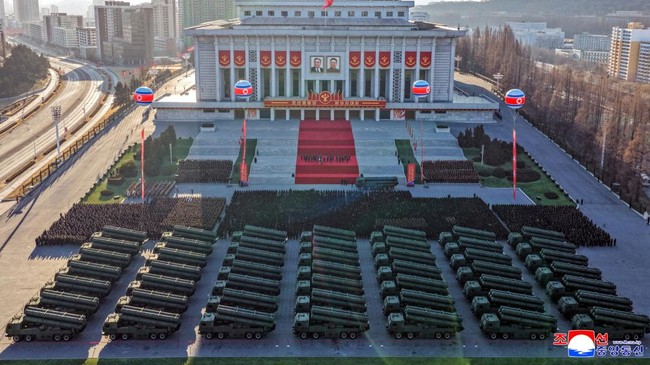
North Korea has reportedly ramped up its nuclear programme development activities, sparking international concerns amid stalled global diplomatic efforts.
Citing The Guardian on Saturday (18/4/2026), IAEA Director General Rafael Grossi stated that Pyongyang has made “very serious” advances in its capacity to produce more nuclear weapons. This statement was made during his visit to Seoul on Wednesday.
According to Grossi, activities at North Korea’s main nuclear complex in Yongbyon have intensified rapidly. He noted accelerated work on the 5-megawatt reactor, reprocessing facilities, light-water reactor, and other installations.
Grossi also confirmed that North Korea is believed to possess several dozen nuclear warheads. Some estimates put the number at around 50, though some experts remain sceptical of Pyongyang’s claims regarding miniaturisation capabilities to fit them onto long-range ballistic missiles.
Since conducting its first nuclear test in 2006, North Korea has developed an operational nuclear capability, including intercontinental ballistic missiles (ICBMs) with potential to reach the US mainland.
Under Kim Jong Un’s leadership since 2011, the country’s nuclear programme has been accelerated despite UN sanctions. Observers view this as an effort by Pyongyang to strengthen deterrence and prevent potential regime change by external actors, particularly the United States.
Recent developments are corroborated by a report from the Washington-based Center for Strategic and International Studies (CSIS) through its Beyond Parallel project. Based on satellite imagery, North Korea has completed construction of a new facility suspected to be for uranium enrichment at Yongbyon.
The facility is reported to be nearly operational. Additionally, there are indications of a similar facility at another site in Kangson, near Pyongyang, which has not been declared to international nuclear authorities.
According to the report, enriched uranium production “will significantly increase the number of nuclear weapons North Korea can possess”.
These findings align with the IAEA’s assessment last June, which stated that North Korea is constructing a uranium enrichment facility at Yongbyon capable of producing weapons-grade material.
In March, Grossi stated there was no evidence of significant changes at North Korea’s main nuclear test site in Punggye-ri, but the facility remains assessed as ready for nuclear tests at any time.
He emphasised that North Korea’s nuclear programme constitutes a serious violation of UN Security Council resolutions. “A clear violation,” Grossi said, adding that the IAEA will continue to maintain readiness to fulfil its role in verifying the programme.
North Korea has not conducted a nuclear test since 2017 but continues to demonstrate progress in missile technology and expand its arsenal, in line with Kim Jong Un’s August commitment to “rapid nuclear expansion”.
Meanwhile, diplomatic efforts to curb Pyongyang’s nuclear ambitions have yet to yield results. Meetings between Kim and US President Donald Trump during his first term ended without agreement, followed by deteriorating relations between North Korea and South Korea.
South Korean President Lee Jae Myung previously warned that North Korea is now capable of producing material for 10 to 20 nuclear weapons per year, while enhancing its long-range ballistic missile capabilities.
“At some point, North Korea will secure the nuclear armament it believes is necessary to defend its regime, along with ICBM capabilities that can threaten not only the United States but the wider world,” Lee said in January.
“And once it achieves surplus, it will spread beyond its borders. A global danger will emerge,” he added.
However, North Korea has rejected Seoul’s efforts to reopen cross-border dialogue, indicating that tensions on the Korean Peninsula remain far from easing.