
New War Erupts, America Furious Over Rp 102 Trillion Extortion
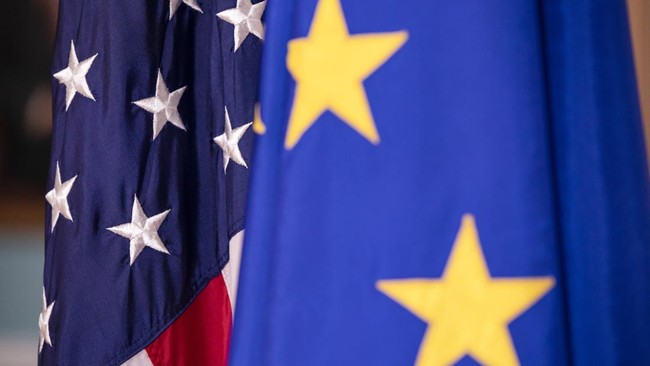
Tensions between the United States (US) and the European Union are intensifying due to sanction fines imposed on US tech giants. Google, Apple, and Meta have collectively challenged fines from the European Union over antitrust and competition law violations in the region.
The total fines demanded by the European Union amount to more than €6 billion (Rp 102 trillion) since the beginning of 2024. This has become a growing source of dispute.
The tech giants and the White House claim the fines reflect the European Union’s resistance to innovation. Meanwhile, the European Union told CNBC International that their tough stance aims to encourage tech giants to make consumer-friendly decisions.
Since 2024, there have been six waves of fines issued to US tech giants. In March 2024, Apple was fined €1.84 billion for using its dominant market position to exploit music streaming app distribution.
Then in November 2024, Meta was fined €797 million for practices deemed to favour Facebook Marketplace. In April 2025, Apple was fined again €500 million for failing to comply with ‘anti-steering’ obligations.
In the same month, Meta was fined another €200 million for requiring users to consent to data sharing with the company or pay for an ad-free service.
In September 2025, Google was fined €2.9 billion for anti-competitive practices in its advertising technology business. Finally, in December 2025, X was fined €120 million for breaching transparency obligations.
“All companies doing business in the European Union are accountable to the European people and must respect existing rules,” a European Commission spokesperson told CNBC International, quoted on Friday (10/4/2026).
The European Commission added that the fines relate only to companies’ operational behaviour in Europe that violates EU rules.
The Donald Trump administration holds a different view. They have ramped up criticism of the bloc, accusing it of over-regulating tech companies and endangering Europe’s ability to benefit from AI advancements.
Trump Intervention
In February 2026, Trump signed a memorandum stating that the US would consider tariffs to counter digital services taxes (DST), fines, practices, and policies imposed by foreign governments on US companies.
Fines against US companies represent the biggest friction point in economic relations between the European Union and the US, said Deputy Secretary of State for Economic Growth Jacob Helberg to reporters last week, as reported by Reuters.
This is not a new point of tension. Helberg also said the European Union has fined US tech companies more than $25 billion over the past two decades.
“If the European Union wants to participate in the AI economy, they will need data centres, data, and access to US AI hardware stacks. The European Union cannot over-regulate, change the rules of the game, and impose huge fines on companies,” US Ambassador to the European Union Andrew Puzder told Ian King on CNBC International’s “Europe Early Edition” on 27 March 2026.
When asked for comment on how fines against big tech affect US-EU relations, a US Department of Commerce spokesperson referred CNBC International to a November interview with Secretary Howard Lutnick.
“Let’s settle the unresolved cases,” he told Bloomberg. “Let’s forget about those cases.”
Europe Unfazed
The European Commission spokesperson said the fines are based on EU competition law, the Digital Markets Act, and the Digital Services Act. The fines primarily serve as punishment for breaching EU law.
Secondly, they act as a deterrent to ensure EU laws are respected, both preventing repeat violations by the companies involved and discouraging violations by other market operators.
The European Union is actually in a vulnerable position. The region depends on US tech companies for much of its digital infrastructure. Nevertheless, governments are working to diversify tech suppliers and develop sovereign alternatives. The region appears undaunted in its efforts to ensure US tech companies comply with its rules.
“Fines are a ‘last resort’ when amicable resolution efforts fail,” the spokesperson said.
Many changes have been achieved without fines, they said. Apple allowed competing devices like smartwatches to sync with iPhones after the European Union launched a formal process in March 2025 under the Digital Markets Act (DMA) without imposing a fine, according to the European Commission spokesperson.
Apple told CNBC International that the DMA hampers innovation, weakens privacy protections, delays or reduces product launch quality, and increases security risks. They declined to comment on the European Union’s claim that they changed their processes in response to the DMA process.
Effectiveness of Fines
The European Commission spokesperson said tech companies sometimes only change their behaviour after receiving fines.
For example, Meta altered its “pay or consent [to data collection]” offer to Facebook and Instagram users in 2025 after a DMA non-compliance decision imposed a €200 million fine.
When asked for comment, Meta directed CNBC International to remarks from Global Affairs Chief Joel Kaplan.
Kaplan said at the time that the European Union’s fines were an attempt to “hamper successful US businesses.
“EU rules effectively impose tar”