
New Risks Emerge from Trump Tariffs as Researchers Warn of Geopolitical Dangers
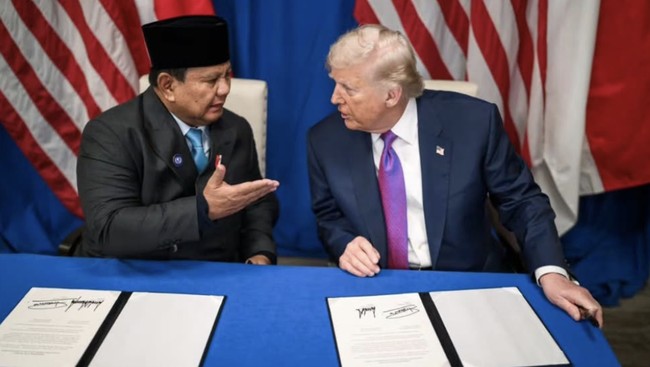
Jakarta – Indonesia’s Agreement on Reciprocal Trade (ART) with the United States has come under intense scrutiny. Whilst promised special market access, researcher Riandy Laksono from the Center for Strategic and International Studies (CSIS) has warned of fatal geopolitical risks that could drag Indonesia into the conflict between Washington and Beijing.
Laksono has challenged government claims that the tariff benefits are substantial. Based on a detailed analysis of the agreement text, Indonesia did secure 0% tariffs on 1,819 products; however, this figure did not result from hard-won negotiations. Rather, these exemptions derive from Annex 3 of the Executive Order, which is based on reciprocal principles. The United States has a universal exemption list in which Trump stated that “if a country is aligned, we will grant some of these products.” This is not a negotiation outcome but rather a predetermined dictate from Trump.
More significantly, whilst the number of products appears substantial, they represent only a fraction of Indonesia’s total trade volume with the US. The economic impact does not justify the concessions the government must make to earn the “aligned country” designation from Washington. Of Indonesia’s total exports to America, only 24% are covered by this additional 0% tariff access. Since exports to America represent just 10% of Indonesia’s total trade, the market access secured amounts to only 2% of total trade. Undertaking structural reforms for a 2% market access gain makes little economic sense.
The most tangible threat, however, comes from the loss of Indonesia’s political sovereignty in foreign policy. Laksono has highlighted clauses within the ART that implicitly could force Indonesia to impose sanctions on China if directed by the White House. There is a substantial risk that if America designates any country as an adversary, Indonesia must follow suit, imposing sanctions and tariffs. Currently, this threat is directed at China.
This potential confrontation represents a critical danger signal for the national economy. Indonesia’s industrial structure is heavily dependent on raw material supplies from China. Should trade relations with Beijing be disrupted as a result of pressure from the ART agreement, Indonesia’s manufacturing competitiveness would be severely damaged by losing access to competitive components.
Laksono has also compared Indonesia’s position unfavourably with neighbouring countries such as Malaysia and Cambodia, which retain “protective barriers” in their trade agreements. Indonesia appears to lack strong negotiating leverage to protect national interests in the document. In the ART, Indonesia’s national guardrails are absent. Compare this with Malaysia or Cambodia, which have clauses stating “shall not violate sovereignty or national interests.” In our agreement, this is unclear. If we are forced to antagonise a critical partner like China, this is a red flag.
The Agreement on Reciprocal Trade (ART) emerged from the United States’ protectionist economic policy under Donald Trump’s leadership, which emphasises reciprocal or mutual principles. Washington wants partner countries to open their markets widely to American products and investment if they wish to maintain access to low tariffs in the US market. The agreement serves as an instrument to ensure that partner nations are not merely exporters but also adopters of commercial standards and security values established by the US.
For Indonesia, the agreement is viewed as an attempt to secure its position in global supply chains amid escalating world trade tensions. However, the ART demands deep commitment from Jakarta, including import regulation reform, removal of investment barriers such as local content requirements, and alignment of labour and environmental standards.