
New Regulations on Customs Area Goods Management Take Effect on 1 April!
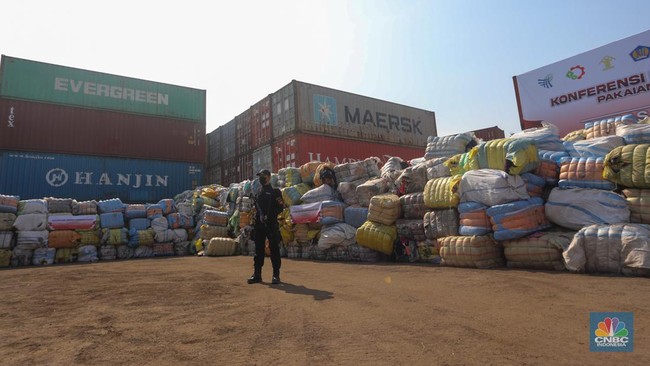
Jakarta, CNBC Indonesia - Every good entering or leaving Indonesian territory via ports, airports, and international post offices undergoes customs processing. This process aims to ensure the fulfilment of administrative obligations while maintaining the smooth flow of goods in international trade activities.
In practice, imported goods arriving in Indonesia or export goods to be shipped abroad are first placed in customs areas, specifically in Temporary Storage Places (TPS).
At this stage, the goods owner or their representative must complete customs administrative obligations, such as submitting customs notifications, meeting permit requirements, and paying any outstanding state levies.
“Goods can only be stored in TPS for a certain period as per regulations to avoid accumulation that could hinder logistics flow at ports,” said the Head of the Subdirectorate of Public Relations and Outreach of Customs, Budi Prasetiyo, on Friday (27/3/2026).
If customs obligations are not completed by the storage deadline, the TPS operator will notify the goods owner. This notification gives the owner an opportunity to promptly settle their administrative duties.
However, if the goods remain unaddressed by the specified deadline, they may enter the state determination stage and subsequently be resolved through government mechanisms, such as public auction sales, donations to needy institutions or agencies, or destruction for heavily damaged or economically valueless items.
Based on their legal status in the customs process, goods are classified into three types: uncontrolled goods (BTD), state-controlled goods (BDN), and state-owned goods (BMMN).
BTD refers to goods whose customs obligations have not been settled, while BDN are goods and/or transport means under Customs control due to violations, seizures, or unknown owners.
“Meanwhile, BMMN are goods and/or transport means declared as state property under applicable provisions,” said Budi.
To provide legal certainty and improve efficiency in managing such goods, the government has issued Minister of Finance Regulation (PMK) No. 92 of 2025 on the Resolution of Uncontrolled Goods, State-Controlled Goods, and State-Owned Goods. This regulation was promulgated on 31 December 2025 and takes effect 90 days after promulgation, or on 1 April 2026. It replaces PMK No. 178 of 2019, which previously governed similar provisions.
The regulatory update is driven by various field dynamics, including high volumes of ownerless goods, the lack of follow-up mechanisms for cash in shipments and commercial cargo, and the absence of provisions for collaborative destruction with third parties. Additionally, previous rules did not accommodate pre-auction service fees or delegation of authority for determining the disposition of unsold auctioned goods.
Several provisions now regulated in PMK No. 92 of 2025 include handling unfulfilled export goods, rules for goods in free trade zones, mechanisms for re-auctions if winners fail to meet obligations, cash item regulations, pre-auction service fee provisions, treatment of post-border imported commodities, and policies for blocking customs access for parties failing to settle goods obligations.
Furthermore, said Budi, the new rules introduce policies to accelerate goods resolution, such as adding criteria for items that can be directly destroyed without auction, delegating some authority for objections and disposition determinations to officials in the Directorate General of Customs and Excise, applying flat import duty rates for certain auctioned goods from shipments or passenger items, and allocating auction proceeds for private customs storage rental costs up to a maximum of 90 days.
“This regulation also serves as the legal basis for developing a collaborative application system between the Directorate General of Customs and Excise and the Directorate General of State Assets to support more integrated and transparent goods management,” he emphasised.
Budi stated that the issuance of PMK No. 92 of 2025 aims to provide legal certainty while enhancing the quality of services in managing goods in customs areas. “Through PMK No. 92 of 2025, the government clarifies mechanisms for handling goods with unsettled customs obligations. This rule is designed to speed up the resolution process while increasing transparency and service efficiency,” he said.
He added that public and business understanding of administrative obligations in customs processes is crucial to prevent goods accumulation at ports.
“We urge the public and businesses to pay attention to storage deadlines and promptly settle customs obligations for their goods. This way, the goods release process can run smoothly without future administrative consequences,” Budi added.
With the implementation of PMK No. 92 of 2025 starting 1 April 2026, it is hoped that the public and businesses will better understand the handling flow of goods in customs areas.
According to Budi, this regulation also serves as a guideline for Customs officials in managing goods that